What does “agentic” mean?
“Agentic” comes from agency: the capacity to act on one’s own toward a goal. Applied to AI, the word separates systems that wait for an instruction from systems that decide what to do next.
Three terms are often mixed up, and the difference matters when you plan an investment:
- AI assistant. Performs the task it is asked for and stops. It reacts to prompts and does not pursue goals of its own. Many chatbots sold as agents are assistants.
- AI agent. One autonomous system that pursues a goal, makes decisions and acts within its rules as conditions change.
- Agentic AI. A way of working in which several agents collaborate on a process: one produces the work, another verifies it against the quality criteria, others plan, delegate and report.
Precise AI terms matter in practice: a team that calls an assistant an agent will expect it to own work it was never built to own.
Agentic AI vs generative AI
Generative AI produces content on request: a draft, a summary, code, an image. A person decides what to do with the result and what happens next. Agentic AI uses the same models but adds four things around them:
- a goal, and the conditions that mean the work is complete;
- a memory of the work in progress, so it can continue across many steps;
- actions in business systems, not only text;
- a control loop that checks results and escalates what it cannot handle.
A practical test is connectivity. An assistant that can only talk is semi-useful: someone still has to carry its answer into the system where the work happens. An agent connected to those systems can fill in the transfer form, update the record or schedule the delivery, and the person confirms.
The economics follow from that. Generative AI makes each person faster at a task, so the gains stop at the edge of that task. Agentic AI changes how much of a process still needs a person at all.
How agentic AI works: the agentic workflow
Every agentic workflow has the same shape, whatever the business process:
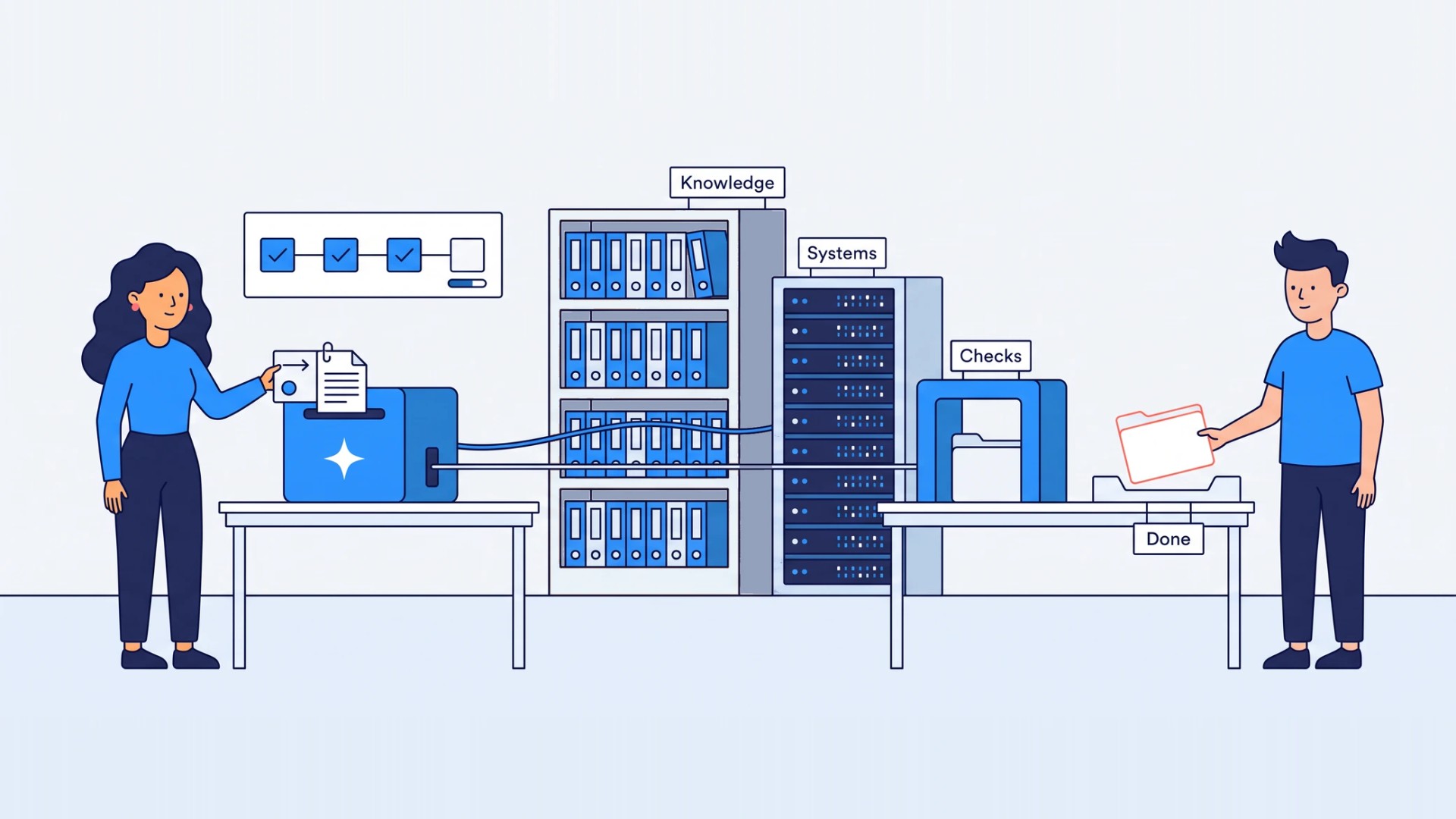
- Goal. The agent receives a defined outcome, the rules it must follow, the actions it may take and the conditions that mean the work is done.
- State. It keeps track of what has already happened, so multi-step work can continue without a person holding the context.
- Next action. It decides which defined step comes next and performs it: it gathers information from systems and people, produces an artifact or hands a specialized part to another agent.
- Check. Results are checked against the quality criteria, often by a separate verification agent.
- Human checkpoint. Decisions that need a person’s authority, such as approving a payment or changing a customer’s terms, are routed to that person before the work continues.
- Completion or escalation. The agent continues until the work is complete. A case outside its defined boundaries goes to a person with the context attached.
The person sees the questions, the approvals, the exceptions and the final result. Requests arrive through the channels people already use, such as a corporate messenger, email or voice. The screens, buttons and intermediate documents that partial automation needed give way to the few decisions and control points that remain with people.
Examples of agentic AI in business operations
The same pattern applies across functions. Some examples of work an agent can carry:
- Internal requests. An employee asks in chat to send an invoice or to register a leave notice. The agent collects the missing details, prepares the documents in the relevant systems, asks for the required approval and confirms when it is done.
- Service delivery to a client. A delivery agent gathers the inputs from the people involved, hands the production of each artifact to specialized agents, has the results checked against the quality criteria and delivers the package.
- Reporting cycles. Agents collect the figures from the systems involved, prepare the report and route the points that need a decision to the right person.
- Compliance checks. Agents check documents or transactions against the rules, record what they checked and escalate the cases that fail.
- Content production. One agent plans, another drafts from the brief, a third reviews against the standards and a fourth publishes. We took our own content process through these stages: standard roles and artifacts first, then custom assistants, with agents for whole workflows as the next step.
In each case the agent owns a defined piece of execution. Most of the value comes from removing the hand-offs between steps, where work used to wait for a person.
Agentic AI architecture: what the system is made of
An agent on its own is rarely the problem. A production agentic system has several layers, and most failures come from the ones that are missing:
- A defined process. The goal, roles, decisions, control points, artifacts and legitimate variations of the work. In many companies this was left to people and handled informally. AI cannot work the informal way: whatever was never written down becomes a failure in production. AI Process Reengineering builds this layer.
- Structured knowledge. The rules, decisions, examples and exceptions the work depends on, verified and kept current. A general model knows the market; it does not know how your business decides. That is the job of an AI knowledge base.
- Connections to systems. Agents act through APIs, connectors and MCP servers. The Model Context Protocol (MCP) exposes the data and actions of a business system in a form any agent can use. Where a legacy system has only a web interface, we build an API and an MCP server over that interface, so AI can read its data and perform simple actions. See AI Connectivity.
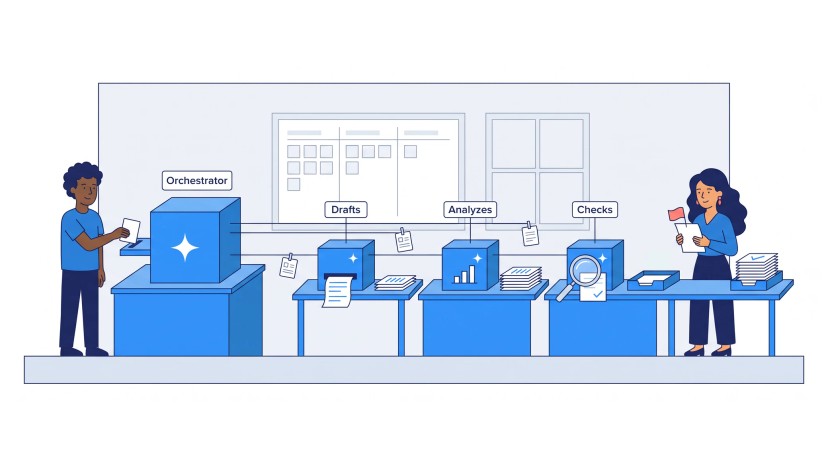
- Production and verification agents. Agents that do the work, and agents that check it against the quality criteria before it moves on.
- Orchestration. As the number of agents grows, an orchestrator plans, delegates, tracks and reports, and people deal with goals and decisions instead of individual agents.
- Controls and visibility. Human checkpoints, escalation rules, logs and notifications, so people can see what is active, completed and escalated.
These layers are durable business assets. Models and platforms will keep changing; a defined process, structured knowledge and connected systems stay, and the next generation of agents can use them.
Why reliability is the hard part
An assistant needs one good answer. An agent needs every step of a chain to go right, and errors compound. If each elementary operation succeeds with probability p, a task of n operations succeeds on the first attempt with probability p to the power of n. An agent that is right 95% of the time on each of ten steps finishes the whole task correctly on the first try only about 60% of the time.
That is why the required quality rises with autonomy. In our model, AI is worth using when its expected time, including preparation, checking and retries, is lower than doing the work by hand. Working that through gives a minimum quality bar for each level of automation:
- assistance, where AI helps with a single operation: from about 50% useful outputs;
- approval, where AI proposes and a person decides: above 70%;
- supervision, where AI runs a workflow and a person monitors: about 85 to 95%;
- full autonomy within a defined scope: close to 100%.
The practical consequence: an agent launched before the work is proven turns out flawed results at machine speed, and someone has to find and fix them. Proving the work under human control first is what makes the agent’s result good.
Levels of autonomy: how work moves to agents
Autonomy grows in steps. We describe five levels of AI automation, from fully manual work to unsupervised execution, and move a process up through them in stages:
- Assisted. People follow the defined process with AI support. This validates the instructions and shows where the workflow is still unclear.
- Collaborative. Proven instructions become reusable skills and assistants. People delegate larger tasks, review the results and refine the exceptions.
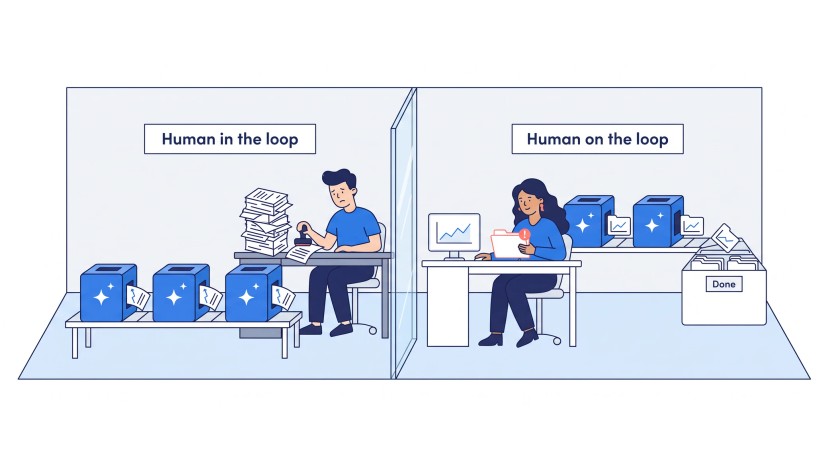
- Supervised. Agents execute defined work end to end. People monitor, step in when needed, and unresolved cases escalate to them.
- Autonomous. Mature work runs with minimal intervention while people supervise performance, policy and exceptions.
These stages match levels 1 to 4 of the framework; level 0 is fully manual work. Different areas of a business sit at different stages at the same time, so there is no need to bring everything to one level first. The levels also coexist inside one system. A supervised agent that meets a case needing judgment drops to approval for that case, asks a person and then continues. Even at full autonomy people are not removed: they review the logs and are notified when the agent cannot proceed.
Agentic AI risks, security and governance
The risk of an agent grows with the authority it has, so the controls are designed before the agent is built:
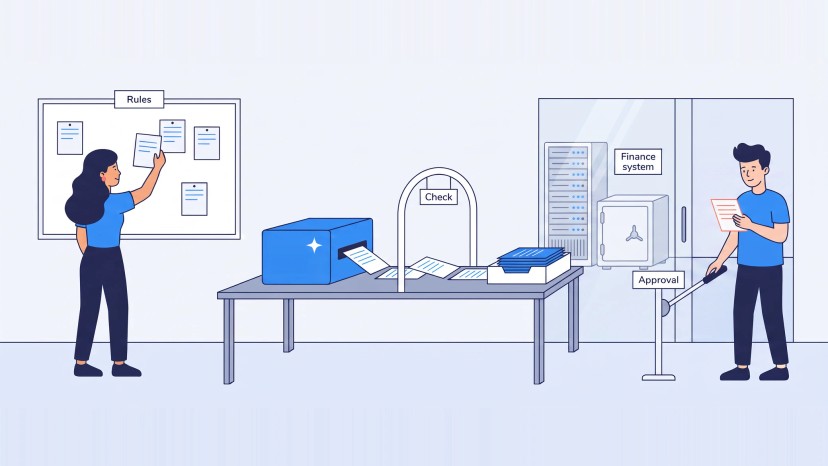
- Control points. Sensitive functions, such as moving money, changing a customer’s terms or publishing to the outside world, require a named person’s permission before they run. Sensitive results are reviewed before they move on.
- Guardrails as barriers and guides. Hard barriers, such as access controls, permission gating and masking of personal data, block what must never happen. Soft guides, such as role and goal instructions, steer the agent in the many cases a rule cannot anticipate.
- Testing against criteria. Before deployment the agent runs on representative real work: main flow, edge cases and failures. Each result is scored against explicit criteria, and the agent goes live only when the share of passing runs clears the bar for its level. Because AI output is not deterministic, tests are judged against standards rather than fixed pairs of input and output.
- Escalation and visibility. Cases outside the boundaries go to a person with the context attached. Logs show what the agent did, and notifications reach people when it is stuck.
An agent that has not cleared the bar stays under supervision. That rule protects the business and the case for automation at the same time. AI Validation & Control builds these controls into execution.
Agentic AI tools and platforms
Agents can be built on the major AI platforms: OpenAI and ChatGPT, Anthropic Claude, Google Gemini, Microsoft Copilot, xAI Grok and open-source models, in environments from Claude and Codex to Copilot and Gemini Gems. Where the platform allows it, we build with no-code and low-code tooling, so the agent can be maintained by AI automation specialists rather than programmers. Agents that write software follow the same logic, with the specification as the lasting asset: see our guide to vibe coding and spec-driven development.
The platform matters less than two decisions that keep the choice reversible:
- Keep the agent’s definition, its goal, state, allowed actions, decision rules and checkpoints, in a platform-independent brief.
- Expose business systems through APIs and MCP servers that any agent can use.
When a better or cheaper platform appears, the agent is re-created for it from the brief instead of being designed again.
How to build agentic AI in your business
Start with how the work should run, then choose the tools:
- Pick a defined piece of execution that is valuable, repeated and already produces consistent results when people do it. A single use case is a good place to begin, as the first step of a larger path.
- Make the process explicit: the goal, steps, decisions, control points and legitimate variations.
- Structure the knowledge and connect the systems the work depends on.
- Prove it with people first. Run it assisted and then collaborative until the main flow and the edge cases are handled.
- Hand it to an agent with explicit boundaries, checkpoints and quality criteria, and run it supervised on real work before it goes further.
The order matters. A foundation that is skipped comes back later as rework, when corrections cost more. The slow part is defining the process, the instructions and the artifacts; once that work is proven, turning skills and assistants into a production agent is mostly repackaging.
How EIC builds agentic execution
AI Agentic Execution transfers defined execution responsibility from people to AI agents in four steps. We select the work an agent can own. We define its responsibility and boundaries: the goal, completion conditions, available actions, the decisions and approvals that stay with people, and the escalation points. We build the production agent and the agentic workflow, then run representative work under supervision to expose missing logic, exceptions and unsafe actions. Finally we refine it until it reliably handles the defined work and deploy it with a supervision model and operating guidance.
The result is a production agent for a defined responsibility, the workflow around it with state, checkpoints and escalation, and a clear line between what the agent does and what people decide. When the foundations are not yet in place, AI Process Reengineering, AI Knowledge Base and AI Connectivity come first. Short answers to the questions buyers ask about agents are in the FAQ on the AI Agentic Execution page.