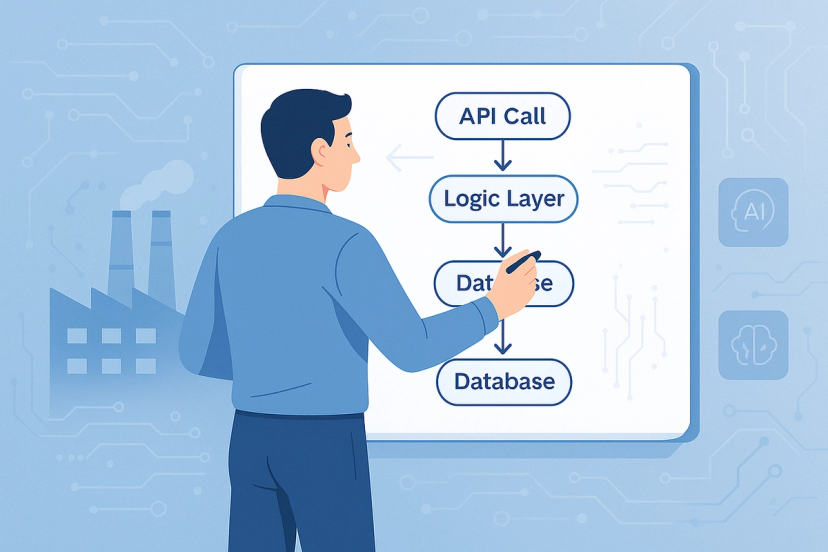


In our previous post, we introduced the AI Agency Roadmap — a five-stage framework for transforming traditional workstreams into AI-augmented systems. But frameworks alone don’t inspire action — examples do. So in this post, we’d like to visualize how the roadmap actually works by walking you through a real case from our own company: how we automated content creation inside a highly technical, fast-moving team.
Content creation is just one of several areas where we’ve applied the roadmap. We’re also implementing AI in Administration, Marketing, Program and Course Creation, Software Development, and more. But content was one of the first and simplest areas we tackled — and it turned out to be a perfect place to demonstrate the core concepts behind building an AI-powered agency.

The Need for Content Creation
We build complex software systems and work on deep AI innovation. Our team is highly technical — but not trained to write clearly or frequently. And yet, we knew content mattered. We needed to show up in search results, earn trust, and attract attention to our ideas. Without consistent publishing, we were invisible.
This wasn’t a theoretical exercise. We needed content to establish our thought leadership and grow organic traffic through SEO — but like many tech teams, we lacked the writing skills, time, and systems to make it happen. Here’s how the roadmap guided us, step by step.
Hitting the Wall with Writers (Stage 0 — Manual Execution)
Our first solution was classic: hire professional writers to do it for us. We gave them access to our team and tried to explain the value of our work. But our topics are deeply technical — things like software architecture, AI tooling, and workflow standardization. Despite investing significant time and money, the writers never fully understood our voice or ideas. The content came out shallow or just wrong. Eventually, we gave up on the model.
Trying AI the First Time (Stage 1 — Initial Adoption)
Later, we tried again. This time we used ChatGPT to generate articles. And while it was more flexible and cheaper than hiring writers, it still didn’t work the way we hoped. Results were inconsistent. Some posts looked promising, but others required heavy editing or rewriting. And even with AI help, the process took far too long — we didn’t have the structure or support to make it efficient.
The Breakthrough via Standardization (Stage 2 — General Assistance)

Our breakthrough came when we stopped treating content as a creative task and started treating it like a system. We did three key things:
- We broke the process into small, clear steps with specific roles:
Content Planners (strategic direction, SEO)
Content Authors / Subject Matter Experts (core ideas, transcripts, voice notes)
Content Writers (drafting based on briefs and outlines)
Social Media Managers (distribution and formatting) - We defined standardized artifacts for each step: SEO Research → Content Planning → Content Topics → Content Delivery Tracker → Post Idea → Post Brief → Post Draft (with Visuals) → Final Content for Publishing → SEO Performance Analysis
- We introduced transcripts and voice notes as raw input — letting our experts simply speak or record their thoughts, which others (or AI) could turn into structured content.
And finally, it clicked. The system worked. Everyone understood their role. The content was consistently good. And we could scale it across multiple team members with repeatable quality.
Making AI Work Better (Stage 3 — Tailored Knowledge)
With the structure in place, we focused on speed and accessibility. We built Custom GPTs trained on our specific roles and documents. Each had clear instructions and examples for tone, format, and content structure.
We also started building internal AI tools to automate repetitive, time-consuming tasks — like generating consistent images for blog posts or processing long meeting transcripts. These were things we did often, and they added friction to the workflow.
Eventually, we considered training custom models to further boost quality. These changes dramatically improved output and made it possible for even junior team members — with limited AI experience or writing skill — to produce excellent content quickly and independently.
Activating AI Agents (Stage 4 — Agentic Execution)

Now, we’re thinking ahead. We’re designing AI agents to handle entire workflows — not just tasks.
At first, they’ll cover well-defined steps like planning content calendars, publishing posts, or analyzing SEO performance. But soon, we want to go further. Imagine an agent acting like a company journalist — monitoring discussions, tracking emerging topics, interviewing team members, and assembling full-length posts with real insight. That’s where we’re headed.
Turning On Auto-Pilot (Stage 5 — Light-off Agency)
Eventually, with enough testing and quality control layers, we’ll reach a point where we can fully trust the system. The AI will manage the entire content lifecycle — from idea to SEO-optimized, multi-platform publishing — without any manual input.
At that stage, we’ll be able to turn the process on auto-pilot. Not just faster. Not just cheaper. But autonomous, always-on, and scalable.
The AI Agency Roadmap Works Everywhere
What we achieved in content creation, you can achieve in any domain. The AI Agency Roadmap is not just for marketing or writing. It’s a universal system for transforming workflows — whether in product development, operations, admin, or engineering.
It starts with chaos. It ends in autonomy. And it works, because we lived it.
Want More Like This?
Subscribe to learn how we’re scaling intelligent systems using AI-powered tools, teams, and workflows.