What is a multi-agent system?
An AI agent is one system that pursues a goal. It plans the steps, uses tools and business systems, keeps track of what has already happened and continues until the result is reached or a defined condition hands the case to a person. A multi-agent system is several such agents working on one outcome, each responsible for its own part.
The difference from a single agent shows in who drives the process. One agent, however capable in a demo, still needs someone to trigger it, feed it and carry its result to the next step. Several agents that hand work to each other remove that carrying.
Strictly, agentic AI means exactly this: several agents collaborating on a process. Our guide What Is Agentic AI? covers the broader everyday sense of the term, agentic workflows and how a single agent works. This guide is about the system of several.
The agents in such a system play different roles:
- Production agents do the work: they draft, analyze or process a case.
- Verification agents check that work against the quality criteria.
- Coordinators plan, delegate, track and report.
Some agents serve one bounded outcome, such as one type of request. Others coordinate shared work across many outcomes.
When do you need more than one agent?
In two cases. The first is when one piece of work needs several specialties. The second is when the work needs an independent check, by something other than the agent that produced it.
The goal of building multi-agent AI workflows is capacity. More initiatives, requests and processes move forward in parallel, and the management structure stays the same size.
Many pieces of work need only one agent. An agent can own an outcome and call a set of skills for the individual steps. In the method we are building, a coordinating step is added only where AI can really do the whole job end to end. A step in the process diagram is not reason enough.
Each agent added also adds coordination. Without an orchestrator, someone has to start it, supply its context and connect its result to the next step. That is why several agents without orchestration multiply the coordination problem instead of solving it.
How does a multi-agent system work?
Work moves between agents the way it moves between people: by delegation. We design one delegation mechanism for both, whoever sets the task and whoever performs it. A task is handed over as a work order, and the protocol answers the same six questions each time:
- What is the goal? The task is described by its goal, with enough detail to do it right and without constraining how the performer gets there.
- What is the big picture? The task carries the context of the problem and the process it belongs to. In a cascade, the parent task becomes part of the child task's context.
- Is it accepted? The performer accepts or declines explicitly. A decline says what is missing and why.
- Where does it stand? Status flows upward, and each level tracks and reports at its own level.
- What if it gets stuck? A situation the performer cannot resolve becomes an exception. Whoever set the task decides whether to stop, add people or resources, or restart.
- What counts as done? The result is checked against its criteria at a defined checkpoint before it moves on.
The protocol is defined in advance and agreed by both sides. Without it, a managing agent spends its time and tokens working out how to set tasks, and it makes mistakes doing so.
Around the agents, the system keeps a shared state: active work, open dependencies, completed actions, requested decisions and exceptions. Nobody has to piece the status together from individual agents and tools.
What is AI agent orchestration?
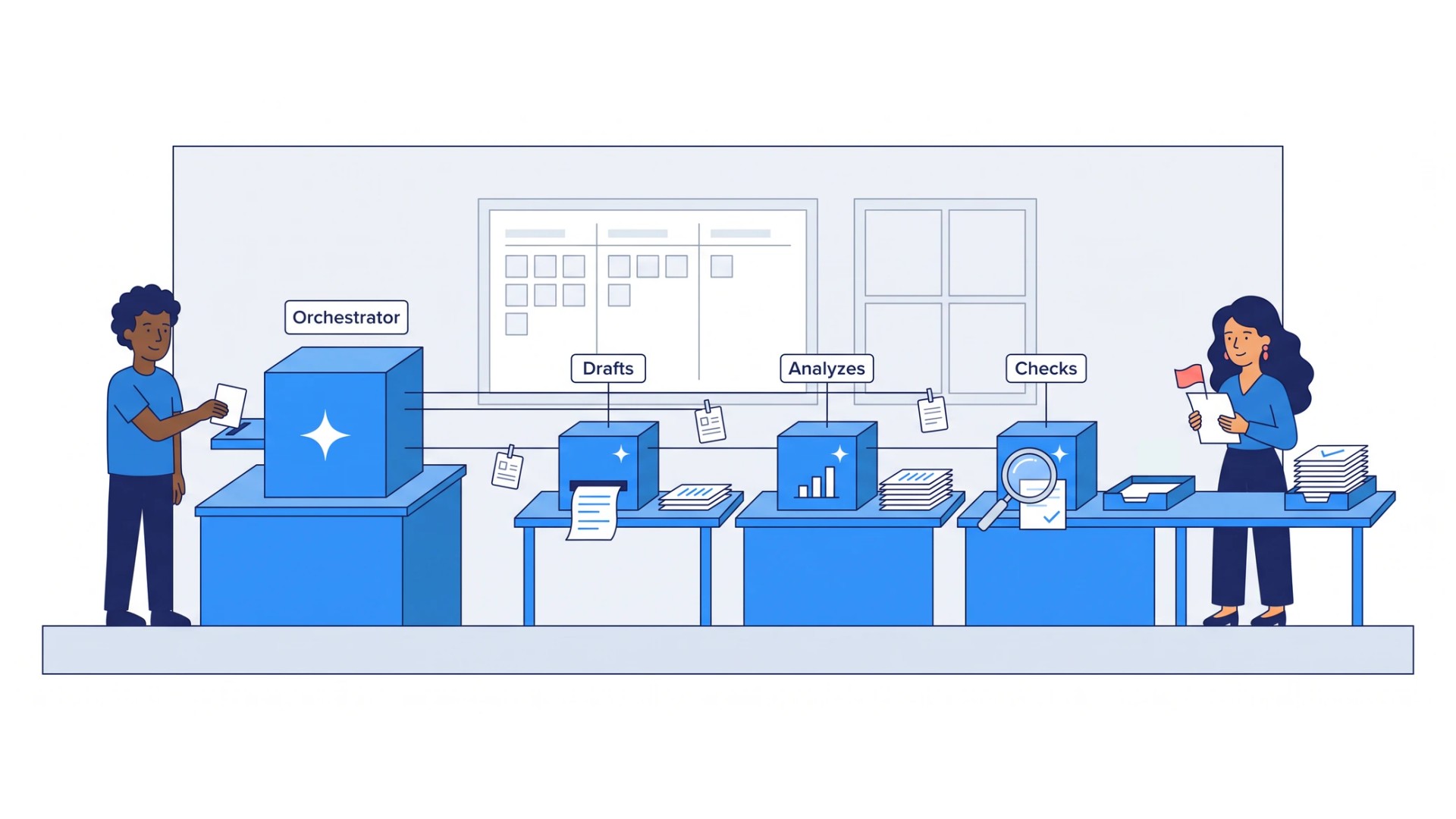
AI agent orchestration turns a business goal into coordinated execution across agents, business systems and people. The orchestrator plans the work, delegates each part to the right agent or person, checks the results and reports. Multi-agent orchestration is the same job at the scale of many agents, and it is where most multi-agent AI systems either hold together or fall apart.
An orchestrator is built differently from a working agent. A working agent performs a type of work. The orchestrator performs none of it. Its job is to know the plan: who does each part, what comes next, what is allowed, what counts as done and when a person has to come in. The closest comparison is a project manager, who tracks quality control without carrying it out and delegates the work without doing it.
The difference matters. Treating orchestration as one more agent in a chain gives a brittle sequence of prompts instead of managed execution. The orchestrator has its own planning, delegation, validation, permissions and reporting logic. It is also the human face of the system: the one place where people set goals, answer questions and make decisions.
It does not take over the authority of people. The rule we apply: a coordinating assistant prepares the context of an escalation, and the decision stays with the person who holds the business authority. AI Orchestration is the service that builds this coordination.
How do agents check other agents?
The first multi-agent pattern most companies need is a pair. A production agent does the work, and a verification agent checks the result against the quality criteria.
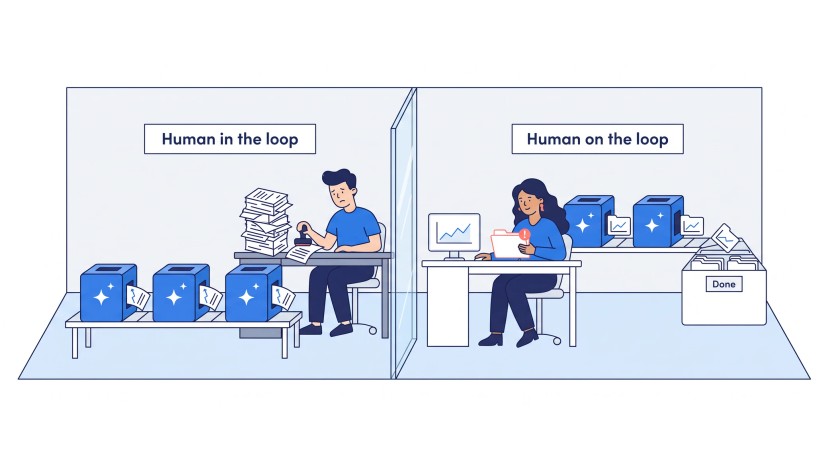
This pairing is the Autonomous stage of our four autonomy stages. People no longer review each result. They keep watching how the work performs, set the policies and handle the exceptions.
A verification agent is only as good as the standards behind it. With no written quality criteria, it has nothing to enforce. The criteria are written before the agents, as checklists or as samples of good and bad results.
Independence matters for agents for the same reason it matters for people. One software company we interviewed had a firm rule that its test team could not report to the manager pushing the release. A verification agent plays that independent role for the agents it checks.
An unattended process needs checking even when nothing looks wrong. In one interview the risk was put plainly: a process can stop, or start recording rubbish, while everyone assumes it works.
How results are scored, and the quality bar each stage needs, is covered in Human on the Loop.
Examples of multi-agent systems in business
Three shapes are common.
A request carried to completion
A request arrives through the channel people already use, chat or voice. One agent asks for the inputs and permissions it needs, gathers information from systems and people, and hands specialized parts to other agents. The results are checked against the criteria, and the completed outcome goes back. The person sees the questions, the approvals, the exceptions and the result. The same shape fits a service delivered to a client, an internal request such as an invoice or a leave notice, a reporting cycle and a compliance check.
A department as a set of roles
In one interview a hospitality specialist broke a sales department down into its roles: the seller, the person who books, the consultant, the person who packages the offer and runs the website, the advertising manager and the head who runs the process. Each role is a candidate for an agent, and the head's role is the coordinator's.
Content that moves through stages
One agent drafts an article, another reviews it against the editorial criteria, and a third schedules and publishes it.
Inside a company, orchestration applies to programs, projects and cross-functional work. Outside it, the same coordination runs customer support, service delivery and partner work.
Where do people fit in a multi-agent system?
People talk to a multi-agent system through the channels they already use. Inside the company that is the corporate messenger. Clients and partners write by email, in a messenger or in a web chat, by text or voice. They state a goal, answer the questions the system asks, provide information and approve decisions. They do not operate the agents underneath or move context between tools. A complex system gets used when its entry point is as simple as a message.
Authority is designed in from the start:
- Each agent, system and person has defined access to information and defined allowed actions.
- Sensitive functions need a named person's permission before they run.
- Consequential decisions escalate to the person who holds the authority.
- Handing a result to a client is itself a control point.
The split between automated checks and people is a design decision made before the agents are built. A system can also step down a level: an agent that meets a case needing approval or human judgment hands it to a person.
The control logic matters more here than with a single assistant, because an orchestrator reaches more systems and coordinates more consequential actions. Controls of this kind are the subject of AI Validation & Control.
Why do multi-agent systems fail?
The failure modes are mostly about coordination:
- A poor task statement. The performer misses what matters and delivers the wrong result.
- A broken feedback chain. A task gets stuck, the performer cannot resolve it within its authority, and whoever set the task never hears about it.
- No visible state. Long tasks run, and nobody can see where they stand.
- No informal channels. People fill gaps by walking over and asking. Agents cannot do that, and every gap the formal mechanism leaves becomes a failure.
Before orchestration, the same problem shows up as work for people. Each agent, assistant and workflow solves its own task and leaves the connecting work to someone: deciding when to use it, supplying the context, sequencing it with the others, collecting the result and handling what failed. One technology leader we interviewed was supervising many parallel agent sessions by hand across several machines, answering their questions one by one, and asked us for exactly this: orchestration. When systems are not connected, people's conversations become the integration.
Do you need an agent framework or an orchestration platform?
An AI agent framework is a software library for building agents and connecting them. An AI orchestration platform adds a place to run and monitor them, and AI orchestration tools cover the pieces in between: queues, schedulers, dashboards. All of them are useful, and all of them are replaceable.
We build on the framework, model or platform the client already uses, or the one that fits the case. One buyer we interviewed chose no open-source framework at all and wrote the agent runtime in-house. Either choice can work.
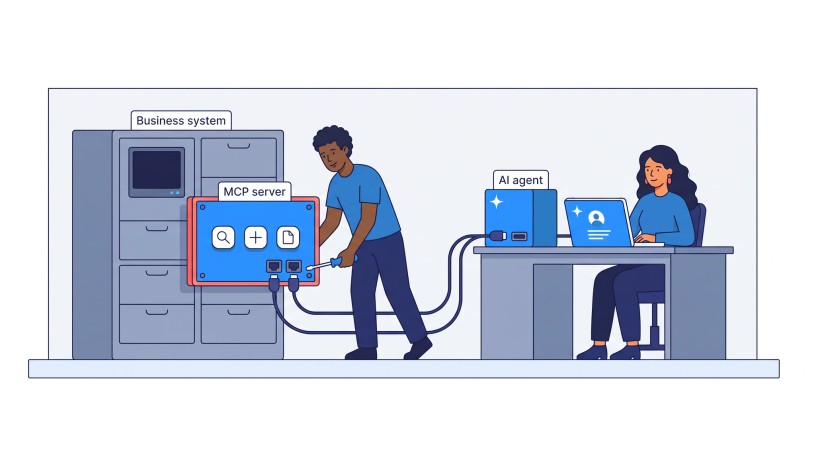
What should outlast the choice is the definition of the work. We keep each agent's definition, its goal, state, allowed actions, decision rules and checkpoints, in a platform-independent brief. Business systems are exposed through APIs and MCP servers that any agent can use. When a better or cheaper platform appears, the agent is re-rendered for it instead of rebuilt.
One caution applies to multi-agent work in particular. Agents built in different frameworks do not coordinate with each other natively, and most multi-agent systems today rely on the conventions of one framework. The coordination model (who does what, who decides, what counts as done) should therefore live in your own definitions, where it stays stable as the technology underneath changes.
When is a company ready for a multi-agent system?
A multi-agent system is not the first step. It comes once the work it coordinates already runs. Inside one process the order is: define the process, structure the knowledge, connect the systems, build the skills, assistants and agents, then validation, then orchestration.
In practice the path looks like this:
- Define the process and run it by hand, with AI doing single steps.
- Structure the knowledge the process depends on, with named owners.
- Connect the main systems the work runs through.
- Wrap the proven steps into skills and assistants.
- Hand a piece of work to an agent once the tasks are well tuned and even the edge cases raise no questions. The agent starts under supervision.
- Add a verification agent once the quality criteria are written down.
- Add orchestration when several agents, systems or teams contribute to one outcome and people are holding them together.
Each stage is extended only after the one before gives a consistent result, because an agent launched too early produces poor work faster. The foundations come from AI Process Reengineering and AI Knowledge Base.
How EIC builds multi-agent systems
AI Agentic Execution builds the agents. Each one is designed around a defined piece of business execution, tested under supervision and handed over with operating guidance. AI Orchestration builds the coordination: the orchestrator itself, the channels people use to talk to it, the controls, and the integration with the agents and systems you already have.
If you are comparing AI agent development with AI orchestration companies, ask who will own the coordination once there are several agents. Multi-agent systems development that delivers agents without it hands the connecting work back to your people.
A good first question for your own operations is the one on our orchestration page: where are people still acting as the orchestrator? We can look at one such outcome with you on a free call. Book it below.
Short answers on orchestration, workflow orchestration versus workflow automation, and permissions are in the FAQ on the AI Orchestration page.