What is AI governance?
Put simply, governance answers a few questions about every use of AI in the business. What may it do? Who approves it? How good must its results be? What happens when it fails, and what record is left? Its purpose is to make the use of AI predictable and safe.
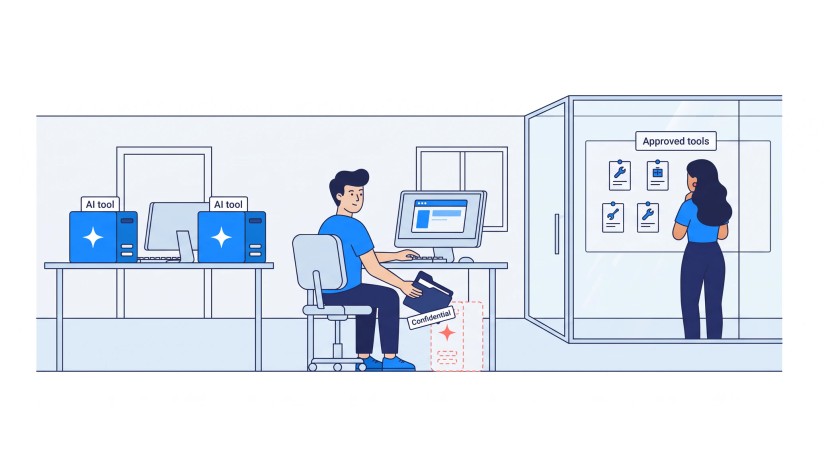
It starts with an inventory of the AI people already use, including shadow AI: the tools nobody registered. Then it names who is responsible for each area.
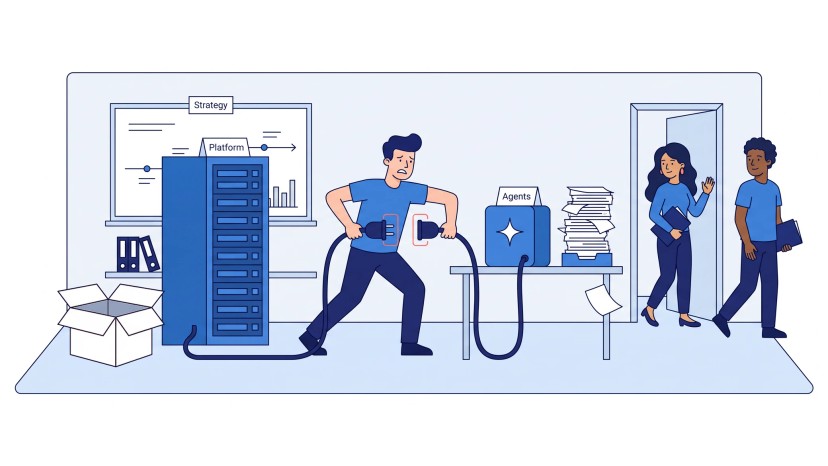
The hard part is balance. Governance has to give people the flexibility to use AI well and keep AI from harming the organization. With too little, use is chaotic. With too much, people work around it.
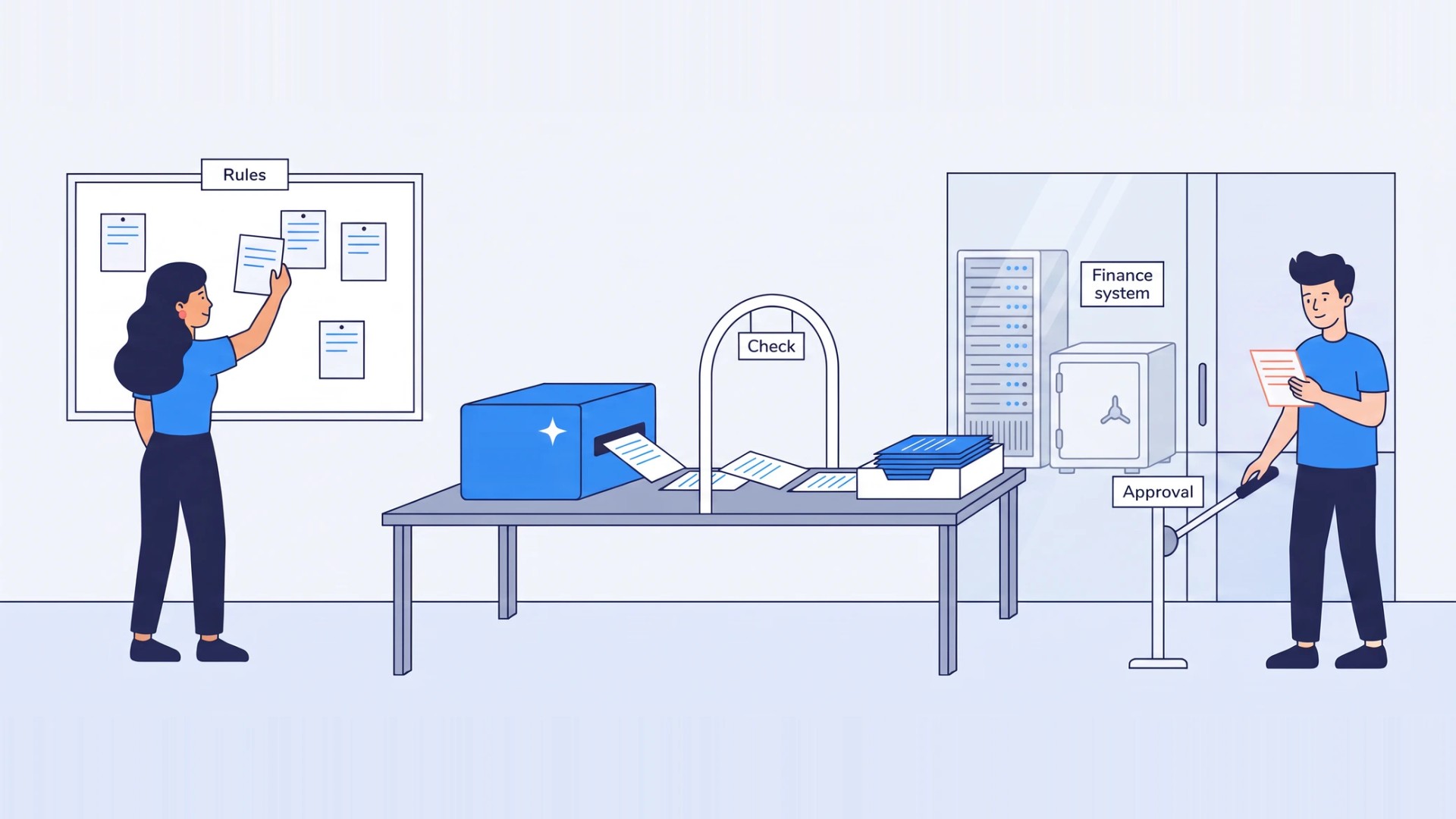
In operations, governance has to be part of the system's design. A policy next to the system describes what should happen. The control points, the permissions on sensitive functions, the validation of results and the escalation paths make it happen, because they are built into execution.
Our working rule: AI does the execution and people control it. As much of that control as possible is automated as checks and balances, and the rest stays as human supervision.
Why does AI governance matter, and what is AI risk management?
The more authority AI has, the more its errors cost. A wrong draft costs the time of the person who reads it. A wrong action in your systems has already happened by the time anyone sees it.
AI also arrives without a decision. A department adds a subscription tier, and an existing product starts generating text or images. The authority of AI in the business grows whether anyone plans it or not.
AI risk management is the discipline of naming those exposures and deciding what to do about each. Two failures are common. Risk management is ignored, and a happy-path plan turns into firefighting. Or a risk list exists and nobody watches it.
Not every risk deserves mitigation in advance. Where prevention is not worth its cost, the risk is ranked, put on watch and given a trigger. Handling starts only when the trigger fires.
Governance itself fails in three ways: it does not exist and AI use is chaotic, it exists for show, or it clamps down so hard that people work around it. Only the working version lets people use AI and keeps that use safe.
How is AI governance different from responsible AI and compliance?
The three terms overlap in search, and they answer different questions:
| Term | The question it answers | Who usually owns it |
|---|---|---|
| Responsible AI, AI ethics | Which responsible AI principles should our AI follow? | Leadership |
| Compliance | Which laws and standards apply to us? | The compliance function and its advisors |
| AI governance | How do we make sure, every day, that AI does only what it may, and well enough? | Operations, with named owners per area |
Principles and obligations both end up in the same place: in rules about what AI may do, in checks on what it produces and in records of what it did. That is the working part of governance, and it is the part this guide covers.
Governance borrows its method from quality management, which works the same way for software, business processes or AI. Quality control checks the result. Quality assurance checks that the process producing it is right. AI governance needs both.
What does an AI governance framework contain?
An AI governance framework is the structure that turns the definition into practice. Many published frameworks run to dozens of pages. The AI governance framework we work with has six elements:
| Element | The question it answers |
|---|---|
| Inventory | Which AI systems are in use, shadow AI first, and for what? |
| Risk by use case | What can go wrong in each use, and how much does it matter? |
| Rules and limits | What may AI do, under which conditions, and what is blocked? |
| Accountability | Who owns each area, who approves, who answers for the result? |
| Controls in execution | Which checks, permissions and escalations enforce the rules? |
| Monitoring and change | How are results measured, and who may change the rules? |
Two principles run through all six. Control is tiered by use case: sensitive areas get tight limits, and low-risk ones get light rules. Applying one level of control everywhere either blocks useful work or leaves the risky work loose. Classification decides the regime, the way one engineering company we interviewed applied a heavier control regime only to products that were classed as safety-critical.
The second principle is evidence before autonomy. AI earns a larger operating scope only where the process is clear, the knowledge is sound, permissions are set, checks are deterministic where they can be, validation is independent, recovery is planned and accountable approvals exist. Ambiguity, policy exceptions, failed validation and material risk go to accountable people.
The rules themselves need protection too. In the agent design we are building, an agent cannot change its own instructions, sources, tools or governance without approved change control. How the inventory, policy and team work in detail is covered in What Is Shadow AI?
How does AI governance work inside execution?
Inside execution, governance comes down to four mechanisms, the ones AI Validation & Control builds:
- Validation gates. Each result is checked against explicit acceptance criteria and thresholds, often with samples of good and bad results. Each gate is tested against known correct and incorrect cases before it governs live work.
- Action controls. These set which actions AI may take and under what conditions. A pre-condition protects a sensitive action before it runs. A post-condition checks that the resulting state is acceptable before the work continues. Consequential actions still need a named person's approval.
- Correction and retry. Routine failures go into defined correction loops instead of landing on someone's desk. A stop condition ends the attempts when automated recovery no longer makes sense.
- Escalation. Uncertain, sensitive or consequential cases go to the right person, with everything needed to make the call.
A simple example of a deterministic check: one retailer we interviewed weighs each package on the warehouse scale and compares it with the weight the order predicts. A mismatch leaves the main flow and becomes an exception.
AI guardrails are part of the same toolkit, and they come in two kinds. Hard barriers block what must not happen. Soft guides, such as instructions, context and quality standards, steer AI toward the right result. Barriers alone keep AI inside the lines and do not help it reach the destination.
Two design rules from the agents we are building for our own work are worth copying. A click on "allow" in a tool, or a yes earlier in a chat, does not count as business approval. And a human gate stops only the work that depends on the decision; everything else keeps running.
What is an AI governance strategy?
An AI governance strategy decides, before implementation, where AI may act and where it must stay limited. In our work these decisions are made in AI Organization Strategy: the strategy records the limits and keeps the control points explicit, and the controls are built later. It starts in the interviews with leaders, where we ask for four kinds of limits:
- Risk tolerance: where automation should stay limited or tightly controlled.
- Governance constraints: security, privacy and compliance requirements.
- Change capacity: how much change the organization can absorb, and when.
- Technology constraints: legacy platforms and integrations that set what is possible.
The strategy then keeps the decisions and control points explicit in the target operating model: which work AI performs, which decisions stay with people, how quality and risk are controlled and who owns each part. It also names the governance gaps that must close before implementation.
Governance roles, responsibilities and rules are defined early, alongside the choice of models and platforms. Retrofitting them after AI is in production costs more. Even where AI can do part of the governance work itself, it does so under an accountable person, because the information is incomplete and the consequences belong to the business.
How do the NIST AI RMF, ISO/IEC 42001 and the EU AI Act relate to AI governance?
Frameworks and regulations such as the NIST AI Risk Management Framework, ISO/IEC 42001 and the EU AI Act describe what a company must be able to show about its AI: that results are checked, that actions are limited and logged, that people oversee defined points and that a record exists. Which of them apply to you, and how, is a question for your compliance function or its advisors. We do not certify against frameworks, and we do not give legal or compliance advice.
Our part is the controls themselves, built into the work:
- quality criteria that each AI result is checked against;
- limits on what AI may do, with every action logged;
- permissions on sensitive functions;
- human oversight at defined points;
- a documented escalation path;
- a record of what the AI did and why.
Each of these leaves a trace: which check a result passed, who approved an action, what the AI did. When your compliance function has to show that AI is under control, those traces are what it shows. We work with that function so the controls match the obligations it has identified.
Traceability is also the thread that auditors pull. One retailer we interviewed has audit rules that require every change to its financial systems to trace back to an approved ticket. AI actions need the same chain: who or what acted, under which permission, and with what result.
Who owns AI governance?
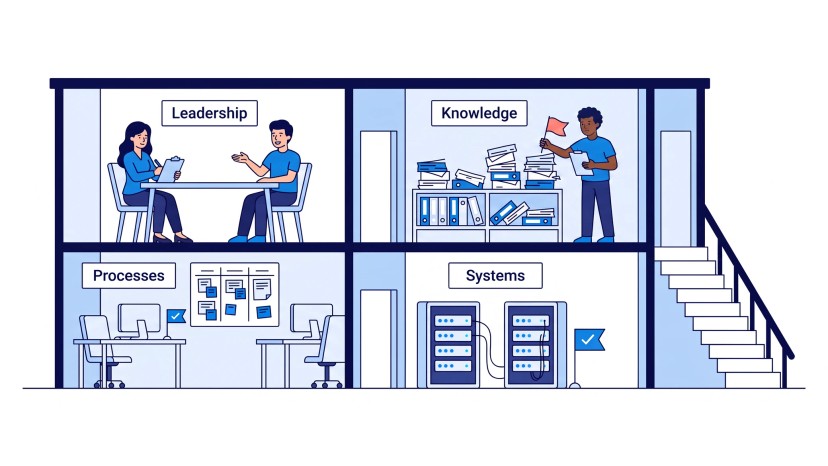
Ownership follows the areas, not the technology. Each area of AI use needs a named owner who approves its rules and answers for its results. The test is simple: no area with unknown, unclear or overlapping responsibility.
The same applies to the knowledge AI uses. A governance model for knowledge names who uses it, who updates it, who may read it and who may change it. Knowledge without an owner goes stale, and every assistant and agent built on it goes stale with it.
A committee helps with decisions that cross areas, such as which investments to make. A committee alone is not ownership. In one company we interviewed, an executive steering committee approved AI and automation investments while nobody was tasked with the whole picture. What a policy should say and when a company needs a governance team is covered in our guide to shadow AI.
Do you need AI governance software?
Sometimes. Beyond documents and communication tools, governance can need technical systems that monitor AI use, track which models are used and record constraints and trails. AI governance platforms of that kind are useful for visibility.
The controls themselves live elsewhere. Validation gates, action checks, correction loops and escalation run inside the workflows the AI executes, in the time the AI already takes. A dashboard that reports on AI use cannot stop a wrong action. A pre-condition in the workflow can.
Choose AI governance tools after the rules exist. Software records and monitors what you have defined. It cannot decide what an acceptable result is or who holds authority.
How do you know AI governance works?
By measurement, not by impressions. We use four signals:
- Quality score. Each output is scored on a five-point scale tied to how much editing it would need. The share of outputs that pass is the quality score, and it is compared with the quality bar for the intended level of autonomy.
- Process signals. The number of problems, repetitions, iterations and escalations, and the time spent.
- Escaped problems. The share of problems the checks caught before they spread, against those that surfaced later. Every escaped problem is material for a better check.
- The failure log. Criteria that fail again and again show where the instructions or the knowledge need work.
Controls are tested the same way as AI output, with positive, negative and error cases, before they govern live work and continuously afterwards. Autonomy is extended only after the previous stage gives a consistent result.
How EIC builds AI governance into AI execution
AI Validation & Control is where we build governance into the work, in three steps. We set the business quality bar: what an acceptable result looks like, which actions need protection and where human authority must stay. We build the validation gates, action controls and execution checks, and test them against known correct, incorrect and edge cases. Then we automate correction and escalation. Routine problems are fixed or retried, and the rest reaches a person who can decide.
Many AI implementations become more autonomous by gradually removing human review, while the execution underneath gets no more reliable. We take the other route. AI earns a larger scope when its outputs keep meeting measurable requirements, its actions stay within defined limits and its failures are handled predictably.
If you are comparing AI governance solutions or AI governance consulting, ask where the controls will run. A framework document and a committee are a start. AI risk management solutions that work in practice also put the checks inside the execution, and every check leaves a record your compliance function can use.
The first step is a free call on one workflow where AI already produces results or takes actions. Book it below.
Short answers on guardrails, human in the loop, hallucinations and frameworks are in the FAQ on the AI Validation & Control page.