When I first started working with AI-generated prompts, I hit a wall. No matter how much I refined the instructions — adding examples, tweaking formats, clarifying expectations — the outputs were never consistent. Sometimes they were close. Other times, glaring formatting errors or missing tags made the results almost useless. It wasn’t just frustrating — it was chaotic.
The deeper problem wasn’t the AI itself. It was that I had no structured way to evaluate what was working and what wasn’t. Without clear metrics, every adjustment felt like a gamble. I needed a way to measure, not guess.

Here’s the simple process I developed — and how it can help you too.
AI Outputs Are Probabilistic, Not Predictable
First, it’s crucial to accept that generative AI isn’t deterministic. Even if you feed the same prompt a hundred times, you might get subtly different results. Some outputs hit the mark, some miss badly. If your evaluation process is based on “vibes” or loose impressions, you’ll end up chasing your tail — making random changes without any real insight. Subjectivity creates noise, and noise prevents meaningful progress. To beat this, you need a structured evaluation system.
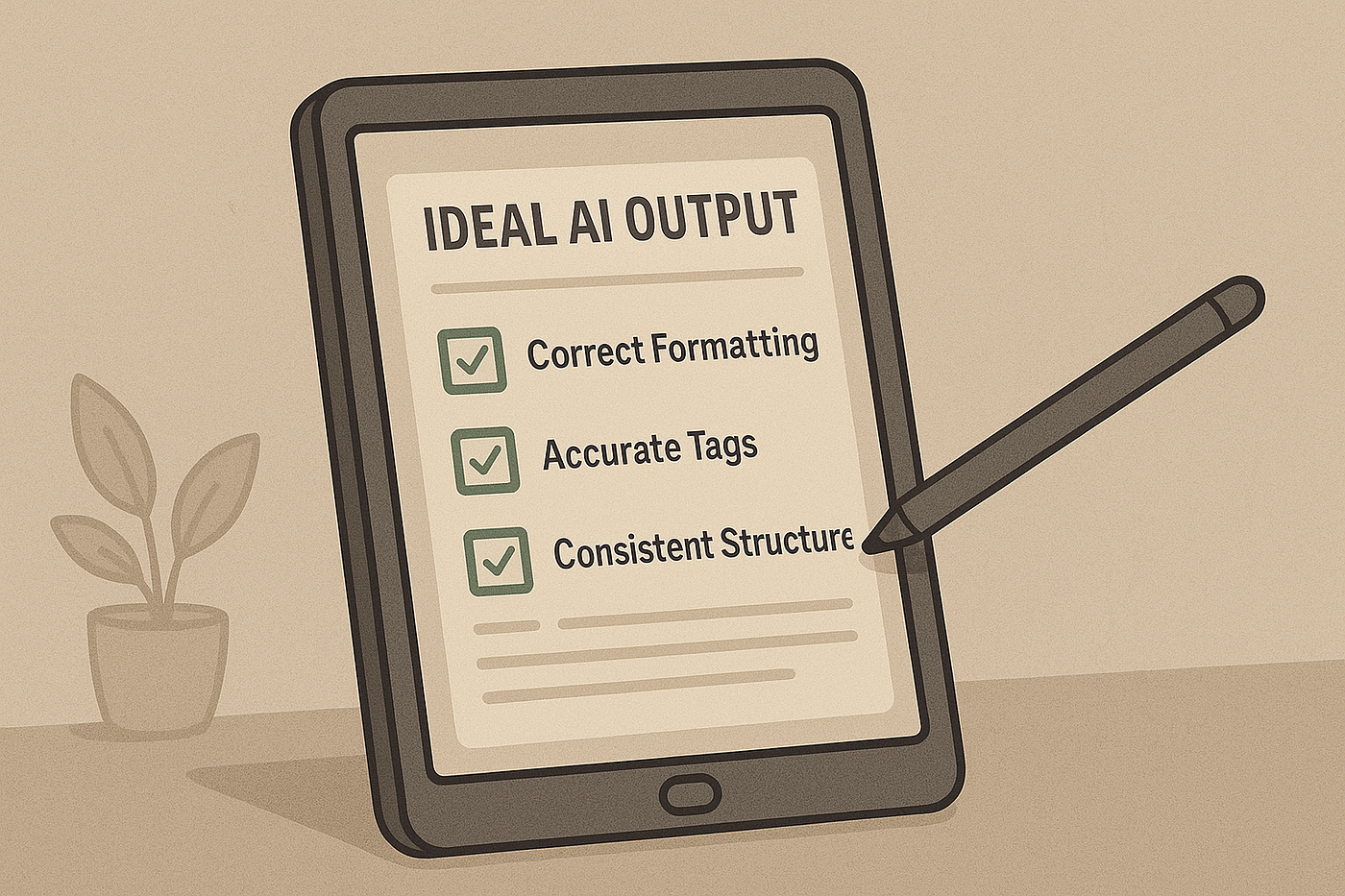
Step 1: Define Your Ideal Output
The first step is establishing what a perfect AI-generated result looks like. Without a clear and objective definition, it’s impossible to consistently measure success. Take a few minutes to think about your ideal output. Ask yourself: what exactly am I expecting from the AI? Define it in simple, specific terms. For example, if you’re generating blog titles, your ideal output could be “a title under 10 words, clearly related to the topic, and free from punctuation errors.” Another example could be generating a product description that includes key features, a persuasive call-to-action, and matches the tone of the brand. By setting a clear ideal upfront, you give yourself — and the AI — a target to aim for. This definition will serve as your reference point for every evaluation going forward.
Step 2: Apply a Five-Point Quality Scale
Now that you know what you’re aiming for, you need a simple way to grade each output. Instead of overcomplicating it, use a familiar, school-style five-point system:
- 5 (Excellent): The result is perfect and requires no edits.
- 4 (Good): The result is acceptable but needs minor edits that take less than 5 minutes.
- 3 (Satisfactory): The output is usable but needs major edits, usually taking around 15 minutes.
- 2 (Poor): There are positive aspects, but the output is overall too flawed and not worth fixing.
- 1 (Fail): The output is completely unusable, with no salvageable parts.
This approach ties the scoring directly to effort — specifically, how much work it would take to fix the AI output. For example, if the AI produces a blog title that’s great but missing a period, it’s a 4. If the title is completely off-topic and confusing, it’s a 1. Keep it simple: grade each result based on how close it is to your ideal and how much work it would take to make it usable.
Step 3: Set a Threshold Based on Your Use Case
Next, you need to decide what level of quality is acceptable for your particular project. Different projects require different standards. For fully autonomous systems, such as AI agents publishing content without human oversight, only perfect outputs (5s) are acceptable. Any lower score means failure, because there’s no one available to catch and fix errors. However, if a human is involved in reviewing or editing, you can afford to accept slightly lower scores — 4s and occasionally even strong 3s.
For example, if you’re using AI to draft social media posts that a marketing assistant will edit, a 4 might be good enough. But if you’re using AI to write customer-facing emails that go out automatically, you’ll want nothing less than a 5. Defining your threshold early helps you avoid confusion later and ensures you’re measuring success in a way that’s aligned with real-world needs.

Step 4: Track, Score, and Calculate
With your ideal result, quality scale, and threshold in place, it’s time to put the system into action. Evaluate a batch of AI outputs by scoring each one using the five-point system. Then apply your threshold: mark each output as a “pass” (1 point) if it meets or exceeds the threshold, and a “fail” (0 points) if it falls below.
After scoring all the outputs, calculate your quality score using this simple formula:
(Number of attempts that passed the threshold) / (Total number of attempts) * 100%
For example, if you evaluate 20 outputs and 15 meet or exceed the threshold, your quality score is (15/20) * 100% = 75%. This gives you a clear, quantitative measure of how well the AI is performing relative to your goals. You can now track this metric over time to see whether prompt adjustments, model updates, or other changes lead to real improvements — not just perceived ones.
Tips for Adapting This Method
- Customize the Scale: Adjust the definitions of each score to fit your specific application or team needs.
- Benchmark Techniques: If you experiment with new prompt styles or AI models, compare results systematically using this scoring method.
- Apply Across Domains: Whether you’re generating code, marketing content, customer support responses, or images, this process adapts easily.
- Be Realistic: Aim for steady improvement, not perfection overnight. AI quality evolves through iterative tuning and learning.

Why Structured Evaluation Changes Everything
Once I implemented this simple system, everything shifted. Suddenly, I wasn’t trapped in endless tweaking cycles. I could measure if a change made outputs better, worse, or had no real effect. Small improvements became visible — and I could double down on what worked. Instead of wrestling unpredictably with AI, I could guide it strategically. If you want to move from “guess and hope” to systematic improvement, start treating AI quality evaluation like any other professional process: with clear definitions, structured scoring, and consistent tracking. You’ll not only get better results — you’ll also unlock AI’s full potential.
Want to better understand what “good enough” actually means for AI?
Our previous article breaks it down: “When is AI Good Enough? Calculating AI’s Quality Threshold.”