
What is AI for business operations?
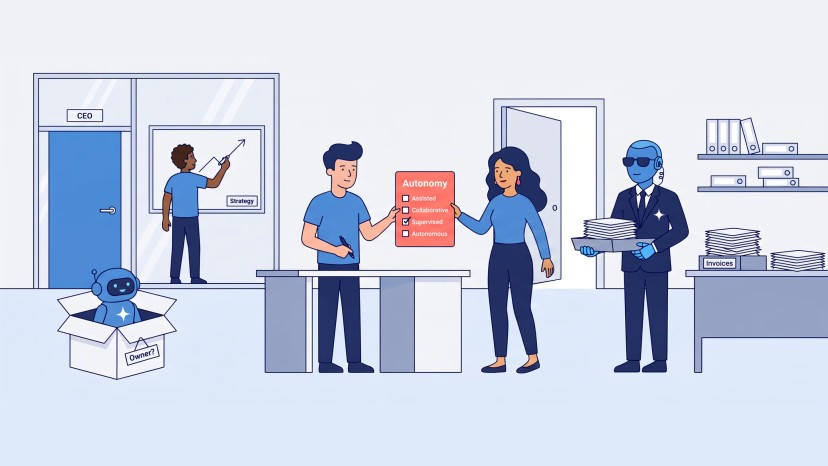
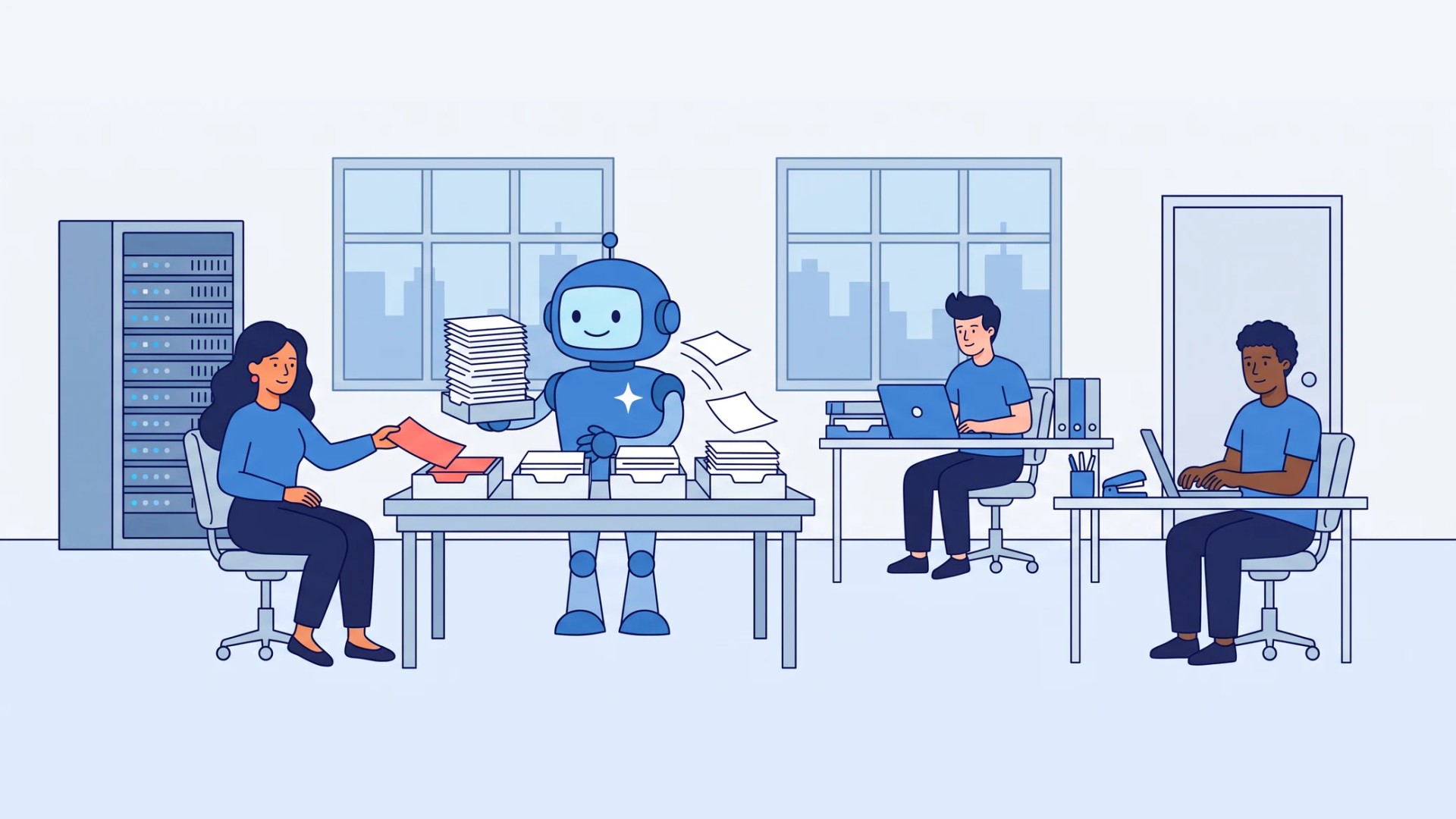
In practice the work is whatever an operations team repeats: handling orders, checking invoices, answering requests, preparing reports. The level of autonomy rises step by step. At one end are skills and assistants that produce a work product on request. At the other are agents that carry a workflow to completion.
Three foundations hold it up: a defined process, structured company knowledge and connections to the systems where the work happens. AI cannot follow what exists only in people’s experience.
A common misconception is that AI either does a task entirely on its own or is useless. In practice automation is a spectrum, and most of the value sits in the middle levels.
The aim is to grow without growing staff at the same rate. The same team delivers more, faster and with more consistent quality, and people keep the decisions, approvals and exceptions. Automation that removes the people who carry the expertise also removes the knowledge it depends on. The wider concept is covered in What Is AI Business Process Automation? and What Is AI Workflow Automation?.
Which operations work pays first with AI?
AI pays first where the work repeats often, follows rules, runs on documents and already has a defined process. We weigh nine factors when we draw the boundary of what to automate, among them how often the work repeats, how structured its decisions are, how complete the knowledge is, how complex its exceptions are and what a mistake costs. Knowledge work in the virtual space suits AI, and most of it is writing and processing documents. Small gains compound across the company. Physical handling, such as picking, packing or inspecting returns, waits for hardware.
| Operations work | What AI does | What a person keeps |
|---|---|---|
| Order handling | Reads incoming orders from email, forms or files, checks them against the rules and records them | Unusual orders and changes to a customer’s terms |
| Invoices | Classifies each document, extracts the fields and matches it to an order or an existing record | Approving payment and settling items that do not match |
| Customer requests | Sorts each request, applies the standard playbook, drafts the reply and passes on what it cannot resolve, with context | Cases outside the playbooks and judgment calls |
| HR requests | Answers routine policy questions, drafts documents and routes requests | Cases, investigations, performance plans, dismissal and hiring decisions |
| Reporting | Collects the data and writes the summary of who did what | Reading the result and deciding what to act on |
Customer requests and HR requests can share one ticket-based model. Types, categories, severity levels, playbooks and escalation are defined first, and the ticketing system stays the backbone with AI working inside it. In our own weekly account reports the summary stage already runs automated, and insights with proposed actions are the next stage we are working toward. More examples by function are in the guide to AI business process automation.
How do you pick the first process to automate?
Start with a process that is already clear, repeated and valuable, where a consistent result is produced today and the effort, the money or the errors concentrate. Rank the candidates from the business side first: which work takes the most effort, where the most money goes and where the most mistakes happen. Then check what current AI can do consistently and how ready the work is.
Five questions screen a candidate.
- Does it repeat often? Capturing the work pays back through volume.
- Are the decisions rule-bearing? Rules that can be written down, even with exceptions, can be given to AI. Decisions that depend on relationships or judgment stay with people.
- What kind of variation does it have? Variable inputs and unstructured documents are what AI handles well. Stable, structured steps suit rule-based software. Many types of exception make the work harder to handle consistently.
- Is everything in reach? The process is described, the knowledge is available and the systems can be reached.
- What does a mistake cost? The higher the cost, the more checking the work needs and the stronger the proof before it moves up a stage.
A manual step is not a gap by itself. A gap needs evidence, and automation is one treatment among several: redesigning the process, repairing the knowledge or training the team can be the better one.
Take a few closely related processes in one problem area rather than a single task. They share knowledge, systems and controls, and the first one sets the pattern for the rest. If the process is unclear, start with AI Process Reengineering. If the knowledge is fragmented, start with AI Knowledge Base. A process that passes the screen is the one AI Process Automation takes through the stages.
Why does AI in operations stall?
AI initiatives in operations stall when the operations around the AI were never made ready for it. The pattern repeats, and new tools arrive faster than the understanding of what to automate, why and how.
- Tools are picked one by one. Teams buy tools, launch pilots and automate whatever looks easiest. Separate teams solve the same problem with different tools, and leadership cannot see how the projects add up.
- The process was never defined. It runs on memory, or it was designed for people and never rethought for AI.
- The knowledge sits in heads or in stale documents. AI fills the gap with a guess, and the result changes from day to day.
- The demo covered the happy path. Real work brings missing information, changing rules, approvals, exceptions and system failures.
- Exceptions return to manual coordination. Nobody defined who steps in, when and with what context. People carry the work again by conversation.
- The automation adds work. A partial automation can leave more manual work or more control risk than the process had before.
Each pilot then needs more correction than expected, the correction is blamed on the model and nothing reaches production scale. The fix is organizational before it is technical. AI Organization Strategy starts from the target state and orders the initiatives. Every project then has a reason and a place in the sequence.
What is the order of work: process, knowledge, then automation?
The order is process, knowledge, connections to systems, then the skills, assistants and agents that use all three, then validation and orchestration. The long part is defining the process, its instructions and its artifacts. Once that is done, building on a platform is largely mechanical. That is why the platform is a replaceable component and the definitions are the asset.
In practice, we map the real process with the team that runs it. The process mapping guide shows how. The redesigned process is then run by hand with AI support several times and cleaned up until the result is consistent. Next, the instructions are wrapped into skills and assistants. When the main flow and the edge cases are proven, turning them into an agent is largely repackaging.
This is the build order of one process. It is not a rollout order for the company. Areas sit at different points at the same time: one has a defined process, another runs assistants and a third runs an agent. The wider sequence, from strategy to orchestration, is in What Is AI Business Process Automation?.
How do the four autonomy stages apply to operations?
Each piece of operational work moves through the four autonomy stages at its own pace. A quality bar is the minimum share of results AI must get right for a stage to save time compared with doing the work by hand.
| Stage | Who does the work | Who checks | Minimum quality bar |
|---|---|---|---|
| Assisted | People follow the defined process with AI help | A person checks every output | 50-60% |
| Collaborative | Skills and assistants take bigger tasks | A person reviews each result before it is used | 70-80% |
| Supervised | Agents do the defined work end to end and pass on what they cannot resolve | A person watches the results and handles exceptions | 85-95% |
| Autonomous | Production agents work and verification agents check them | Verification agents check every result, and people oversee | 99-100% |
The bar rises because the work has more steps, people check less of it and a failure costs more.
A stage belongs to a piece of work, not to a company. One company can run invoice checking at the Supervised stage while discount decisions stay at the Assisted stage. Some work is best kept at the Assisted stage for good, such as decisions that depend on relationships or judgment.
Work moves up when the process is written down, the knowledge is structured, the systems are reachable, the results pass the bar on real work and the control points are decided first. It steps back down when results drop below the bar, for example after a change in the business, the data or the AI model.
What stays with people when AI runs operations?
People keep the control points the business defines. Moving money, changing a customer’s terms and publishing to the outside world need a named person’s permission before they run. Sensitive results are reviewed by a defined person before they move on. The split between automated checks and human control is a design decision made before the automation is built.
Exceptions follow a path. Predictable failures are corrected or retried automatically first. What remains goes to the responsible person with the context needed to decide: what came in, what was done, which check failed and what decision is needed. The workflow continues once the person decides, and it does not fall back to manual handling. In our current design, a pending decision pauses only the work that depends on it.
A person on every step does not scale. One who has to approve everything becomes the new bottleneck. The control is a precise escalation policy: the cases with real consequences or real ambiguity go to a person, and the rest runs.
As automation matures, people spend less time on routine steps and more on customers, judgment and improvement. At the Autonomous stage they still set the standards, read the logs and handle the exceptions.
How do you measure AI in operations?
Take the baseline before anything changes. Record how long cases take by type and complexity, what each case costs in effort, how often results need rework and how much work the team can carry. Without it there is nothing to compare against.
Then read these measures continuously instead of estimating them.
| Measure | What it tells you |
|---|---|
| Cycle time (speed) | How long a case takes from request to result |
| Cost of a case (cost) | The effort and money each case takes, with the AI cost included |
| Error rate (quality) | The share of results that fail the written criteria or need rework |
| Throughput (capacity) | How much work the same team gets through |
| Escalation rate | The share of cases passed to a person, and the reasons |
The first four are the four results of automation: speed, cost, quality and capacity. The escalation rate adds a view of readiness. Its reasons show where instructions or knowledge are missing, because criteria that fail repeatedly point to what needs fixing.
Score each result on the five-point scale by how much editing it needs. The quality score is the share of results that reach the score the stage requires, and it has to stay above the bar for that stage. The same measures decide when a piece of work is ready for the next stage. The yardstick is delivered results, not activity.
Build, buy or partner?
Buy what is generic and own what is specific. Workflow engines, agent runtimes, RPA and low-code tools are useful for triggers, scheduling and mechanical steps, and the process decides which of them you need. Existing business applications are connected, not replaced. Rule-based software, RPA included, gives the same output for the same input and fits stable, structured steps. AI fits variable inputs and unstructured documents. A working automation combines them, and the AI workflow automation guide compares the two.
What no platform supplies is the definition: the process, the knowledge, the decision rules and the quality criteria. They are the lasting part of the automation. Keep them in a form you own, independent of the tool, and changing the platform becomes an implementation step.
Bring in a partner when you lack the method or the capacity to engineer AI execution. What Do AI Consulting Firms Do? explains what to expect. Ask four questions before you sign. Does the work start from your process or from their tool? How is every critical output checked before anyone relies on it? What happens when the AI is not sure of an answer or a case falls outside the rules? Who trains your team and supports the automation after go-live?
How EIC puts AI into operations
AI Process Automation automates a workflow that is clear, repeated and valuable. We use AI assistants and agents, connect them to the systems and knowledge they need and check every critical output before autonomy expands. The service includes the automation itself, training for your team and ongoing support, because an automation that is delivered but not adopted changes nothing. Autonomy grows one stage at a time, and only after the outputs keep meeting the written criteria. The result is more output from the same team, under control.
When many processes compete for the first slot, AI Organization Strategy comes first. We map how the organization runs today, describe the AI-native target state and build a phased roadmap, working backward from the target. The roadmap orders the initiatives by business value, technical feasibility, risk, readiness and dependencies.
Bring one priority workflow to start. On a call we review its readiness in process, knowledge, integration and control, and confirm the safest useful automation level. Short answers to common questions are in the FAQ on the AI Process Automation page.