

What is AI business process automation?
Business process automation (BPA) means running a repeatable business process through software instead of having people coordinate it step by step. An order comes in, an invoice arrives, a new employee starts, a customer asks a question. Each of these sets off a chain of steps across people and systems. Automation runs that chain.
For decades, software could take only part of the chain: the steps with fixed rules and structured data. Someone still had to read the email, understand the document, decide what the case needed and enter the result. Those steps stayed with people, and the delays and errors gathered around them.
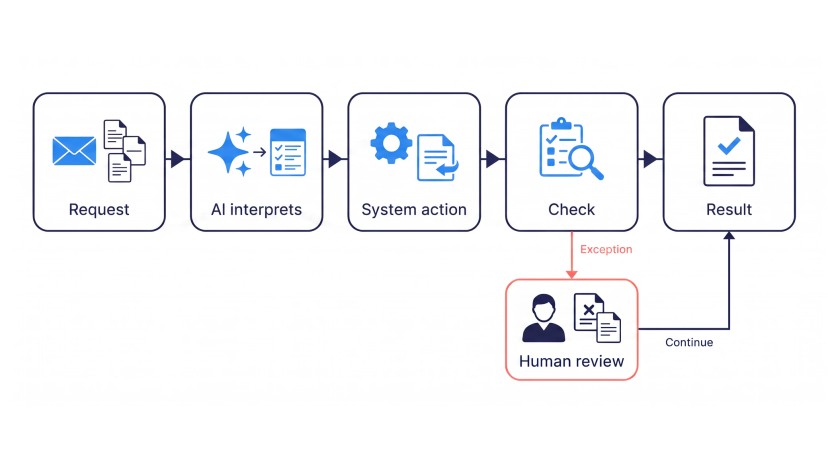
AI business process automation adds software that can read, interpret, decide and write. The whole cycle of a process, from taking in information to acting on it, can now run through software. The cost and time of the work can fall by multiples rather than percentages, and the same team can take on more work with more consistent quality.
The method changes as well. Adding AI features to a process built for people rarely gives a fully automated process. We define the process, its knowledge, its decisions and its controls first, and the software carries out that definition.
How is BPA different from BPM, RPA and hyperautomation?
The terms overlap, and vendors use them loosely. In their usual sense:
| Term | What it means | What it reaches |
|---|---|---|
| Business process management (BPM) | The discipline of modeling, running, measuring and improving processes. BPM software models a process and routes its tasks | The design and the flow of the process. The reading and deciding inside human tasks stays with people |
| Business process automation (BPA) | Running a repeatable process through software instead of people coordinating it | Steps with fixed rules and structured data |
| Robotic process automation (RPA) | Software robots that replay fixed rules and clicks in user interfaces | Stable steps that match the script, including systems with no API |
| Intelligent automation | Rule-based automation and AI combined in one process | Rule-based steps plus variable documents and requests |
| Hyperautomation | Gartner's name for automating as many processes as possible with a mix of RPA, workflow engines, integration platforms, process mining and AI | Breadth across the company, through a mix of tools |
| AI business process automation | A whole process run through software, with AI on the steps that need interpretation, and checks and escalation built in | The full cycle, from taking in information to acting on it |
The useful question is which steps each approach leaves with people. RPA leaves every case that does not match its script. BPM software routes the work, while the reading and deciding inside each human task stays with a person. AI covers that part.
In practice the approaches combine. Rules and system interfaces perform the mechanical actions, and AI interprets and decides. The guide What Is AI Workflow Automation? shows how such a chain runs step by step.
Business process automation examples by function
Most processes worth automating start with information that older software could not read: an email, a scanned document, a chat message, a free-text request. Typical examples by function:
| Function | Process | What AI takes on | What stays with people |
|---|---|---|---|
| Finance | Supplier invoices | Reads invoices in any layout, matches them to orders and receipts, flags differences | Approving payments and settling disputed differences |
| Sales and marketing | Lead intake | Reads form entries, emails and messages, records them in the CRM, qualifies and routes them | Conversations with qualified buyers and the offer |
| Customer support | Requests and tickets | Classifies requests, answers routine ones, escalates the rest with the history attached | Complex cases, exceptions to policy, unhappy customers |
| HR | Employee onboarding | Collects documents, prepares account and access requests, answers policy questions | Hiring decisions and the conversations that matter |
| IT | Incidents | Classifies incidents, applies the standard playbook, gathers diagnostics for the engineer | Fixes outside the playbook and changes to systems |
| Supply chain and warehousing | Purchase orders and supplier confirmations | Reads confirmations and delivery notices, updates the order status, flags delays | Deciding what to do about a delay or a shortage |
| Service delivery | Job scheduling and job records | Turns requests into scheduled jobs, completes the job record from field notes | The work on site and judgment calls with the customer |
| Administration | Recurring reports | Collects status and metrics from the systems and drafts the weekly report | Reading it and deciding what to act on |
Two patterns repeat across the table. The structured part of each process, with clear data and rules, belongs to rule-based software and system interfaces, which give the same output for the same input. AI takes the part that has to be read and interpreted. And the system of record stays the backbone: an incident process runs on top of the ticketing system, with AI working inside it.
A good first unit is a few closely related processes in one problem area, for example invoices, payments and supplier queries in finance. They share knowledge, systems and controls. Our reference solutions work such units through end to end, for example inventory and replenishment for a retailer.
Why does automation with AI follow a set order?
Every step of automation removes one manual load and exposes the next one. That is the reason we build in a fixed order. Inside one area of a business it looks like this:
- Without a shared target, AI initiatives scatter across teams and tools. AI Organization Strategy defines the target state and the path to it.
- An unclear process is inconsistent, undocumented and depends on who does it. AI Process Reengineering makes it explicit and executable.
- A defined process still depends on scattered documents and individual expertise. AI Knowledge Base structures the knowledge AI works from.
- With process and knowledge in place, AI understands the work but cannot reach the systems and the data. AI Connectivity gives it that access.
- Connected systems still leave people executing and coordinating most of the process. AI Execution Assistance packages the work into skills and assistants.
- Skills and assistants still leave people driving the work to completion. AI Agentic Execution lets agents carry defined work forward.
- Agents at work still need people to review outputs, decisions and routine exceptions. AI Validation & Control builds the checks into the workflow.
- Many agents and systems multiply dependencies, handoffs and coordination. AI Orchestration coordinates agents, systems and people.
For one workflow, AI process automation brings connections, assistants, agents and checks together and delivers the workflow end to end.
A skipped step comes back. A missing foundation returns during implementation as rework, and corrections cost more at that point. An agent on top of an unclear process produces poor work faster.
The order is a build order inside one process, not a schedule for the whole company. Different areas move at different speeds and stand at different points at the same time. Each step is a separate service, and a company starts at the step where its own work stands today.
Even at the far end of the sequence, people decide what to improve next, and they keep overseeing performance, policies and exceptions.
Where should a company start?
Choose the processes from the business side first: which work takes the most effort, where the most money goes, where the most mistakes happen. Then check whether current AI can carry that work and how ready the work is for it:
- Is the process described?
- Is the knowledge it needs available?
- Can its systems be reached?
- Are its quality criteria known?
Choosing on both sides avoids features bolted onto whatever looked easy, which bring little and are later thrown away.
The first constraint then decides the entry point. If AI activity is spread across teams with no shared target, define the target state first. If a valuable process runs on memory and individual judgment, make it explicit first. If AI lacks the company's context, structure the knowledge first. If a process is already clear, repeated and valuable, automate it directly.
How does autonomy grow without losing control?
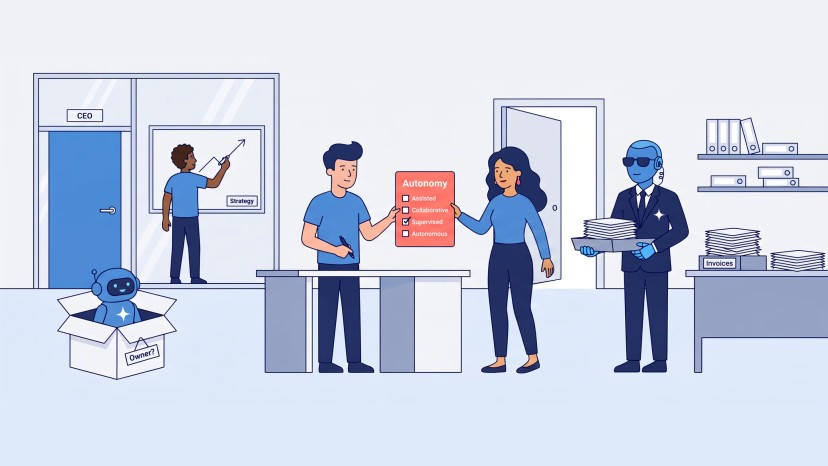
Automation grows in four stages, and each stage has its own job:
- Assisted. People run the defined process with a general AI chat and written instructions. This tests the process and shows where it is still unclear.
- Collaborative. Proven instructions become skills and assistants. People hand over larger tasks, review the results and work through the cases outside the main flow.
- Supervised. An agent owns the result of a defined process and passes the cases it cannot resolve to a person. People supervise the results and set the quality standards.
- Autonomous. Verification agents check the work of production agents against written quality criteria. People stop reviewing every result and oversee performance, policies and exceptions.
A stage is extended only after the one before it gives a consistent result. We do not rush to agents, because an agent launched too early produces poor work faster.
Different areas of a business sit at different stages at the same time. A finance process can run Supervised while a sales process is still Assisted. Our blog describes the same ladder as Levels 1 to 4 of AI automation, each with a minimum quality bar.
What is process automation software, and which tools do you need?
Process automation software runs defined workflows across business systems. The main kinds:
- Workflow engines and BPM suites route tasks, track their status and keep the steps in order.
- RPA tools drive user interfaces, which helps with systems that have no API.
- Integration platforms move data between business applications.
- Low-code platforms let a team build forms and small internal apps.
- AI platforms and assistants, such as Microsoft Copilot, Claude and ChatGPT, run the skills, assistants and agents.
Lists of the best business process automation tools are easy to find. None of the tools supply the definition of the work. A platform provides components. It does not decide how the business should run, and a process that was never defined gives it nothing to follow. In our experience, the long part of automation is defining the process, its instructions and its artifacts. Once that is done, building on a platform is largely mechanical.
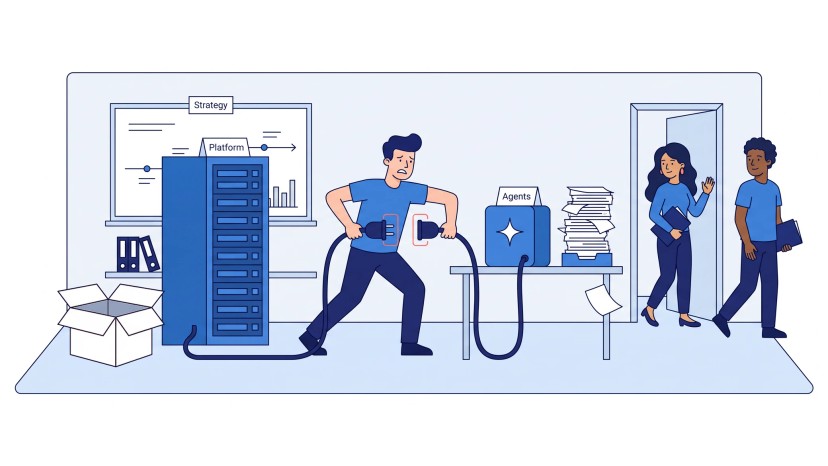
We therefore treat the platform as a replaceable component, and your existing business applications stay in place and are connected. What the company keeps:
- defined processes and goals;
- structured company knowledge;
- explicit decision and exception logic;
- quality criteria and verification rules;
- connections to the business systems;
- governance for access, cost, risk and oversight.
With these in hand, a change of platform is an implementation step rather than a new project.
Does business process automation replace employees?
No. The aim is for the same team to deliver more, faster and with more consistent quality, and for the business to grow without adding staff at the same rate. Routine steps move to AI. People direct the work, supervise the results and keep the decisions, approvals and exceptions. As automation matures, their attention shifts to customers, judgment and improvement.
There is a practical reason too. The people who run a process carry the knowledge it depends on. Automation that removes them removes that knowledge, and the next change in the process has no one to describe it.
Training is part of the automation for the same reason. People have to use it, supervise it and know where their judgment remains. An automation that is delivered but not adopted changes nothing.
How do you measure the results of business process automation?
The benefits of business process automation show up in four results, and each of them can be measured:
| Result | What it shows |
|---|---|
| Cost | The effort and money each case takes |
| Speed | How long the work takes from request to result |
| Quality | How often results meet the criteria the first time, and how much rework they need |
| Capacity | How much work the same team can carry |
Take the baseline before anything changes: how long tasks take by type and complexity, what each case costs in effort, how often results need rework, how much work the team handles. After launch, the automation's own management view shows throughput, quality against the criteria, failure reasons and AI cost. The same measures are then read continuously instead of estimated.
Where a process moves from partial to full automation, expect gains by multiples rather than percentages. The same measures also decide when a process is ready for the next stage of autonomy.
How EIC delivers business process automation services
Business process automation services and consulting should cover everything a process needs to run on AI, beyond the software itself. That means a strategy that picks which processes to automate first, a redesign of the process, the company knowledge AI works from, the connections to your systems, the assistants and agents that do the work, and the checks and escalation rules that keep the results reliable. A tool bought on its own leaves the old process in place, along with its cost and quality problems.
We sell each part as its own service. For a company that wants all of them under one roadmap, AI Agency Transformation is our AI transformation consulting program. For one workflow, AI process automation covers the automation itself, training for your team and ongoing support. We work with mid-size companies and business units of larger organizations whose processes are complex and knowledge-heavy, and with smaller firms that want to grow without adding staff at the same rate. The scope can be one problem area, a department or, for a smaller organization, the whole company.
If you are choosing a business process automation company or consultant, ask four questions. Does the work start from your process or from their tool? How is every critical output checked before anyone relies on it? What happens when the AI is unsure or a case falls outside the rules? Who trains your team and supports the automation after launch? Our answers: we start from how the work should run, check critical outputs against written criteria, route unclear cases to a person, and train your team and support the automation after launch. We also stay independent of any vendor and raise autonomy one stage at a time.
The first step is a free call to find where automation should start at your company. Book it below.
Short answers are in the FAQ on the home page and, for a single workflow, in the FAQ on the AI Process Automation page.