What is AI consulting?
AI consulting is a service that solves a business problem with artificial intelligence. The firm studies how the company works, decides where AI should do the work and helps put it there. An AI consultant does this work alone or inside a firm. An AI consulting firm is a team with a method for it.
Consulting is often confused with two other services. Staffing sells the time and skills of specialists, and the client directs them. Outsourcing sells a product, built to a specification the client already has. Consulting sells a result against a problem, and the client pays for the path to it.
That is why method matters so much in AI consulting. New tools and platforms appear every week, and people try to solve problems with them before anyone has stated what is being done and why. A consultant has to show a clear, transparent path from the problem to the result. Without one, the client pays for effort and still has to find the path alone.
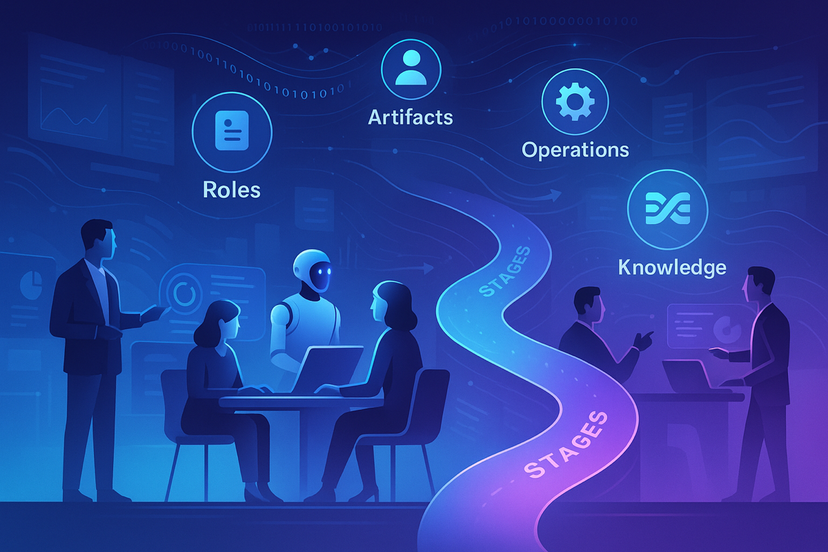
One more word causes confusion. In the market an "AI agency" is a provider that sells AI work. We use the term for a result: a company whose routine work is carried out by AI agents, with people directing and supervising them. That meaning is explained in What Is an AI Agency?
What do AI consulting firms do?
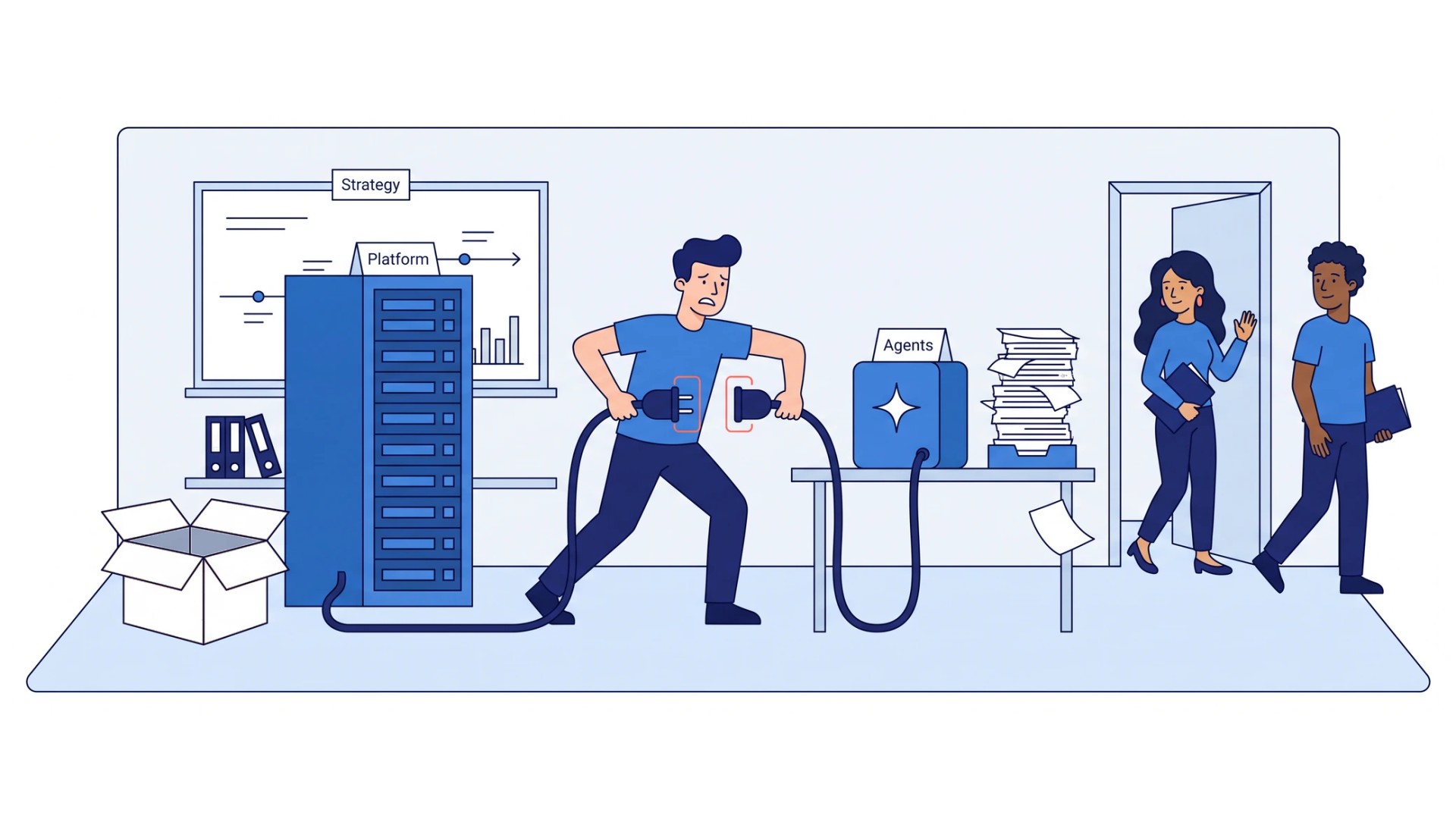
Most AI consulting firms cover one part of the problem. One writes a strategy. Another implements a platform. A third builds an integration or a set of agents. The client coordinates the rest.
| Kind of firm | What it delivers | What stays with you |
|---|---|---|
| Strategy advisory | A strategy or a list of use cases | Turning the plan into processes, knowledge, connections and running automation |
| Vendor-led partner | Its own platform, configured for you | Lock-in, and the cost of rebuilding when the platform changes |
| Technology implementer | A tool, set up and running | Explaining how your business works, before and during the build |
| Agent or integration builder | Agents or connections for a chosen use case | The processes and knowledge the agents need to give consistent results |
| Off-the-shelf solution | A product with its own predefined process | The gaps where that process differs from yours |
None of this makes the work itself bad. For companies the size of our clients, finding several vendors and handing work from one to the next is a real expense, and it is where the gaps open.
Many firms also work bottom-up. They take separate use cases, or whatever comes to hand, and automate them one at a time. Each use case can succeed while the business as a whole runs the way it did before. Cost and complexity go up, and the work gets done the same way.
What do AI consulting services include?
Complete AI consulting services cover the whole path from today's operations to operations in which AI executes a large share of the work. We count eight parts:
- Strategy: the target state, the priorities and a phased roadmap.
- Processes: goals, information flow, decisions, variants, exceptions and quality standards, made explicit.
- Knowledge: company knowledge structured, verified and owned, in a form AI can use.
- Connections: access for AI to the systems the work runs through, including older systems without a usable interface.
- Execution: the skills, assistants and agents that do the work.
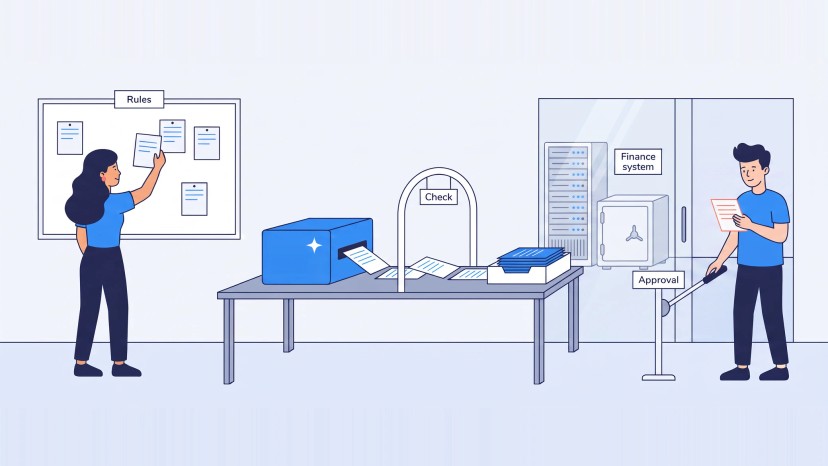
- Control: validation of results, limits on actions and escalation to people.
- Coordination: orchestration across agents, systems and people when one goal needs them all.
- Adoption: training, operating instructions and ownership, until the team runs the result.
The strategy sets the order for the rest. Inside one process the build order is fixed: the process is defined first, then the knowledge it depends on, then the connections to systems, then the skills, assistants and agents that use them, then validation, then orchestration. Adoption runs alongside every step. A part that is skipped comes back during implementation as rework, when corrections cost more. Across a company, areas move at different speeds. The order describes one process, not the rollout of a whole business.
Most AI consulting services sell one or two of these parts. AI Agency Transformation joins up what is usually sold as separate projects.
Why do AI consulting projects stall between vendors?
The pattern repeats from company to company. A pilot shows good results on a small, controlled task. In production the same AI gives answers that are good one day and poor the next. The correction gets blamed on the model, and nothing reaches production scale.
Two causes sit underneath. The company's knowledge lives in people's heads or in stale documents. Its processes are either undefined or were designed for people and never rethought for AI. When each vendor owns one part, these two causes fall between the contracts.
Meanwhile AI spreads on its own. Departments build their own chat assistants and upload a few documents to share. People use whichever assistant sits inside their spreadsheet. In one team that already worked with AI every day, repeated tasks were automated piece by piece with no shared structure, and over time the automations turned into chaos. Tools used this way, outside any register, are called shadow AI.
Our reading of the market is that technology currently moves faster than method. AI amplifies what is already there: defined work gets faster, and disorganized work gets more disorganized.
How does an AI consulting engagement work?
Ours runs in five steps:
- Define the target state and the roadmap. We describe how the business would run if AI carried its operations as fully as it can, map today and build the path between the two. The first version is broad on purpose: good enough to show the directions, then deepened area by area.
- Formalize the processes. Each priority process is written down the way people and AI will run it, with its responsibilities, decisions and quality standards.
- Connect knowledge and systems. The business context AI needs is structured, and the applications the work runs through are connected.
- Automate step by step. Assistance comes first. Agents, verification and wider workflow automation follow once execution is consistent.
- Operate under supervision. The system runs with monitoring, escalation and human authority, and it grows as the evidence supports.
Two rules hold across the steps. The first is control points. Work moves in stages, and at each stage we show the result and take feedback. The client can stop if the direction looks wrong, and a wrong direction shows early instead of at the end.
The second is to build around what already works. One sponsor asked us not to change a procedure the company had released a few months earlier, because people were still pushing back against it. Change fatigue is real, and the engagement adapts to it. Autonomy also grows in stages: it is extended only after the previous level gives consistent results.
How the readiness picture is built and how the roadmap is sequenced is covered in our guide to the AI readiness assessment.
What should stay with your company when the consultants leave?
This question separates one kind of AI consulting from another. A strategy document can be filed away. A platform stays until its contract ends. What should stay is your company's ability to run and extend the work.
We judge our own engagements by this list:
- Running operations for the agreed scope, with AI executing routine work under control.
- Defined processes: goals, decisions, exceptions and quality criteria, written down.
- Structured knowledge with named owners and update rules.
- Connections to your systems that your company owns.
- Quality criteria and controls that run inside execution.
- A trained team with operating instructions, clear ownership and escalation paths.
These are durable assets. Platforms and models will change. The definitions of how your business works survive the change, and a new tool can be connected to them without rebuilding the operation.
Training is on the list for a plain reason: an automation that is delivered but not used changes nothing. Each step of our work comes with training, coaching and operating instructions for the people who will run it. A technology leader we interviewed described the same idea from the client's side. The first project is built as a standard and then reused. Nothing new starts from scratch after that.
How do you choose the best AI consulting firm?
There is no fair ranking of the best AI consulting firms, because firms sell different parts of the work. Compare them on what they would leave behind, then ask four questions:
- Does the firm start from your target operating model and your processes, or from a tool?
- Is it independent of vendors, letting tools change without rebuilding the operation?
- Does it build around what already works?
- Does it leave your team trained to run and extend the result?
Two more screens are worth adding. Has the firm worked in your industry? Does its path cover the whole organization, department by department?
Vendor independence deserves a closer look. Heavy investment in one technology ages fast in this market. One technology leader we interviewed refused to route the company's order and customer systems through the chat tools people already used. Once people got used to that, the company could never switch systems. We start from business needs instead of technology capabilities, and keep the options open.
Be careful with claims of complete knowledge. In a field that changes every week, nobody can honestly claim to know it all. A partner should show a method that holds as the tools change, and experience across industries.
The same questions apply when you hire an individual AI consultant or compare AI consulting companies of different sizes. Ask who will build, connect and run what the consultant recommends.
Is AI consulting only for large companies?
No. Smaller companies feel the cost of several vendors more than large ones. A large company has people whose job is to coordinate suppliers. In a small one, that job falls to the owner, who often holds half the functions already.
AI is usually in use there already, personal and informal. The owner of one small machine shop we interviewed uses a general chat assistant for reference questions, such as the weight of a blank. A coding assistant writes simple programs for a lathe, and the owner checks each one in a visual simulation before running it. Another small business told us it could not grow its network of partner workshops, because each new partner needed conversation and bookkeeping by hand.
That second case is a typical starting point: growth limited by manual coordination. A single use case is a good place to start, and we treat it as the first step of a path.
Where should you start: strategy, one service or the full transformation?
Start from what blocks progress today. Each of our services is sold on its own, and a company that already has a strategy and defined processes may need only one of them.
- AI activity is spread across teams with no shared target. Start with AI Organization Strategy and define the target state first.
- A valuable workflow runs on memory and individual judgment. Start by making the process explicit with AI Process Reengineering.
- AI lacks your company's context. Start with the knowledge it needs.
- AI spend is growing and pilots are multiplying. If leadership wants one route instead of a series of separate decisions, the full transformation fits.
A fair objection is that starting with features is cheaper. Features are fast to build and easy to test, and existing pilots are not wasted. They become evidence of what works, what people skip and what the organization still has to prepare. A feature on its own does not change how the business runs.
How EIC works as an AI transformation partner
AI Agency Transformation is our answer to the gaps described above. One team takes the whole path: strategy, processes and knowledge, connectivity, automation, control, orchestration and the training of your people, under one roadmap. The change comes area by area, and nothing in the business has to stop for it.
If you are comparing AI consulting companies or AI transformation consulting services, ask each one what it will leave behind. Our answer is operations that run with AI for the agreed scope, the definitions behind them and a team that can extend them. If you need AI implementation consulting for one part of the work, each of our services is also sold on its own.
If a full transformation is too early, AI Organization Strategy is the entry point. Its roadmap shows which services follow and in what order.
The first conversation is free. In 30 minutes we look at the result you want, find the constraint that blocks it and sketch where the path starts. It commits you to nothing. Book it below.
Short answers on AI transformation, choosing a partner and managing the change for employees are in the FAQ on the AI Agency Transformation page.