What is AI enablement?
AI enablement is the function that introduces AI into the work of a company, governs it and keeps improving it, step by step toward an AI-native business. It covers AI strategy and the portfolio of AI initiatives, the preparation of processes and knowledge, connections to business systems and data, skills, assistants and agents, the AI platform and its models, evaluation, governance, adoption and training.
Some areas stay outside it: general IT and infrastructure, the operation of ordinary business systems, the business strategy of the company, HR, custom software development and any AI services the company sells to its own customers. They give the function inputs and constraints, and some of them do work for it. They do not own AI.
The unit goes by different names, such as Artificial Intelligence or AI Automation.
Who owns AI in a company?
In most companies nobody does at first. Tools arrive before owners. A department adds an AI tier to a product it already uses. Another builds a custom GPT, loads a stack of documents into it and shares it with the team. In a small firm, the accountant works with a personal paid subscription, and the owner does not know whether it is used on the company books.
A large retailer we interviewed shows how far this goes. Nobody owned the business strategy: it landed in finance as a combination of all the department heads. Governance sat with IT only because audits required it, and every department handled the rest on its own.
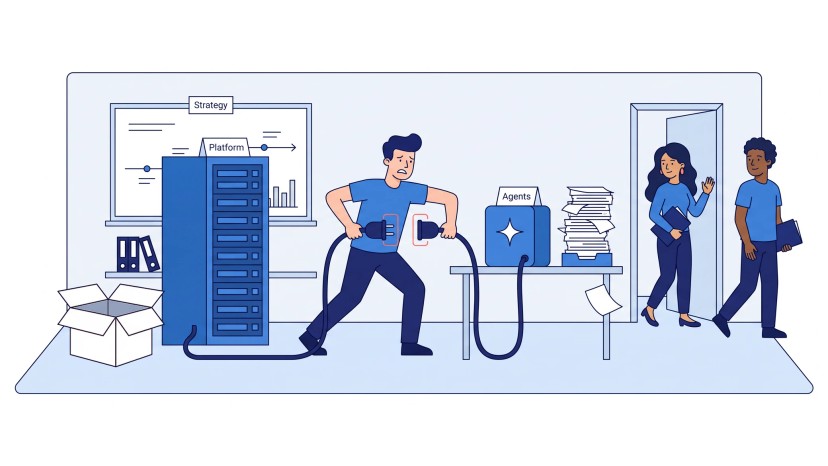
We call what follows shadow automation. Keen employees build AI solutions outside the strategy and the rules, and when the technology changes or the person leaves, the automation breaks. Our guide to shadow AI covers the pattern. Sanctioned projects can lose owners too, once the automation is live.
Ownership has three parts, and each holds different decisions.
- The executive sets the direction, approves major AI investments and chooses the priorities.
- The enablement function owns the AI work: strategy, methods, platforms, standards, governance and the lifecycle of every automation from release to retirement. Its leader answers for adoption and for the results of automation.
- The business departments keep their processes, decisions, knowledge and results. The enablement function redesigns a process for AI and hands it back. The process owner approves material changes and the level of autonomy AI gets in that process.
These parts are recorded in the AI operating model: which work AI performs, which decisions stay with people and who owns each part. AI Organization Strategy builds this model.
How is an AI enablement department structured?
In the reference model we built for the function, a full department has six groups.
| Group | What it owns |
|---|---|
| Management | The portfolio of AI initiatives, programs, budgets, priorities and capacity, and line management of the team |
| Strategy and architecture | AI direction, the target operating model, solution architecture, and the choice of models, platforms and vendors |
| Process and knowledge engineering | Models of each business area, processes redesigned for AI, decision rules and exceptions, and AI-ready company knowledge |
| AI automation | Skills, assistants, agents, workflows, orchestration and AI connectors, from release to retirement |
| AI platform | Running the AI platforms and models: reliability, monitoring, usage and cost, access to the platform |
| Governance and adoption | Policies, decision rights, AI risks, shadow AI, evaluation of AI results, adoption and training |
Management works across the five specialist groups and does not duplicate their work. AI initiatives turn into many projects that share a few scarce specialists, and someone has to decide where those specialists go. Project teams are temporary: people join them from the groups and keep their home group.
Should IT, an AI center of excellence or an AI enablement team own AI?
Companies usually pick one of three answers, and each carries a different amount.
- IT. IT runs the systems and the licenses, and its groups already build simple software and automations, some of it with AI coding tools. IT can carry simple AI automation. The full scope is wider.
- An AI center of excellence. It gathers scarce expertise in one place for the departments to use. One corporation we interviewed runs a matrix with line management on one axis, functional management on the other and centers of excellence by country. The label tells you where expertise sits. It does not tell you who owns strategy, who trains, who governs and who builds.
- An AI enablement function. It owns those jobs by name, from strategy and training to governance and building.
We apply one test to any of the three: no area of AI work may have unknown, unclear or overlapping responsibility. A name cannot pass that test. A list of owned jobs can. A center of excellence that holds the list is an enablement function under another name.
Placement follows demand. A separate department suits larger and AI-intensive companies. A specialized group under IT is common when demand justifies a dedicated team and does not yet justify a department.
The line with IT is drawn by scope. IT keeps simple AI automation and simple software, the general infrastructure, cloud, networks, company-wide identity, cybersecurity and user support. The enablement function runs the AI platforms and models: their configuration, reliability, monitoring, usage and cost. It configures and integrates first and orders custom code when configuration falls short. Requests stall at that hand-off when nobody has decided whether they are configuration or engineering.
How big does an AI team need to be?
As big as the company needs. The function scales down without losing its jobs.
- A department. A Chief AI Officer leads AI strategists and architects, program managers, process architects or engineers, knowledge engineers, governance and platform specialists, and AI automation specialists who build with low-code tools.
- A group under IT. An AI enablement lead, who can be the IT manager, works with a strategist, a process engineer, a knowledge engineer and automation specialists. In a small group several of these roles can sit with the same people.
- A pilot team. A small company starts with one pilot: one piece of work, the result it must show and a team with time set aside for it. The team needs someone who knows the work, someone who builds and someone who accepts the result. A role nobody inside can take, most often the builder, can come from outside, and we can take it.
The jobs do not shrink with the headcount. Someone still sets the direction, chooses tools, defines the rules, trains people and decides what gets built. What changes is how much one person can carry, and how much comes from durable assets built once, such as process definitions, company knowledge and connectors.
In a small company IT may not be a formal function at all, and AI has no natural home. A small manufacturer's owner named the gap: nobody who could own the implementation. A team also keeps the work from resting on one enthusiast.
What can a company hand to a partner, and what must it keep?
Who does a piece of work is a separate decision from who owns it. The team, another department, a vendor or AI itself can do the same job, and its owner stays the same.
A common setup mixes the two. The company keeps strategy, priorities, governance, architecture and the ownership of each business result. IT, software teams, vendors and outside specialists carry the specialist implementation. When most of the work is bought, a small internal owner still sets the direction, the requirements and the rules, and accepts what is delivered.
Hold that line with any partner, including us. A partner can design, build and run parts of the system. The decisions about direction and the acceptance of results stay with the company.
In what order should a company roll out AI?
An enablement function introduces AI to a company in this order. The steps overlap, and low-risk assistants and skills can start before the full foundation is in place.
- Purpose, then strategy. Fix the end goal, then write the strategy and the plans.
- Technology. Choose platforms after the strategy.
- Preparation. Make the processes and the knowledge base ready.
- Governance. Define roles, responsibilities, rules and enforcement now, in parallel with the choice of base models and the connection of knowledge. It is not added at the end.
- Training. People learn to use AI as it comes out of the box, before knowledge is connected.
- Connectors. First read access to knowledge, then the ability to act in business systems.
- Skills, assistants and agents. Skills and assistants run in a semi-manual mode first. Agents start when the tasks are well tuned and even edge cases raise no questions, and they start under supervision. Orchestration and automated validation and control follow.
- Change management for people. It goes with each release: training, support, coaching and mentoring at go-live.
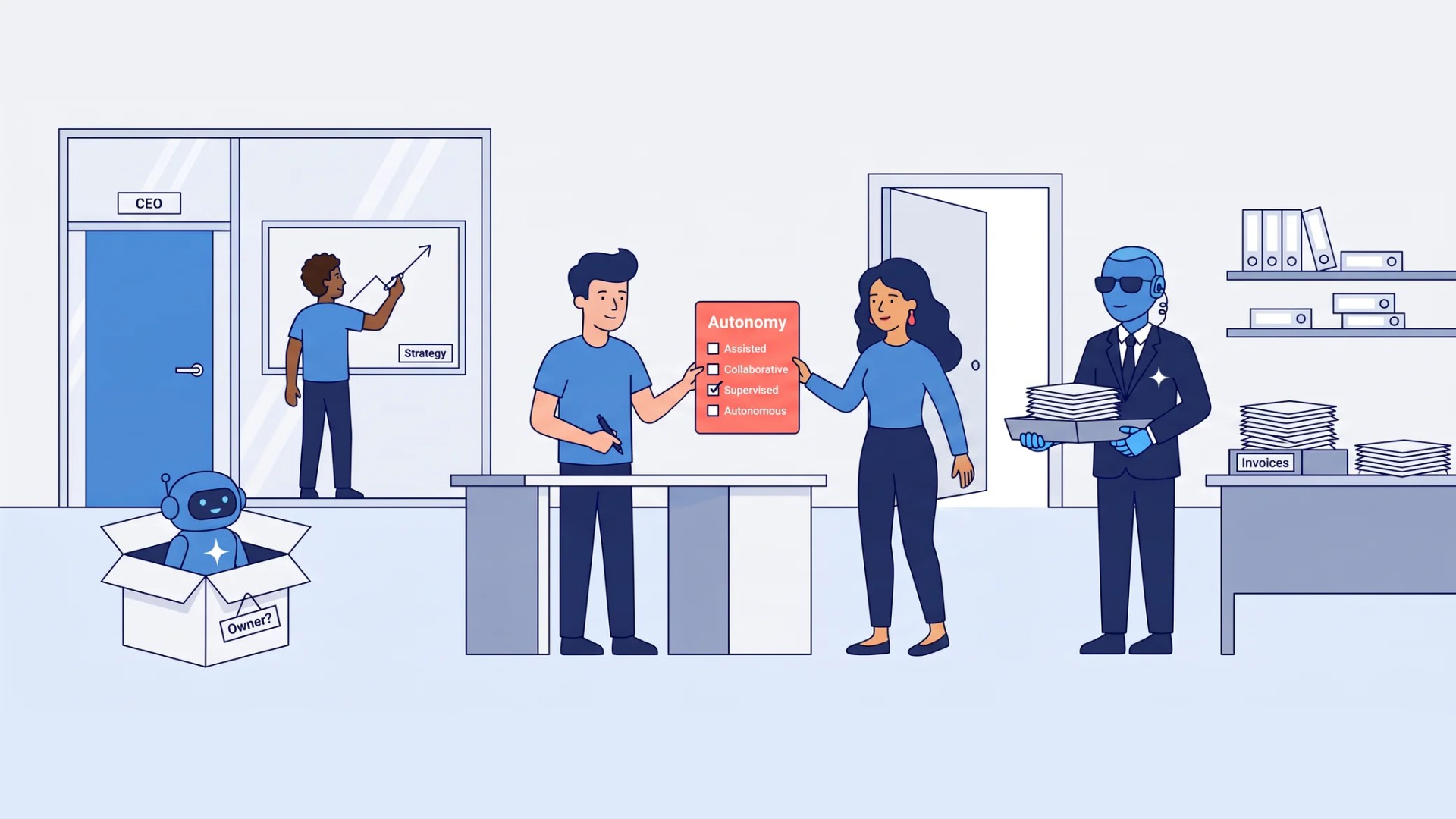
The rollout goes area by area and level by level. Each area moves through the four autonomy stages, Assisted, Collaborative, Supervised and Autonomous, when the previous stage gives consistent results and the process owner approves the next one. After go-live the function keeps each automation running: it watches reliability, quality, usage, cost and the value delivered, and turns failures and feedback into the next change.
This is the rollout order of a company. The build order of a single process differs. It runs process, knowledge, connectors, then skills, assistants and agents, then validation, then orchestration.
What does an AI governance committee do?
An AI governance committee is a standing group that decides which AI the company may use, under which rules and who answers for it. What AI governance covers and who owns each area of it is in our guide to AI governance.
A charter can be short. The governance cycle we use gives it six items:
- Scope: all AI in use, shadow AI first, with the work it serves.
- Risk assessment: technical, legal and other.
- The rules, constraints and standards that follow from the risks.
- Named accountability and oversight.
- Monitoring and assurance.
- A rule for divergence: when practice and rules differ, either change the rules or bring the practice back.
Control is tiered by process. Sensitive work gets tight constraints and stronger human authority, and low-risk work moves faster under lighter rules. Set the amount of human review with care. Too much of it eats the value of the automation, and approval given without a real check controls nothing.
Who owns training and the people side of AI?
Four parties touch AI upskilling, and each owns a different part.
- The enablement function owns what people learn about AI, in what order and by role, and the support around go-live: coaching, mentoring and operating instructions. We teach skills, including where each person's own review and judgment remain, and judge training by what the person can do afterwards.
- The line manager owns the person: readiness, assignments, performance review, development and career. A typical failure of line management is that people are managed by the residual principle: hiring happens, and training does not. AI skills can fall into the same gap.
- The head of the function owns the tasks and agrees how the work changes when AI takes over steps. Where a process crosses functions, the process owner is accountable that an end-to-end process exists and wins buy-in from the others.
- HR keeps hiring, workforce planning, job and skills frameworks and general learning. The enablement function adds the AI-specific requirements to them.
People also adopt what they helped draw: mapping the work together exposes contradictions in terms and in responsibility before they reach the automation.
What stays with the executive?
An executive keeps the direction and the accountability for it. The AI strategy serves the business strategy and does not replace it. The executive decides what the business is becoming, and which initiatives get funded. In one corporation we interviewed, a major platform rewrite was declared a business-unit decision: the scope came from the business strategy, engineering decides how, and the business decides whether.
Much of the execution can be automated, including governance work such as taking inventory of AI use, monitoring and checking against the rules. In the target state we design for, people concentrate on strategic direction, high-risk approvals, unresolved exceptions, policy boundaries and accountability. Strategy keeps a named person, because information is incomplete and the cost of an error can be the life of the company.
Two rules follow. Accountability moves only through an explicit operating-model decision, and automation does not move it as a side effect. And where the cost of an error is the business, a named person approves. In one agent we are designing, the rule reads that the agent owns execution, and people own business authority, governance decisions, formal approval and consequences.
How EIC designs the AI operating model
AI Organization Strategy answers the ownership question as part of the operating model. We map how the business runs today: capabilities, functions, processes, knowledge, systems and the manual gaps, for the whole organization, a department or a problem area. Then we describe the target operating model, with the roles in it, who owns what and what stays with people. You receive an organization model, an AI-native blueprint and a phased roadmap.
The roles and charters of an enablement function come from that model. The structure in this guide comes from the same method applied to the function itself: we modeled its capabilities, functions, operations, knowledge, systems and gaps, and the agentic systems that can take over its own work.
The model also gives grassroots automation a place: when every automation has a known slot, it can be rebuilt or connected later without breaking anything.
When a company wants the whole path with one team, AI Agency Transformation carries it from strategy to adoption and governance, including training, operating instructions, ownership and access boundaries. Initiatives stall when the organization around the AI was not made ready, and the fix is organizational before it is technical.
Short answers to the questions buyers ask about operating models and pilots are in the FAQ on the AI Organization Strategy page.