What is a standard operating procedure, and what does AI need instead?
Standard operating procedures exist so that a routine task comes out the same whoever does it. The document names what the task is for, who is responsible, the steps in order and the records they leave. Work instructions and checklists go into more detail below it.
A person reads an SOP once and then relies on experience: why a step exists, which process the task belongs to, what to skip and whom to ask when the page is silent.
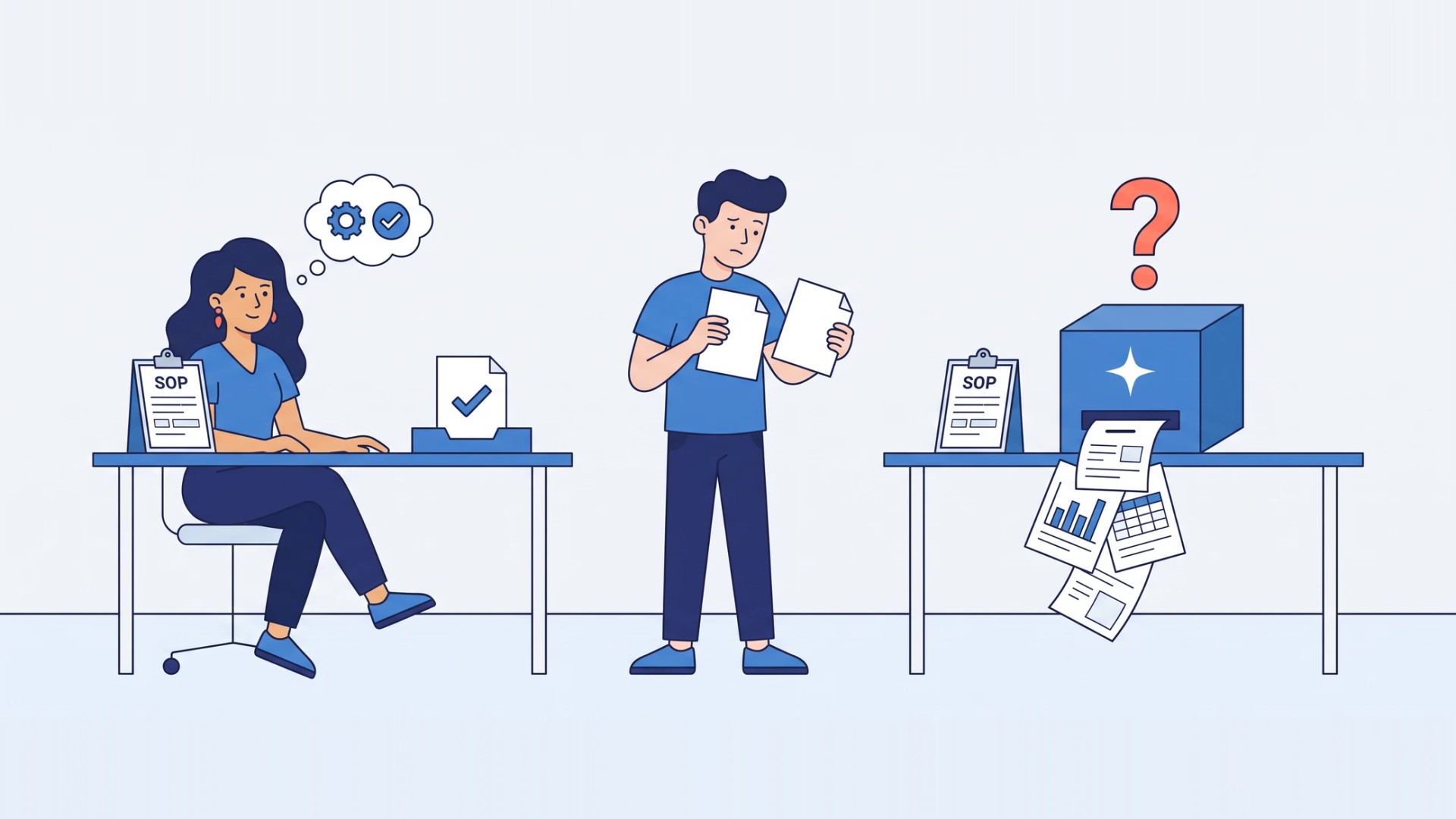
AI has none of this to lean on. Our position is simple: most processes and their SOPs were written for people, and AI works differently. Without clear instructions its decisions are generated at random, and the results do not repeat.
What AI needs is the process the SOP belongs to, written down: which information each step needs and where it comes from, which decision is made on it, who or what carries out the step and what the step produces. AI Process Reengineering is the work of making a process explicit enough for people and AI to execute.
Why do AI agents fail when they follow your SOPs?
The agent invents. The SOP leaves out a piece of information that a trained person carries in their head. The model fills the gap from what it absorbed in training and guesses where precision is needed. The same request gives a different answer tomorrow.
The agent skips. A step that people perform without thinking was never written down, and the agent does not perform it either.
The agent goes to the wrong role. Responsibilities copied from the org chart name the role on paper. In one mapping session, an AI-drafted description said that the owner manages supplier relationships. The technicians do.
A process can also be defined and published and still be run badly, as one program sponsor told us about their own company, and AI on top of it reproduces the inconsistency. The same pattern shows in automation built without that groundwork: it works in small controlled pilots and fails to deliver consistent quality in production.
What is process documentation for AI?
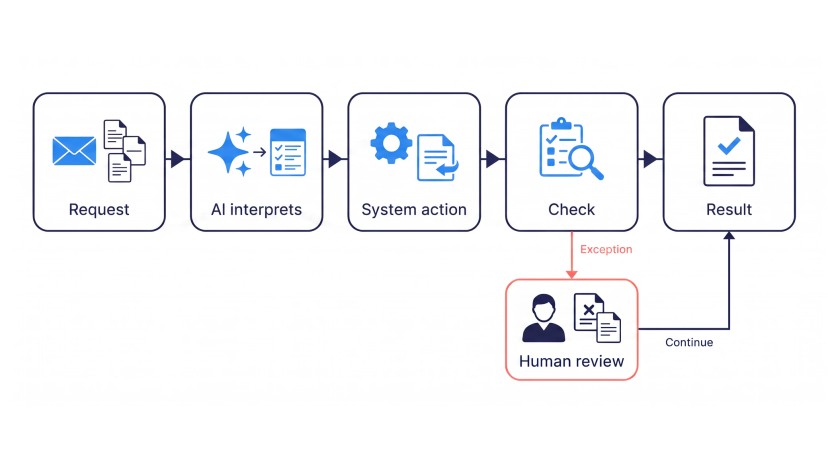
Process documentation records how a process runs from its trigger to its result: the steps in order, who performs each one, the inputs and outputs, the decisions and the exceptions. SOPs sit inside it and cover its routine tasks. A process definition for AI has to answer more than a map and a set of SOPs answer for people.
We state the rule in one line: AI needs the right information, at the right time, in the right order. When a piece is missing or late, AI falls back on what the model carries.
For each step, the documentation records what the step produces, what it takes from earlier steps and which approved sources it must consult. It also records what is read from which business system and when, and what is written back. We call that the interaction model.
Flowcharts do not carry this. We told a client’s business analyst, who was already mapping processes as flowcharts, that we do not model that way. AI takes different routes depending on the situation, and forcing it down one drawn path takes a great deal of effort. We model goals and constraints.
The frame we use is a goal-oriented reference process: the goal the process must reach, its structure, the information flow, the decisions and the quality gates, with explicit variations by outcome and by phase.
Where do people belong in an AI process?
A process has two kinds of human point. Input points are where a person supplies key information or makes a decision the process cannot get anywhere else. Control points are where a person checks what AI generated before an error cascades through the steps that follow.
We place them after confirming that each step has the information it needs.
In the process form we are building, each step names which human role applies: providing knowledge, validating the current state or the target, resolving a business ambiguity, confirming accountability, agreeing targets, validating usability or approving the final package.
Producing, reviewing and approving stay separate jobs. An assistant that approves its own output is a defect in the process. Execution can be automated end to end, and a named person stays where the cost of an error is the business.
Who does each step: an assistant or a deterministic workflow?
The same form gives each step exactly one primary executor: an assistant or a deterministic workflow. An agent comes later and takes over the same steps end to end, once the main flow and the edge cases are proven.
Use an assistant when the step needs interpretation, analysis, synthesis, design, review or content development. Use a workflow when the step can be completed from explicit rules and known state. The test is whether explicit rules are enough.
Each executor has written limits. A workflow may search approved repositories, fill predefined structures, route by explicit state and publish an already approved artifact. It must not settle a disputed business meaning, design a target process, define roles or KPIs or replace a human approver.
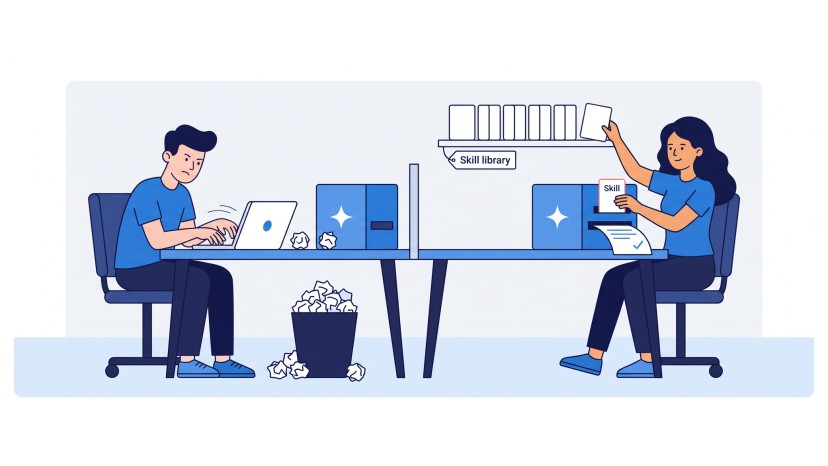
Each step also lists the skills it uses, and where no defined skill supports a step the map says SKILL GAP. That is how a backlog of missing skills is found from a real process. AI Execution Assistance builds those skills.
Why do exact words matter in a process for AI?
A person who hears “invoice” works out the meaning from the situation. An agent works from the word. The vocabulary of a process is its data model. Three examples come from one appliance-repair business.
- Invoice and receipt. Customers pay on site and receive a receipt. An invoice exists only when payment is still owed. A model that mixes the two specifies the wrong artifact.
- Callback and return. A callback is the same issue inside the warranty period, at no charge, created as a copy of the original visit. A return is the same customer with new work, or work outside the warranty, and it is paid. An agent can compute warranty status from the date of the original visit.
- A call. In that business a call is any inbound request, whatever the channel: phone, email, text message, a review site or a partner’s platform. An intake agent defined as a phone bot covers only part of it.
What does an AI draft of your process get wrong?
In one domain-mapping session, a first description of the workflows of a small appliance-repair business, the material its SOPs would be written from, was drafted from its website with an AI. The owner corrected it section by section. Twelve corrections follow.
| The AI draft said | The owner said | What it shows |
|---|---|---|
| The process starts when a call is taken. | It starts with generating the demand. | Ask what happens before the first record exists. |
| Collect details, then explain the diagnostic fee. | Explain the fee first. | Step order carries a rule. |
| Urgency changes the charge and the time windows. | Urgency is treated alike, with one exception for spoiling food. | A plausible default was wrong. |
| The call fee is waived when a repair goes ahead. | It is collected and credited against the repair. | A payment rule was reversed. |
| Assign work by ZIP-code territory. | The aim is a route with less empty travel. | A heuristic had replaced the goal. |
| Send a copy of the invoice. | It is a receipt. | One word changes the artifact. |
| Ask for a review after a successful job. | Ask everyone except customers flagged as unhappy. | The rule is defined by exclusion. |
| Escalate unfair reviews. | The action is a report to the review platform. | The verb has to match the real action. |
| The owner manages supplier relationships. | The technicians do. | Ask who really does the work. |
| Seasonal demand follows heating and cooling appliances. | The biggest swing is seasonal residents. | Generic risks need local checks. |
| The business serves residential customers only. | The boundary is the appliance class, set by access to parts. | A scope rule needs its reason. |
| (Not in the draft) | Disassembly, complaint handling, payment collection, callbacks versus returns, business-customer variants, telephony, a messenger, missed calls. | Whole workflows and systems were absent. |
Each wrong line was a sensible default. We use the same method in our interviews: prepare a structured draft, read it aloud and let the owner reorder, rename and add.
How to create standard operating procedures that AI can follow
An SOP that AI can follow is written after the process around it is explicit. Seven steps take a process from habit to procedures an agent can follow. The SOPs appear in step five.
- Start with a process scope definition. It records the purpose and expected outcomes, what is in and out of scope, the start trigger and end state, key inputs and outputs, major activities and decisions, roles, core artifacts and success criteria. The usual errors are outcomes written as activities, scope lists that contradict each other and an unclear start or end.
- Map each decision and the information behind it. Record which information each step needs, where it comes from and when it arrives. Capture the current state from the process owner, the process users, the domain specialists and the process’s own logs. Time taken, errors and iterations give the baseline.
- Write down the legitimate variations. Different outcomes, customer types and phases follow different paths. A process that is too informal does not repeat, and one that is too rigid fails the first case that differs.
- Write down the exceptions with their reasons. A payout calculation keeps its formula and records exceptions on a separate corrections line. A rule that says “residential only” cannot be reused. One that names the real boundary, the appliance class set by access to parts, can.
- Write the SOPs, name the artifacts and build a template for each. The SOP keeps its usual form, purpose, scope, responsibility, steps and records, and now states the inputs and sources of each step. The template holds the instructions: the steps, the prompts for the steps that use AI and the context parameters where a person enters input.
- Mark the control points and the executors. Decide where a person supplies input, where a person controls the result and which assistant or workflow executes each step.
- Run the process with people first. People follow it with AI support and note what is unclear. Run it several times, clean it up and confirm that the result is consistent. Only then wrap it into skills and assistants.
One priority workflow is enough to start. Its SOPs, templates and quality gates are reused, and the next processes take less effort to define.
What is SOP format, and what does a good example look like?
The conventional SOP format has a fixed set of sections: a title with an identifier and version, purpose, scope, responsibilities, definitions, the procedure as numbered steps, the records it produces and the documents it refers to. It serves a trained reader.
In the process guide we are building, the task-level document for people, a task also says why it is needed, who performs it and how, with fields for variations, inputs, output, role, work instructions and references.
For an agent, the unit is the step. In the step form we are building, each step records its number and name, its executor, the deterministic work, the skills it uses, its deliverables, its inputs, the evidence it must consult, its review, the human point and the condition for escalation. Four are present in every step: name, executor, skills and deliverables. Those fields are the template for an AI-ready step: a person can follow it today, and it becomes the specification an assistant follows later.
An example is the owner’s account of call intake in the appliance-repair business, written as the steps of an intake procedure an agent could follow:
- A request is any inbound contact: phone, email, text message, review site or partner platform.
- Explain the diagnostic fee, the charging policy and what to expect from the appointment before collecting details.
- Read the customer information back and check it for completeness and correctness. One wrong digit in a phone number cancels the appointment.
- Measure the step by appointments that stay booked rather than by calls taken.
Can an AI SOP generator write your SOPs?
Yes, up to a point, and the point is the source material.
An AI SOP generator can turn recorded material, such as interview transcripts, into a first draft in a consistent structure. An AI interviewer can run the interview itself by chat or voice.
A generator cannot know how your company works. We told a training developer who planned courses from a loose mental plan that AI cannot read your mind: if you want AI to help, something has to be written down, even a simple list. A generator given only a topic writes the plausible default, and the table above shows what that can get wrong.
The same test applies to SOP writing services. Ask what the writer works from. Interviews with the people who run the work and the records of the process give a draft worth correcting. A template of your industry gives the same generic draft a generator would.
Our rule for document skills: a skill documents what is approved and invents nothing. In our current work, the skill that writes a process guide maps approved information into the required structure, writes the guide and validates it. When information is missing, or a task has no responsible role in the approved process definition, it asks instead of inferring.
AI-written documents also drift from their structure. Our answer is a template with the instructions embedded in it and a structure check when the result is verified. Use a generator for the draft, and put approved sources, a template and the owner’s corrections around it.
How EIC reengineers processes for AI
AI Process Reengineering turns an informal workflow into an executable business process in three steps. We reconstruct the current process with the people involved, design the goal-oriented reference process with its variations, and create the execution assets: SOPs, artifact templates with embedded prompts, checklists and worker instructions, tested in practical use.
Process improvement consulting optimizes inside the existing design: fewer steps, less waiting, fewer errors. Reengineering changes the design: which work needs to happen, who or what performs it, and where the information must be when it is needed. AI needs the second kind, because work moves from people to AI and the context people used to supply has to become visible.
If you are comparing business process reengineering consultants or process mapping services, ask what the engagement leaves behind. From us you receive a Process Definition Document (goal, scope, phases, roles, inputs, outputs, decisions, variants, exceptions and quality gates), the execution assets above, and walkthroughs with the people who use the process. We take the redesign end to end, from the interviews to the tested assets. Building the automation on that structure is a separate service, AI Process Automation.
After the redesign, people run the process with AI support first. Proven instructions are then wrapped into skills and assistants with AI Execution Assistance. When the main flow and the edge cases are proven, converting a skill into an agent is largely repackaging. The quality bar rises at each stage, as The 5 Levels of AI Automation sets out.
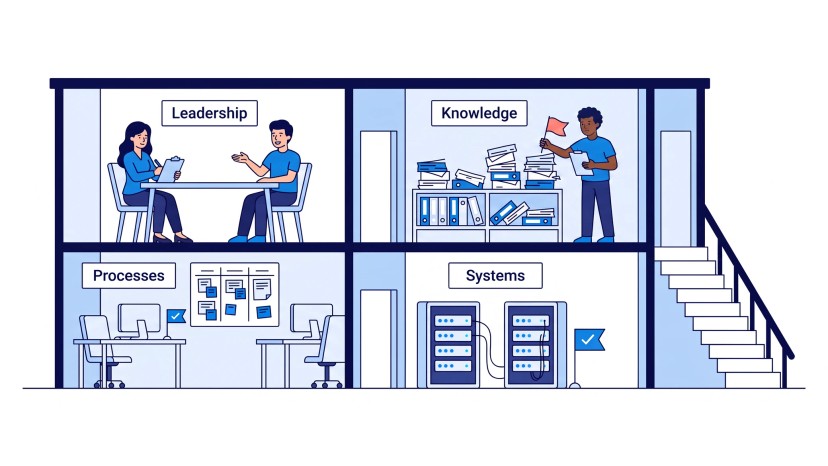
Within one process we build in a fixed order: the process, the knowledge, the connections to systems, then the skills, assistants and agents that use them. In our own company, different areas sit at different levels at the same time: some processes are defined and not yet built, some run with assistants, some with agents.
Short answers to buyers’ questions on process mapping, SOPs and the first workflow are in the FAQ on the AI Process Reengineering page.