What is an AI readiness assessment?
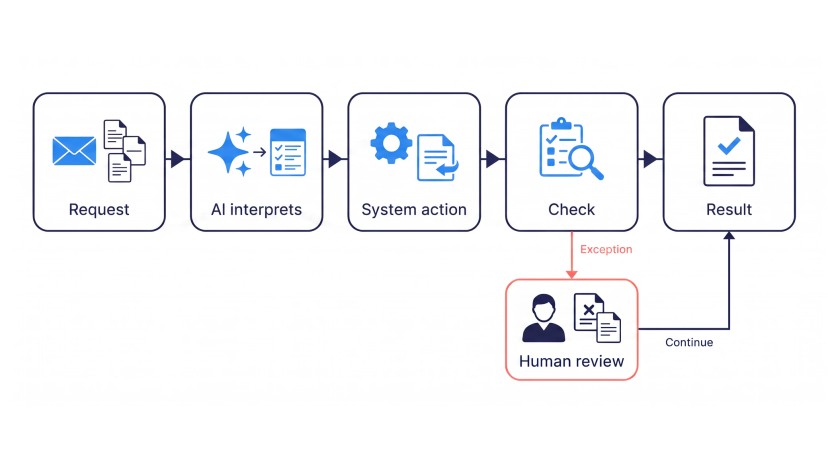
AI readiness is the condition that lets a business run AI inside its operations. An assessment finds out whether that condition exists and what is missing.
It comes in two forms. A short checklist is the quick first look: it places the organization on the adoption scale by area, shows the strengths and gaps of each area and names the next steps for that stage. The interview-led assessment deepens the picture. We talk to the people who run the business and write down what they describe: capabilities, functions, processes, knowledge, systems and the work still done by hand. The model shows who holds each function and where people carry work between systems, which no checklist can see.
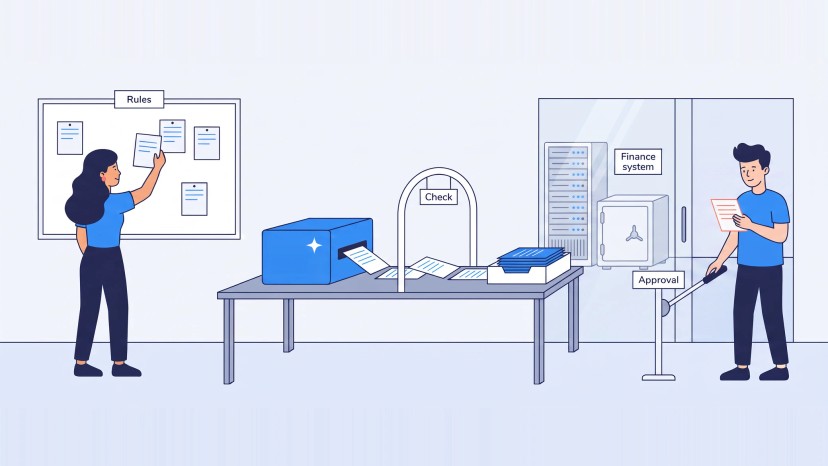
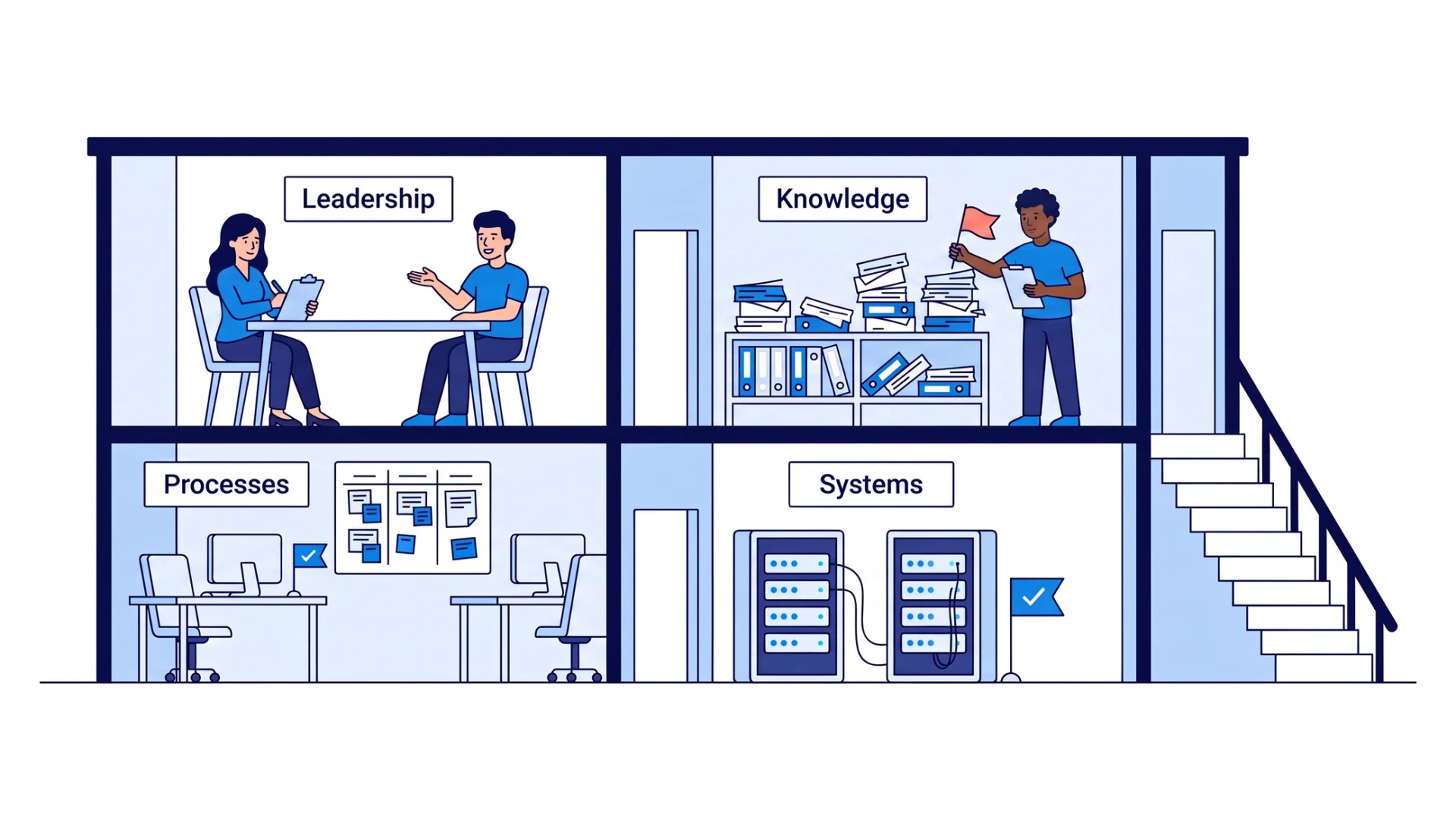
We check four things:
| Check | The question | Without it |
|---|---|---|
| Information | Is the information AI would use structured, current and findable? | AI has nothing reliable to read |
| Processes | Are the priority processes defined and repeatable, or do they vary by person? | Output is inconsistent |
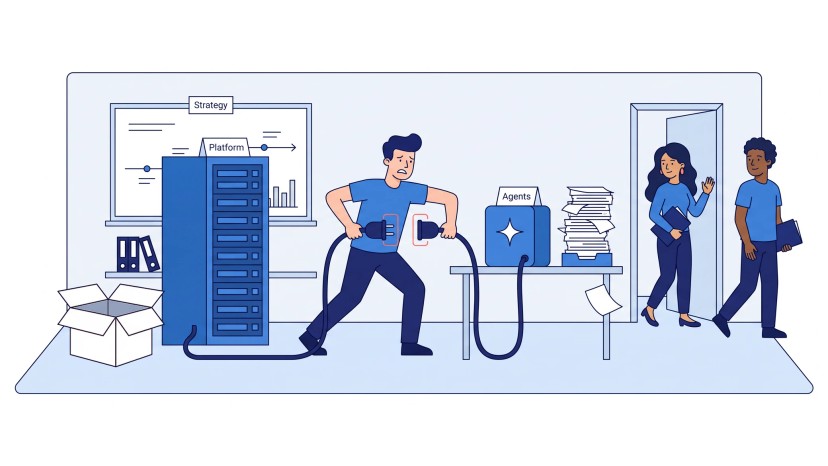
| Systems | Can AI reach the systems the work runs in? | AI cannot act where the work happens |
| Alignment | Does the organization agree on what AI should accomplish? | Initiatives drift into side projects |
On top of these we check quality criteria, ownership and controls. The interview also asks leaders for the limits the strategy must respect: risk tolerance (where automation stays limited), governance (security, privacy, compliance), change capacity (timing, resources, skills) and technology (legacy platforms, integrations).
The two gaps we find almost everywhere are knowledge that lives only in people’s heads or in stale documents, and processes that were not designed for AI. They surface later as rework in the middle of a build.
Who do you interview for an AI readiness assessment?
We interview the leaders who each hold a different part of the picture:
- The business sponsor: purpose, objectives and scope.
- The head of operations: structure, core processes and dependencies.
- The technology leader: systems, integrations and current AI use.
- The product and function leaders: what each area does and which tools support it.
- The architect: the system landscape.
- Process owners and domain specialists: workflows, roles, decisions and handoffs.
- The person who leads AI or automation: current initiatives and adoption limits.
The first question records how much weight the answers carry: whether the person recommends, validates, approves, funds, executes or governs decisions. We also ask what the person can vouch for firsthand.
The org chart is only a starting point. In one assessment the same function sat under two executives. Each interview ends by asking who else to talk to and which documents can check what was said.
What questions do you ask in an AI readiness assessment?
The order stays the same from one company to the next. The questions are open, and follow-ups go where answers lead.
- State the protocol. The interviewee hears how it works before it starts: many questions, short answers, follow-ups on anything skipped, a recording and transcript, and anonymity.
- Ask who the person is and what the company does.
- Ask what AI is used today. Informal use is easy to miss. Ask what people already use.
- Walk the value chain from an idea or an order to sale, shipment and support. Ask how quality is controlled and what extra tasks surround the chain.
- Sweep the functions. Name each one, such as accounting, premises, HR, IT, strategy and marketing, and ask who holds it. Finish with a catch-all: what else do you spend time on? In one interview that question surfaced a function nobody had mentioned.
- Ask for roles, structure and headcount.
- List the systems from the basics up: where documents live, then communication, accounting, stock and production tools.
- Ask the dream question. If means were unlimited and everything worked, what would you do with the business?
- Ask what the interviewee controls.
One rule holds throughout: keep the interviewee on the work and off the solution. When an owner jumps to tools, the interviewer steers back to what is done today. Automation is designed later, from the model. Before an answer becomes a finding, the interviewer says it back in the interviewee’s own words and asks for confirmation.
With leaders we also put the end state: how would this business run if AI carried its operations as fully as possible? It is a reference point for the path, and no headcount target comes with it.
Which interview questions reveal readiness best?
Four questions do most of the work.
Where is critical knowledge undocumented, inconsistent or tied to specific people? Three symptoms sit behind it. Tribal knowledge is information that individuals hold and nobody captured. Inconsistency is teams reading the same rules or processes differently. Dependency risk is a single point of failure: one person whose absence stops the work.
What keeps these gaps in place? We ask for failed attempts: earlier improvement, automation, documentation or system projects that did not solve the problem. We ask what would have to change first, and which constraint applies: funding, system limits, data quality, policy or resistance. A failed attempt shows what the next one has to prepare.
How does this work actually happen? Vague answers get a clarifying question. “Approval takes forever” becomes “which approval, and where does the delay occur?” “We sometimes bypass the system” leads to what triggers the bypass, who authorizes it and how the result is recorded. Bypasses are shadow processes, and automation has to surface them.
What would you change that is within your control? In our interviews with owners of small firms the answer has been a person to carry the work or a system of record. An AI use case has not come up once.
What is a business capability map?
A business capability is an enduring ability the business needs in order to produce its results. A capability map lists and groups those abilities. Our model starts there, because the map describes the stable “what” of the business.
The test is stability. A capability stays meaningful when the org chart changes, when a system or vendor is replaced, when work is outsourced and when AI is introduced. “Qualify inbound leads” remains a capability whether a person does it by hand, a CRM workflow runs it, an AI assistant handles it or an autonomous agent performs it.
A quick check: imagine removing the departments, roles, workflows, vendors, systems, platforms and AI. If the business would still need the ability, it is a capability.
Capabilities split into core and support. Core is decided by contribution to what the business fundamentally produces. Importance, dependence and ownership do not decide it. A vendor can run a core capability while an in-house team runs a support one.
Under each capability the model adds the functions, processes, roles, knowledge, systems and data, and last the gaps and automation opportunities. AI Process Reengineering writes the processes down. Extra columns turn the map into a readiness view: current and target maturity, process stability, knowledge maturity and data readiness.
We build the map around value, decisions, information and the flow of work. A map copied from the org chart fills with reporting and coordination.
What does an AI readiness assessment produce?
A readiness view of the business, written per priority area. For each area it records the answers to the four checks, the gaps found (knowledge, process, data, system access, alignment, controls), the constraints leadership set, where each function and process sits today on the automation scale, and what has to be prepared before AI can run there. It names where to start.
The assessment is not a strategy. It is the readiness part of the current-state analysis, and its findings are built broad and shallow first, then deepened area by area. The gap it finds becomes the first phase of work: the processes and knowledge of the first priority area are written down before anything is automated.
AI Organization Strategy takes the assessment further. The current state becomes an organization model, and the strategy adds two artifacts of its own: an AI-native blueprint (how the business should run with AI, which agentic systems do what, where people direct and supervise) and a phased roadmap (in what order to get there, sequenced by business value and technical feasibility, with decision gates). Behind them sits a chain of working documents, each built from the one before: strategy scope, operation model, business systems catalog, current-state automation model, manual gap analysis, blueprint and roadmap. The model also works as a filing structure: an ad hoc automation with a known place in it can later be connected or rebuilt without breaking anything.
How does the strategy score AI use cases and build the roadmap?
This is strategy work that follows the assessment. At strategy level we do not compute ROI for each use case. The calculation takes heavy work and still rests on estimates. Each agentic system in the blueprint gets two scores instead:
- Business score: how important the system is, how much work it carries, how much is spent on it and how many problems and errors occur there.
- Technical score: how large, difficult and complex the system is, and how feasible it is with today’s AI.
The next milestone is the one that scores well on both. The automation boundary weighs operational value, repetition, decision structure, knowledge, data quality, system access, control requirements, exception complexity and risk. Each use case lands in one of three places: do now, prepare next, or wait until business need and technical feasibility align.
The roadmap sets principles first and then steps. Each step names which agentic systems reach which autonomy stage, and each step pays for the next one. The pace follows what the client can actually build.
The first phase formalizes the processes and knowledge of the first priority area, and people can use that preparation at once. Assistants, skills, connectors and agents follow, each phase behind a readiness gate.
What does a company that is not ready for AI look like?
In our interviews with owners of small manufacturing firms, the same facts come up:
- Processes exist “on fingers.” The work is handed over by example. In one assessment of a workshop nothing was documented, and training meant showing a task once.
- The archive is a chat. Client files sit in folders on one computer, and a messenger history with a freelancer is the record of past work.
- The tooling stock is in the owner’s head. Nothing records consumables, and a missing tool stops a job.
- The owner is the hub. Marketing, intake, measuring, design, quotes, contracts, invoices and supplier orders run through one person.
- Rules are tacit. A quote that depends on how full the order book is lives in the owner’s judgment.
Companies with active pilots show different signs: wildly inconsistent results, and a project that relies on one enthusiastic person.
AI use already exists in these firms, personal and informal. Some owners have no plan to grow and little capital to invest, and the assessment then starts from the owner’s own goals.
What should be fixed before the first automation?
First a base, then the productivity gain. We say it to leaders in those words. Measurable productivity needs a chain of standards:
- A standard process: which tasks happen, and in what order.
- A reference architecture: components of defined types and a standard way to develop them.
- Standard work products: the same output looks the same each time.
- A time baseline: repeatable tasks carry a norm time, and people note which tasks they worked on.
Without them there is nothing to measure an AI gain against. In one assessment of an engineering organization, time was tracked only for cost allocation and not per task. We take the baseline before automation and measure again at defined control points as the automation level rises. It covers what is done and by whom, and also the time taken, the errors and the iterations.
The usual things that stop a process from being ready are unstable processes, knowledge without enough structure, missing decision rules, poor-quality data, weak integrations, no access to a system and inadequate controls.
Manual work is not a gap by itself. A gap needs evidence, and automation is one treatment among several. Process redesign, better knowledge, data repair, a governance change or training may fit better.
The gap that is found becomes the first roadmap work. The process is written down, run by hand with AI support and confirmed to give a consistent result before anything is automated. Knowledge held only by people moves into an AI knowledge base.
AI maturity model or AI readiness assessment: what is the difference?
A maturity model is a ladder of stages that asks where the company stands. A readiness assessment asks what has to be true before this work can run on AI, and what comes first.
One maturity level hides most of what matters. Different areas of one business sit at different levels at the same time. In our own company some processes are defined and not yet built, some run with assistants and some run with agents. One score for the company describes none of them.
A ladder still works as a map. Our staged view of adoption runs from manual operations to a lights-off operation, and most companies sit between manual operations and generic assistance. The assessment places each function and process on the scale the roadmap uses: Assisted, Collaborative, Supervised and Autonomous. The target state sets the next stage. A score alone starts no work.
How EIC runs an AI readiness assessment
AI Organization Strategy is where the assessment lives, and it is our entry point. We analyze the current state, define the target state and build the phased roadmap. We work backward: first we describe the business as it runs when its operations execute through AI as fully as they can, then we map today and build the path between the two. The assessment is the first step of that work; a full strategy engagement delivers the organization model, the AI-native blueprint and the phased implementation roadmap.
If you are comparing AI strategy consulting or AI readiness assessment services, ask what the assessment is built from. A checklist gives a placement and the next steps, and that is a good first look. Interviews with the people who run the work give a model you can plan from, and the model is what the roadmap, the blueprint and every later automation are built on.
The assessment starts with a free call. We take one priority area of your company through the four checks above and name what to prepare first. The call costs nothing and commits you to nothing. Book it below.
Two of our articles go deeper. The four building blocks of AI readiness sit behind the assessment, and the five stages of AI adoption describe our staged view.
Short answers on what an AI strategy is, what a consultant does and how use cases are prioritized are in the FAQ on the AI Organization Strategy page.