
What is retrieval-augmented generation (RAG)?
RAG stands for retrieval-augmented generation. When a request arrives, the system retrieves relevant content from your sources and adds it to the instruction it sends to the model. The model writes its answer from that content. RAG does not replace the language model. It feeds the model, which otherwise answers from whatever it absorbed in training.
The method was named in the 2020 paper “Retrieval-Augmented Generation for Knowledge-Intensive NLP Tasks” by Lewis and colleagues (NeurIPS 2020). It joined two kinds of memory: the knowledge stored inside a language model and a separate index of documents that a retriever searches at question time. The authors named two open problems of models used alone: showing where an answer came from and updating what the model knows.
A business has a third reason. A general model was trained on the internet. It holds no detail on your products, your rules, your customers or the way your teams decide. What it says about your domain is unverified, and it fills gaps with assumptions. RAG points the model at your own sources, which makes answers specific to the business and traceable to a file.
How does a RAG pipeline work?
A RAG pipeline has one part prepared in advance and one part that runs on every question.
Before any question arrives:
- Collect the sources the answers may come from: documents, database records, tickets, pages.
- Split them into passages small enough to retrieve one at a time.
- Index the passages so they can be searched by meaning, usually by turning each into a vector of numbers stored in a vector index, also called a vector database.
On every question:
- Retrieve. The system finds the passages closest in meaning to the question.
- Augment. It adds those passages to the instruction it sends to the model.
- Generate. The model writes an answer from the passages, ideally with a reference to each.
Retrieve, augment and generate are the three words in the name. Everything else is engineering around them: how passages are split, how results are ranked, how much text fits into one request and how references are shown.
Standard retrieval ranks passages by similarity to the question. Similarity says nothing about which passage is current, which team’s version is authoritative or whether two passages contradict each other. Those decisions live in the knowledge, and they have to be made before the pipeline runs. We map, restructure and fill the sources as part of that work. People and retrieval then find what they need.
RAG or fine-tuning: which one do you need?
The answer is both, decided per type of knowledge.
| Type of knowledge | Example | How it reaches the model |
|---|---|---|
| Dynamic: changes day to day | Current policies, open requests, this week’s rules | Retrieval (RAG) |
| Static: changes rarely | Standards, definitions, templates, naming rules | Knowledge files in a project or workspace, or a fine-tuned model |
Fast-changing knowledge makes no sense inside a model, because the model would need retraining each time the rule changes. Retrieval pulls the current version when it is asked. For static knowledge, knowledge files or fine-tuning are the usual routes. Retrieved text competes for space in the model’s input window, which makes RAG the weaker route for knowledge that never moves.
Fine-tuning also has an economic side. Large general models are charged by the amount of text they process, and the bill rises with use. For a domain a team queries constantly, a smaller fine-tuned model that carries the static knowledge, run on the company’s own servers, can cost less. A well-worked process does not need the most powerful model, and the rule we follow is to match the model to the task.
How is RAG different from enterprise search?
Enterprise search, like a classic knowledge management system, returns documents for a person to read and interpret. RAG removes the reading step: the model reads the passages and writes the reply. A person who gets ten search hits can tell that one of them is an old draft. A model that gets the same ten passages may treat them as equals.
Connecting every wiki, mailbox and ticket system to an AI tool solves access, and access is a precondition. Access to stale and conflicting material produces confident answers from the wrong version.
An AI knowledge base adds what search and a bare RAG setup both lack: a model of what AI needs to know, a map of where it lives, the gaps filled, and owners with review and update rules. The difference is the one between records and knowledge. Data records information. Knowledge supplies the meaning, the rules and the context that decide what to do with it. A search index holds the first, and answers need the second.
RAG is one way the knowledge reaches the model. It sits inside the knowledge base and does not replace it. For the wider picture of what a company knows only in people’s heads, see tribal knowledge.
How is RAG different from MCP and skills?
RAG answers one question: what does the business know? The Model Context Protocol (MCP) answers a different one: how does the AI reach the systems where the work happens? An MCP server is an interface that exposes a system’s data and actions to an AI. A connector of that kind can feed retrieval, and it can also act: read a record, update it, complete a transaction.
Skills answer a third question: how is the work done? They carry the instructions, the steps and the expected output.
An automated process needs all three. Each gets sold as the complete answer, and the result is a knowledge base that cannot act or a connector with no process behind it. We build them in a fixed order: process first, then knowledge, then connectors, and only then the skills, assistants and agents that use all three. The interface side is covered in What Is an MCP Server?.
Why do RAG answers go wrong?
Most wrong answers trace to the knowledge, not the model. Five patterns recur:
- The knowledge was never written down. It lives in people’s heads, and retrieval cannot find what does not exist.
- The material is stale. Nobody maintains it, and the old rule comes back with full confidence.
- The sources conflict. Two teams hold two versions. Similarity ranking has no opinion on which one is authoritative, and the model may blend them.
- The structure hides the content. Folder trees and file names make it hard to tell where anything is and who is responsible for it.
- Nobody is sure what the process needs. Without that, nobody can say what is missing.
When part of the context is missing, the model fills the gap. Today it generates one thing, tomorrow something different or even the opposite, in the same situation. That is a hallucination, and more documents do not remove it.
Retrieval can fall short on its own side too. A 2023 study by Liu and colleagues (TACL 2023) varied where the relevant passage sat inside a long input. Models did best when it sat at the start or the end, and performance dropped when it sat in the middle, including for models built for long inputs. Longer input windows change how much text a model can take. They do not tell it which source is current.
Our yardstick is consistency and repeatability. The same question in the same situation should give the same answer. It is reached by restructuring the knowledge, filling the gaps and assigning owners, and better search alone does not get there.
What knowledge does a RAG system need?
Enterprise RAG needs four things that no pipeline supplies.
- A knowledge model. It records which domains and areas the business knows, which containers hold each piece, how pieces depend on each other and which process uses or creates them. We build it from the process definition and the domain model before anyone touches the files.
- A rule of authority. When two documents disagree, the system must not average them. It surfaces the conflict, and a named person decides. In our current agent briefs, approved material outranks drafts, examples and copies, and a source that cannot be opened is never treated as proof that the information does not exist.
- Metadata that says what can be trusted. Source, owner, version, status and the period a rule is valid are attached to each piece. The system can then tell the current rule from an old one. Freshness is judged from content, because a date on a file proves little.
- Owners and a review cycle. A named owner for each area, with review events and update rules. Unmaintained knowledge decays quickly, and every assistant built on it decays with it.
Where the knowledge does not exist yet, we recover it through structured interviews and reverse engineering of systems and code. The tribal knowledge guide describes how.
How do you evaluate a RAG system?
Test retrieval and generation separately, then together. A wrong answer can come from the wrong passage or from a model that ignored the right one, and the fixes differ. The 2023 Ragas paper (Es and colleagues) names three aspects: the retriever finds relevant and focused passages, the model uses them faithfully, and the generated answer is good in itself.
For a business the test set matters more than the metric. It holds real questions with their approved answers, difficult cases, negative cases and conflicting-source cases. A negative case is an input where the right outcome is a refusal or a flag, for example a question the sources cannot answer, where the right output is “not found”. In our current agent briefs the same set also lists the expected human gates.
Score each answer on a five-point scale tied to how much editing it needs, from perfect to unusable. The quality score is the share of answers that reach the score the use requires. Compare it with the quality bar of the autonomy stage the work is meant to run at.
| Stage | Who checks | Minimum quality bar |
|---|---|---|
| Assisted | A person checks every output | 50-60% |
| Collaborative | A person reviews each result before it is used | 70-80% |
| Supervised | A person watches the results and handles exceptions | 85-95% |
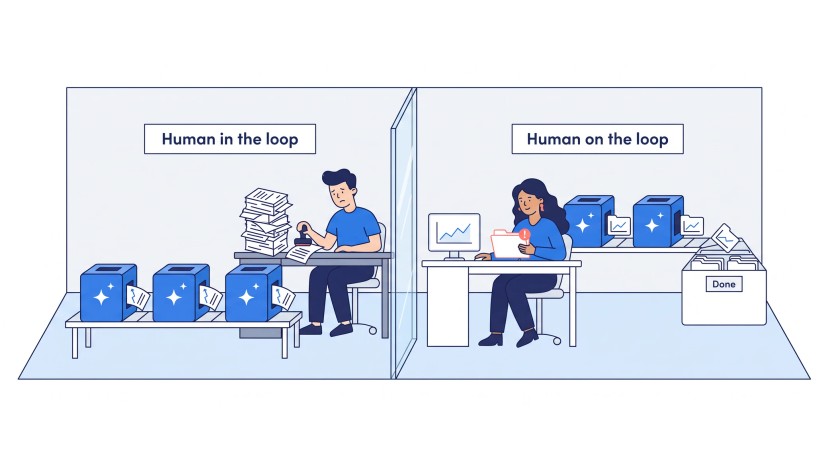
| Autonomous | Verification agents check every result, and people oversee | 99-100% |
An assistant answering a colleague’s question, with the colleague reading the reply, can run at an early stage. A retrieved answer that feeds an agent’s decision needs a higher bar, because nobody is there to catch a near miss. Problems that escape into production go back into the tests, and the share of problems found before production is the measure of the checks themselves.
When do you need a knowledge graph?
A knowledge graph stores business entities and the relationships between them explicitly. With one, AI can follow connections instead of relying on text similarity alone.
It earns its place when answers depend on combinations. Which rule applies to which product for which customer type is a typical case. Similarity search returns documents about each part and has no model of how the parts relate. A vector index finds passages that read alike, and a graph stores how things relate. The relationship becomes a stored fact.
The cost is real. Schema design, entity extraction and relationship validation need upfront work, and teams that treat a graph as a configuration task get fragile graphs that break as the business changes. We plan a graph as knowledge engineering work and build one where the structure of the business requires it. For many businesses, a well-organized knowledge base with clear relationships and owners is enough. A graph is one way to deliver the structure of the knowledge model, and the model has to exist first.
How EIC builds an AI knowledge base with RAG
AI Knowledge Base is where we build enterprise RAG, as one part of a governed knowledge foundation. We start from what AI has to know to do the work, and not from loading every document we can find into a retrieval tool. There are three steps:
- Build the knowledge model. Define what the target workflows need to know, organized into domains, areas, assets and entities, with their rules and relationships.
- Map, restructure and fill the sources. Connect the existing evidence, resolve conflicts, find the gaps and capture missing expertise through structured interviews or reverse engineering.
- Deliver, validate and govern. Choose how each type of knowledge reaches AI, from RAG implementation to knowledge files and fine-tuning. Test how AI uses it in its output, assign owners and set the update and review rules.
Knowledge engineering, the work on the knowledge itself, covers the structure, the inventory of what exists and what is missing, the extraction of the gap and the restructuring for owners and for AI. It stops before the AI side. An AI knowledge base adds that side: model choice and tuning, retrieval pipelines, the connection to AI, control of model cost and drift, permissions and guardrails on the knowledge.
Your organization owns the knowledge after delivery, with a named owner for each area. If you prefer, we keep maintaining it under an ongoing support arrangement.
To start, bring one priority workflow. We find what knowledge it depends on, where that knowledge lives, what is missing and how it should be governed before AI relies on it. When the process itself is unclear, AI Process Reengineering comes first. Short answers to common buyer questions are in the FAQ on the AI Knowledge Base page.