

What are AI hallucinations?
An AI hallucination is a confident output that is wrong. The model states an invented fact, a wrong value, a reference that does not exist or a step the process does not have, in the same fluent tone it uses for correct answers.
The US National Institute of Standards and Technology (NIST) calls the same thing confabulation in its 2024 profile for generative AI: the production of “confidently stated but erroneous or false content”, known colloquially as hallucinations or fabrications. NIST adds that a model can also produce the logic or the citations that appear to justify an answer, and that can mislead people into trusting it.
Two features set a hallucination apart from an ordinary mistake. The output sounds certain, and nothing in it marks the invented part. And because generation is probabilistic, the invention can change from one run to the next. The same question can get one answer today and a different, even opposite, answer tomorrow.
Why do AI models hallucinate?
Two forces produce hallucinations, and only one of them sits inside the model.
The model. A language model learns by predicting the next word across huge amounts of text. NIST describes the result in plain terms: outputs approximate the statistical distribution of the training data, and that can give accurate answers or inaccurate and inconsistent ones. A 2025 paper by Kalai and colleagues, explained in an OpenAI post, goes further. Pretraining shows the model only examples of fluent language, with no labels for true and false. Patterns such as spelling are learned well. Arbitrary, rare facts cannot be predicted from patterns, and the model produces a plausible answer instead.
Evaluation adds a second push. Most tests score accuracy alone. A guess can earn a point, and an admission of uncertainty earns nothing. Models trained and ranked this way learn to guess. The authors propose scoring confident errors worse than uncertainty and giving partial credit for abstaining.
The process. A general model was trained on the internet. It holds no detail on your company, and its knowledge of a niche field with little coverage online is contradictory and vague. When part of the context a process depends on is missing, the model fills the gap. Today it generates one thing, tomorrow another.
The first force is outside your control. The second is yours, and it is why hallucinations in business processes are controlled at the level of the process and not by waiting for a better model.
What are examples of AI hallucinations?
Four kinds recur in business processes. The cases below are illustrations written for this guide.
| Kind | Illustration | What it does in an automated process |
|---|---|---|
| Invented fact | A summary of a supplier agreement quotes a termination clause the agreement does not contain | A decision rests on a clause nobody wrote |
| Wrong value | A report prints a total that matches no combination of its rows | The wrong amount is booked or passed on |
| Made-up reference | A research note cites a report with a plausible title that does not exist | A false source makes the claim look checked |
| Invented step | A draft procedure includes an approval that the process does not have | People or agents follow a rule nobody set |
Each of these looks like its correct neighbors: the same format and the same tone. The made-up reference and the invented step are the quietest. They carry the signs of care, a source or a rule, and that lends the wrong answer authority.
Why do hallucinations matter more in automated processes?
In a chat, a person reads the answer and decides what to do with it. In an automated process the output feeds the next step, and a hallucination inside an automated process is an action and not a draft. Exposure grows with authority. An AI that writes drafts can be wrong cheaply, and an AI that takes actions in your systems cannot.
Errors also compound. If each elementary operation is right with probability p, a task of n operations is right on the first attempt with probability p to the power of n. At 95% per step, a ten-step task comes out right on the first try 60% of the time. The more steps AI carries alone, the higher the quality each step needs.
NIST names a human side of the problem as well. People may over-rely on AI output and judge it better than it is, a pattern called automation bias, and that can worsen the risk of confabulation.
That is why each autonomy stage has its own minimum quality bar, the share of results AI must get right for the stage to save time compared with doing the work by hand.
| Stage | Who checks | Minimum quality bar |
|---|---|---|
| Assisted | A person checks every output | 50-60% |
| Collaborative | A person reviews each result before it is used | 70-80% |
| Supervised | A person watches the results and handles exceptions | 85-95% |
| Autonomous | Verification agents check every result, and people oversee | 99-100% |
At the top stage nobody is there to catch a near miss. The checking has to be built in.
How do you reduce AI hallucinations?
Reduction works on four levers.
- Complete and current knowledge. Missing context is the specific cause in business processes. The knowledge a process needs is made complete, current and owned, and that is the work of an AI knowledge base.
- Grounding in approved sources. The model answers from retrieved or supplied passages and can point to them. Retrieval-augmented generation is one way to do it. A model provider’s own guidance agrees: the documentation of one provider (Anthropic) recommends restricting the model to the provided documents, extracting word-for-word quotes first for long documents and asking for a supporting quote for each claim, with any unsupported claim retracted.
- Instructions with explicit patterns and room to say “not found”. Instructions carry explicit patterns and do not leave the AI to improvise. The same documentation recommends giving the model permission to say that it does not know, which fits the training incentive described above. In the skill briefs we are writing, a missing role means a question and not a plausible guess, and a name or technical term is checked against approved sources.
- One objective per step, with structured output between steps. A long prompt with many requirements drops one silently. A chain works when each step has one objective, its result is validated before the next step starts and the output at each handoff has a fixed structure.
Grounding lowers the rate and does not remove it. Retrieval of a stale or conflicting source gives a grounded wrong answer, which is why the knowledge comes first. The provider’s documentation says the same of its own techniques: they reduce hallucinations significantly and do not eliminate them entirely.
How do you catch a hallucination before it acts?
Reduction lowers the rate. Catching stops what remains from reaching a customer. In AI Validation & Control we build the checks into execution, in the time the AI already takes.
- Validation gates. Explicit acceptance criteria and thresholds, with representative good and bad examples where they help. Each gate is tested against known correct and incorrect cases and its performance is measured before it governs live work. For hallucinations the criteria are concrete: every claim traceable to a supplied passage, every reference found in the approved sources.
- Deterministic checks. Where the rule is explicit, code applies it. A total is recomputed and a reference is looked up. A model’s own statement of completion is no evidence of completion.
- A verification agent. For work that runs without a person, a second agent checks every result against the written quality criteria. Producing and checking are separate jobs. The verification agent produces signals, and it is only as good as the standards written behind it.
- Action controls. Pre-conditions must hold before a sensitive action runs. Post-conditions verify the result. Stop conditions end attempts that cannot succeed.
- Cheap checks first. Fast, important checks run early and expensive ones last, as in software testing.
- Correction and escalation. A result that misses a known criterion goes back into a correction or retry loop with the review report attached. What remains uncertain, touches a sensitive action or carries real consequence reaches a person, with the information needed to decide.
An AI review does not replace an accountable human approval where one is required.
How do you measure the hallucination rate and AI accuracy?
Measure against written criteria and not against impressions. The method has four steps:
- Define what an ideal result looks like, with “no unsupported claim” as one of the criteria.
- Score each output on a five-point scale tied to how much editing it needs, from 5 (excellent, used as is) down to 1 (fail, nothing to salvage).
- Set the threshold by what the output is used for. Where no person will review it, only perfect results pass.
- Track the share of outputs that pass. This is the quality score, and it is compared with the quality bar for the intended stage.
Accuracy alone hides the error rate. OpenAI’s 2025 comparison on a factual-question test shows it. One model declined to answer on 52% of the questions and was wrong on 26%. An older model declined on 1% and was wrong on 75%, yet its accuracy was slightly higher, 24% against 22%. Track three numbers separately: right, wrong and not found. An answer of “not found” when the sources do not support one is correct behavior.
Test with positive, negative and error cases. A negative case is an input where the right outcome is a refusal or a flag, such as a question the sources cannot answer. After launch, keep measuring. An agent can pass every test in staging and degrade quietly in production when inputs shift, the context changes or upstream data drifts. It still runs, its outputs get less accurate, and nobody notices until a process downstream is affected. Problems that escape go back into the tests, and the share found before production measures the checks themselves.
Human in the loop or on the loop: where do people stay?
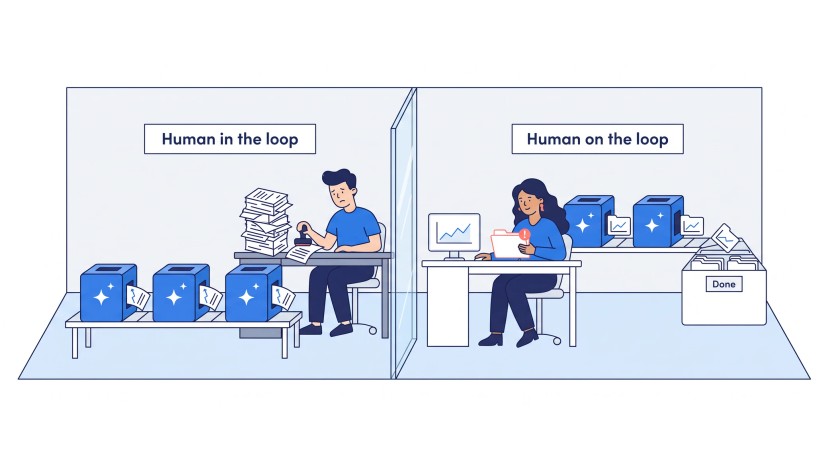
Hallucination control decides where people stay, and the answer changes with the stage. At the Assisted stage a person checks every output. At the Collaborative stage a person reviews each result before it is used, which is human in the loop. At the Supervised stage a person watches the results and handles exceptions, which is human on the loop. At the Autonomous stage verification agents check every result, and people oversee performance, policies and exceptions. The guide to human on the loop covers the design in detail.
Two rules hold at every stage. Actions with real consequences, such as moving money or changing a customer’s terms, keep a named person’s approval. And when results fall below the quality bar, for example after a change in the business, the data or the model, the work steps back to an earlier stage until the tests pass again.
The economics follow from this. Review in the loop grows with the volume of AI execution and eats the savings. Moving routine work on the loop restores them, while consequential actions keep a named approver in the loop by design.
How EIC builds validation and control into AI execution
AI Validation & Control builds validation gates, action controls, correction and escalation into execution. Routine work then runs with less manual supervision. More autonomy should come from stronger control and not from fewer reviewers, because removing reviewers without making execution more reliable only means the organization has accepted more uncertainty. We work in three steps:
- Set the business quality bar. Define what an acceptable result looks like, which actions need protection and where human authority must stay. Set explicit criteria, thresholds and operating rules, with representative cases where they help.
- Build and test the controls. Build the validation gates, action controls and execution checks. Test them against known correct, incorrect and edge cases until they reach the required performance.
- Automate correction and escalation. Define what happens when a check fails. Routine problems are corrected or retried automatically, and uncertain, sensitive or consequential cases go to a person who can decide.
AI earns a wider scope only when its outputs keep meeting the requirements. The controls leave your compliance owners with evidence that AI is governed in practice. We do not certify against frameworks such as the NIST AI RMF, and we give no legal or compliance advice. The wider set of rules and responsibilities is described in What Is AI Governance?.
If AI does not yet do the work, AI Agentic Execution comes first. To start, show us where people still inspect AI outputs, approve routine actions or fix repeatable failures. We find where validation and control can move routine oversight into the system, while human judgment and authority stay where they matter. Short answers to common buyer questions are in the FAQ on the AI Validation & Control page.