In my previous post, The AI Agency Roadmap, I introduced the high-level idea of building an AI-powered business operation that can eventually run with minimal human intervention. That post laid the strategic foundation. But if you’re leading automation initiatives today — whether as a CTO, product owner, or operations manager — you might be wondering: How does this actually work in practice? This post breaks it down.
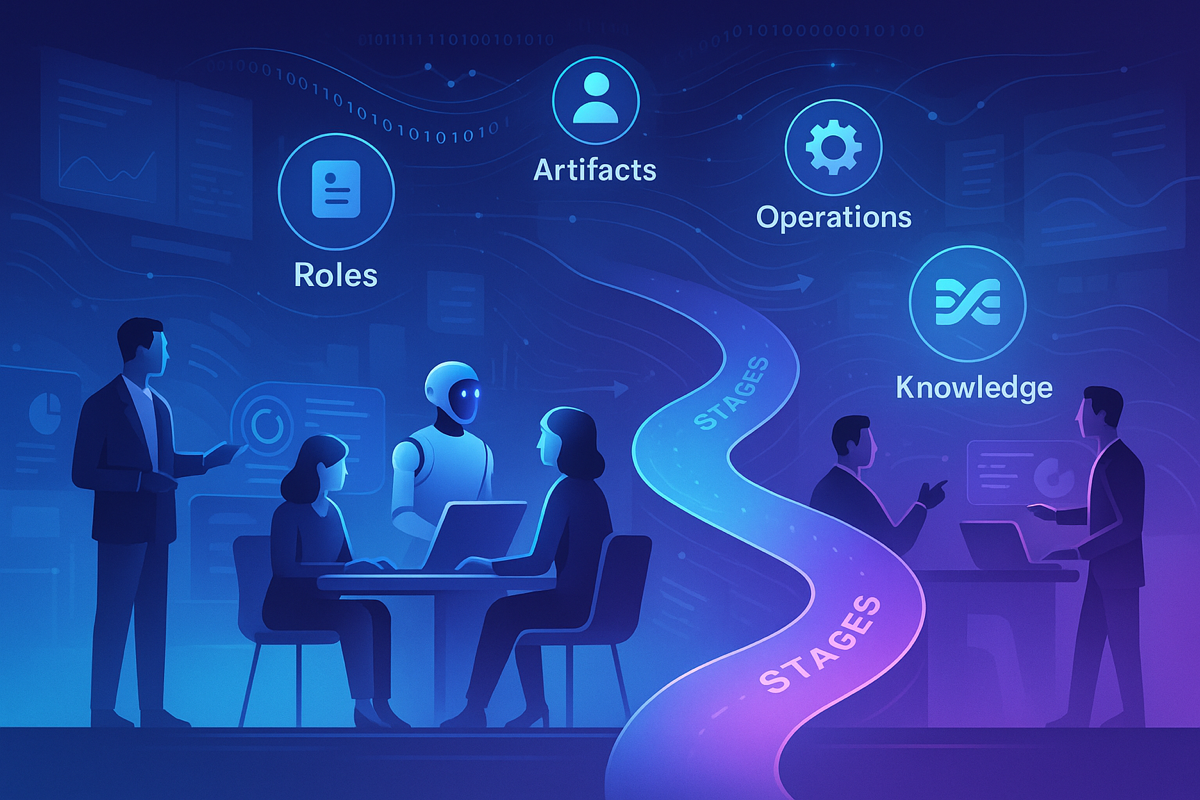
Let’s walk through a practical framework that shows how five simple ideas — Roles, Artifacts, Operations, Flows, and Knowledge — evolve across the stages of automation. This isn’t just theory. It’s a model you can use to map where you are, where you’re headed, and what you need to scale AI in a structured, intelligent way.
5 Keys to Understanding Workflow Evolution
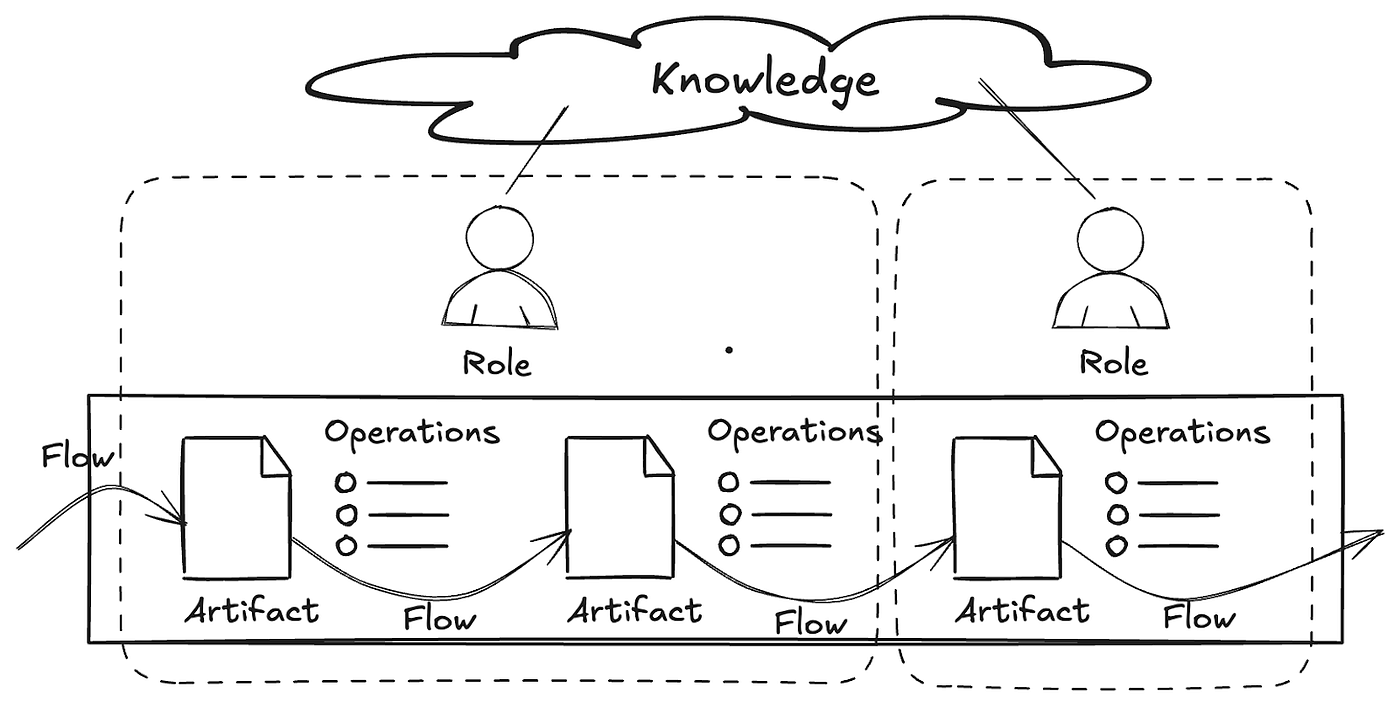
Before diving into the stages, let’s define our core building blocks:
- Roles — Define an area of responsibility over artifacts and operations. A role can be fulfilled by a person, a group, or AI agent(s).
- Artifacts — An internal or external document, an email or a message, a piece of code or another tangible result of work. Artifacts can be generated manually or with AI.
- Operations — A set of steps to create an artifact. When done with AI, operations are represented in the form of instructions (prompts).
- Flows — Logical sequences or flows of information where an artifact is generated using other artifacts as input. When AI generates the artifact, these inputs are provided as context. Clearly defined flows greatly simplify artifact creation, since roles don’t need to generate context from scratch. They also make the resulting artifacts more consistent and integrated.
- Knowledge — Knowledge about practices, standards, guidelines, and other forms of institutional understanding that guide artifact creation. This knowledge can be carried by humans and communicated to AI through instructions or context, or it can be embedded in the AI model itself.
Think of these as the DNA of any workflow — human or machine. As AI takes over more responsibility, each of these evolves. Let’s see how.
Stage 0 — The Human-Only Zone (Manual Operations)

This is the starting point for most organizations. All work is performed manually by humans. There may be some formal processes or tools, but AI is not involved at all. Everything depends on human time, effort, and decision-making.
- Roles: Broad, flexible, and fully human. Responsibilities are often shared across people or unclear.
- Artifacts: Created manually with variable formats and quality. May exist in many versions or templates.
- Operations: Performed through intuition, habit, SOPs, or personal expertise. No automation.
- Flows: Disconnected or poorly defined. Rely on email, meetings, or direct communication.
- Knowledge: Held entirely in people’s minds or scattered across documents. Transmitted through training or informal communication.
To move beyond Stage 0, teams must begin exploring AI tools within isolated use cases. This requires creating space for experimentation and documenting outcomes to build awareness. The goal is not transformation yet — just exposure.
Stage 1 — Dabbling in AI (Initial Adoption)
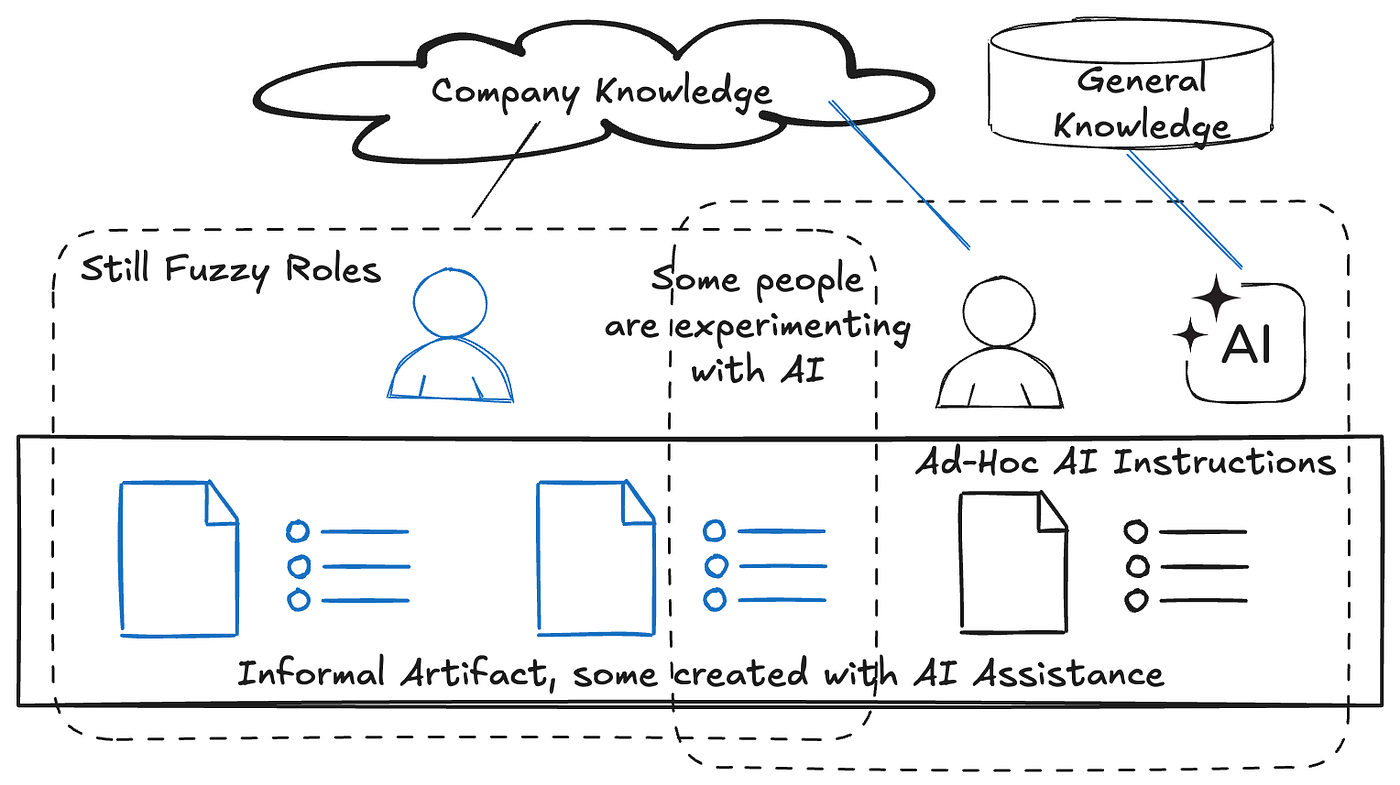
At this stage, teams begin experimenting with AI tools in isolated ways. Maybe someone is using ChatGPT to draft emails, or a designer is playing with AI image generation. These efforts are uncoordinated, and AI has not yet been integrated into any core processes. Most of the work is still manual, and AI is used in an ad hoc manner.
- Roles: Still broad and fuzzy. Little separation of responsibilities.
- Artifacts: Some are created using AI, but formats and quality are inconsistent.
- Operations: Prompting is ad hoc. Results depend on individual skill and experimentation.
- Flows: Informal. AI is used as a one-off tool rather than part of a process.
- Knowledge: Not codified. Each person learns through trial and error. Shared best practices are rare or nonexistent.
To reach Stage 2, you must consolidate learning into repeatable methods — prompt libraries, shared templates, and workflows. The focus shifts from isolated play to structured patterns that can be applied across the team.
Stage 2 — Getting Organized with AI Help (Generic Assistance)

Now AI starts to play a defined role in the workflow. Prompts are reused. Tools are chosen intentionally. Teams begin standardizing how they use AI, and results become more predictable. This is often where “prompt libraries” or “AI playbooks” start to emerge. Humans still drive the process, delegate some tasks to AI assistants, and reintegrate the outputs into the workflow.
- Roles: Specialized and clarified. Specific individuals own parts of the workflow.
- Artifacts: Standard formats are adopted to ensure quality and consistency.
- Operations: Prompts and steps are documented. AI usage becomes structured and repeatable.
- Flows: Clear paths emerge where AI fits into the workflow. Prior artifacts are used as context.
- Knowledge: Starts to be centralized — often in shared docs or team wikis. Human knowledge is translated into instructions and workflows.
Progressing to Stage 3 means enriching your AI tools with organization-specific knowledge and integrating them more deeply into tools and platforms. You need to shift from general-purpose prompting to contextual automation.
Stage 3 — Smarter Tools, Better Results (Tailored Knowledge)

At this stage, the AI itself gets smarter. Models are augmented with organization-specific knowledge. Tools are integrated to provide richer, contextual inputs automatically. Humans are still responsible for driving the process, but AI models and assistants are more aware of organizational standards and capable of taking on more complex tasks.
- Roles: Shift from doing the work to designing the systems and curating the knowledge.
- Artifacts: Higher quality, more domain-specific, and more aligned with internal standards.
- Operations: Prompts are shorter and smarter. Instructions are partially embedded in tools and context.
- Flows: Connected and automated. Context from one artifact is passed to another without human intervention.
- Knowledge: Becomes part of the system — via fine-tuned models, RAG pipelines, or embedded documentation. Human oversight continues but is more strategic.
To unlock Stage 4, start orchestrating workflows using agents or automation tools. This involves designing AI agents to act on behalf of human roles and giving them access to the systems and data they need to execute tasks autonomously.
Stage 4 — Let the Agents Work (Agentic Execution)

This is the tipping point. AI agents can perform complete workflows with minimal human input. Tools and APIs trigger actions based on workflows or events. Roles are now taken over by AI agents, who drive the process from end to end. People supervise and direct the agents.
- Roles: Taken over by AI agents. Humans oversee and provide strategic direction.
- Artifacts: Generated quickly and consistently. Integrated into end-to-end business processes.
- Operations: Automated through agents. Executed based on events or system triggers.
- Flows: Orchestrated and interlinked. Agents communicate through shared context.
- Knowledge: Actively used by agents to make decisions and adjust execution. Maintained as part of the system’s ongoing learning.
To move into Stage 5, you must build multi-agent systems that can self-monitor, apply quality assurance, and dynamically refine their workflows. This shift demands robust governance and confidence in your system’s reliability at scale.
Stage 5 — Humans Step Back (Light-Off AI Agency)
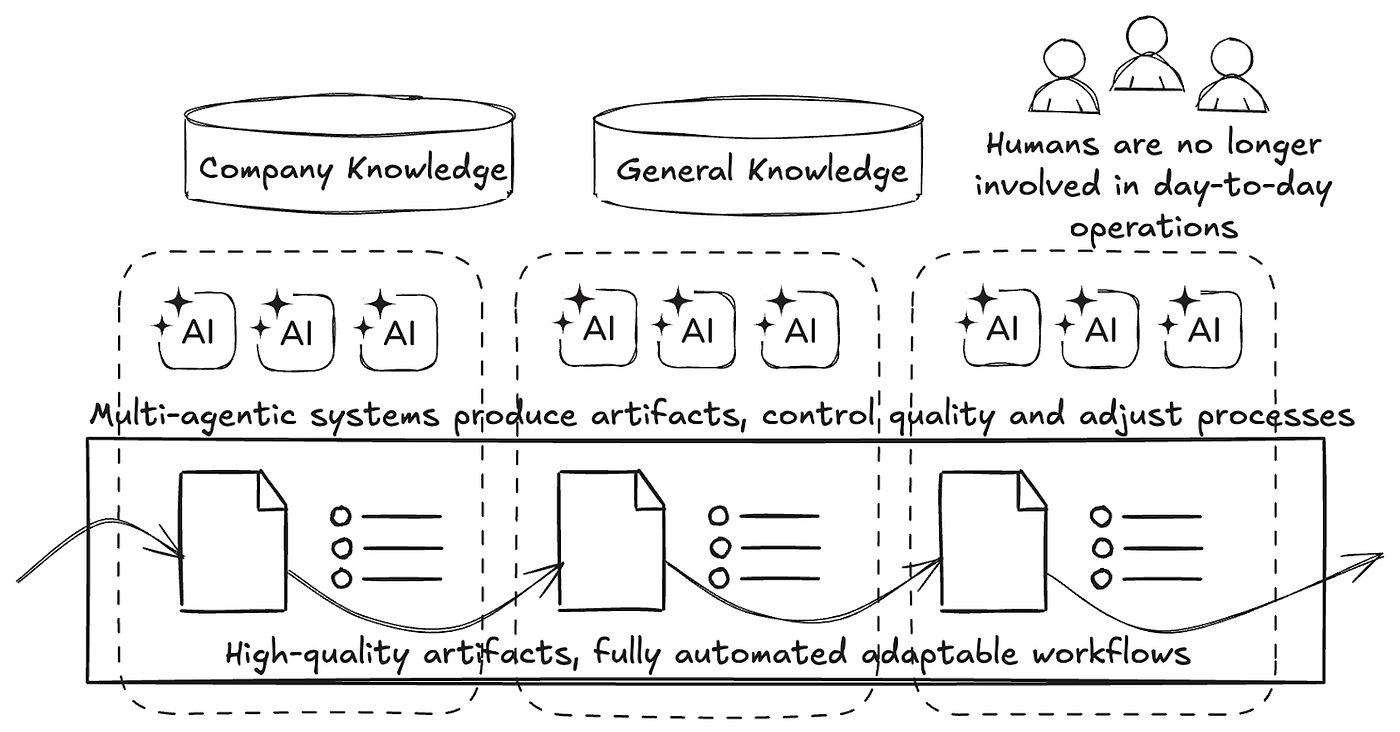
In the final stage, the system becomes adaptive and self-correcting. Roles are performed by Multi-Agent Systems, where multiple AI agents collaborate to manage execution. In addition to “producer agents,” additional agents are added to create layers of quality control (QC) and quality assurance (QA). As quality exceeds 99%, humans are no longer needed for day-to-day operations. Human involvement is limited to setup, monitoring, and rare exceptions.
- Roles: Performed by a multi-agent system. Humans handle only system-level governance and lifecycle updates.
- Artifacts: Continuously monitored, revised, and aligned to changing standards.
- Operations: Self-improving. Agents refine instructions, monitor output, and escalate exceptions.
- Flows: Dynamic and responsive. Flows evolve based on performance or external input.
- Knowledge: Embedded throughout the system. Agents access and update knowledge bases, enforce standards, and adapt workflows autonomously.
At this level, your priority shifts to scaling, resilience, and ethical governance. While AI fully handles operational tasks, success now hinges on steering the system strategically and evolving its boundaries as new capabilities emerge.
What’s Next — A Real-World Example
Want to see what this looks like in action? In my post, Content Creation Agency, I’ll walk you through how these stages apply to building a fully AI-driven content production pipeline. Spoiler: It’s already happening.
Ready to Go Deeper?
Subscribe to our channels and stay up to date with the latest in AI automation, agent systems, and intelligent workflow design.