
What are AI agents?
An AI agent is an AI system that pursues a goal on its own within rules it has been given. It decides which step to take next, uses tools and business systems to take it, checks the result and continues until the work is done or a defined condition hands the case to a person.
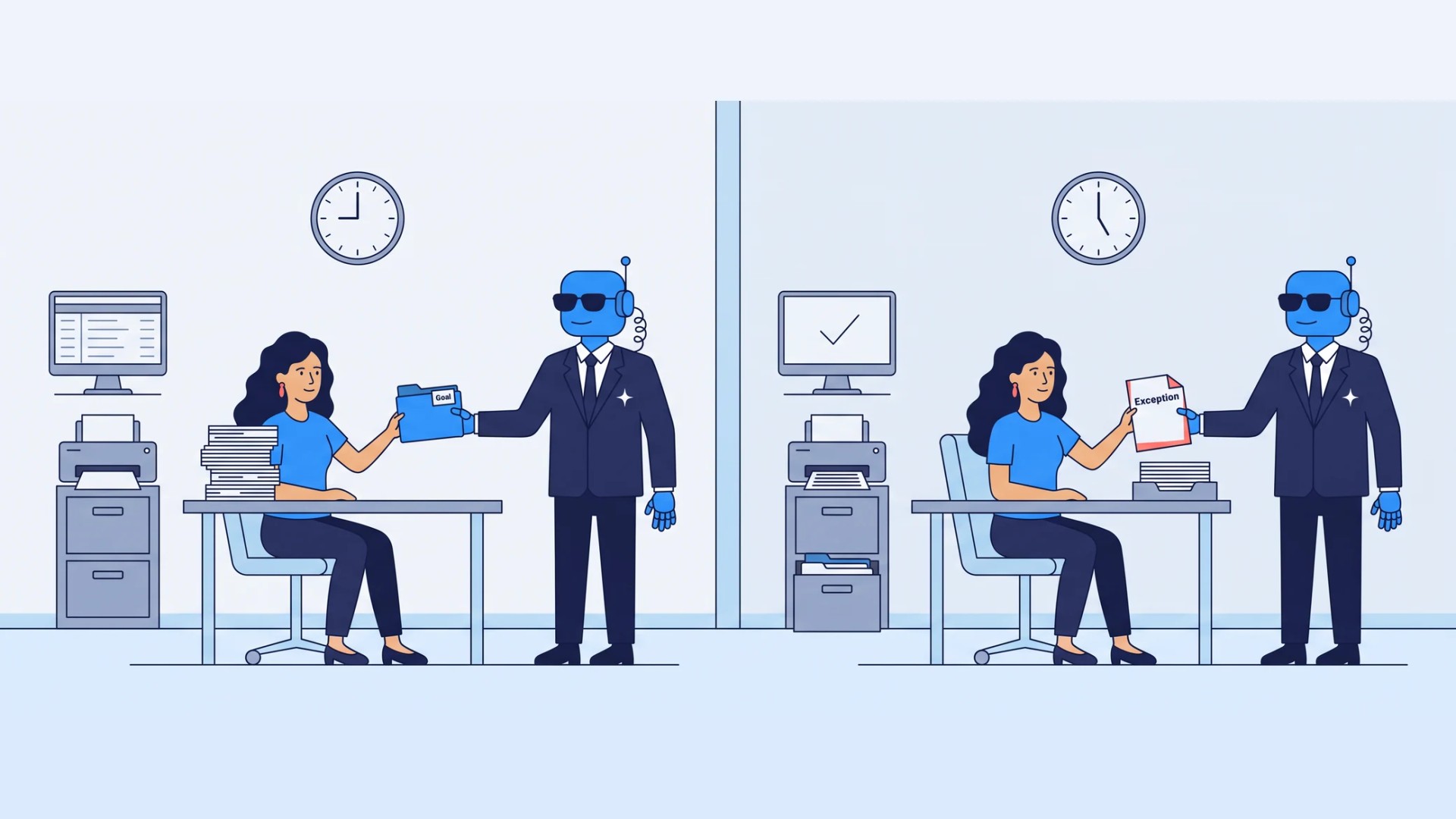
The difference from the AI most people use every day is who drives the work. With an assistant such as a chat tool, a person asks, reads the answer and decides what to do next. With an agent, the person sets the goal and the rules, and the agent carries the work forward. That shifts responsibility. An assistant is responsible for an answer. An agent is responsible for a result.
Much of what is sold as an agent is an assistant with a new name. A simple test: if someone still has to start it, feed it every input and carry its output to the next step, it is an assistant.
How AI agents work
Every agent runs the same loop, whatever it is built on:
- Take the task. A request arrives through a channel people already use: chat, email, a form, a ticket. The agent checks that it has what the task needs and asks for anything missing.
- Plan. It works out the steps toward the goal, within its rules.
- Act. It uses tools: reads documents, queries systems, fills in records, drafts messages, calls other software through connectors.
- Check. It compares the result of each step with the criteria it was given.
- Continue or hand over. It moves to the next step, or stops and passes the case to a person when a rule says so: a missing permission, an exception it may not decide, a result that fails the check.
Three things make this loop work in a business. The agent needs instructions: the goal, the rules and what a good result looks like. It needs knowledge: the facts and policies of your company, in a form it can read. And it needs access: connections to the systems where the work happens. Our guide to MCP servers explains how that access is usually built.
In a well-built agent, deciding and doing are separate. The agent proposes an action in a structured form. A separate layer checks it against the rules and permissions, and only then a narrow tool built for that one action carries it out and logs it. Our own agents work this way: the agent makes the judgment, and code performs the action and checks it. The agent also keeps three kinds of memory: the task in progress, the decisions it made before and the state of the process. A person can then see where the work stands at any moment.
AI agents vs assistants, chatbots and workflows
| What it does | Who drives the work | Good for | |
|---|---|---|---|
| Chatbot | Answers questions in a conversation | The person | Questions with known answers |
| AI assistant | Does a task it is asked for, then stops | The person | Drafting, summarizing, analysis with a person deciding |
| Workflow automation | Runs fixed steps in a fixed order | The workflow design | Steps that never change and need no judgment |
| AI agent | Pursues a goal, chooses steps, acts in systems | The agent, within rules | Work that needs judgment at several steps |
An agent is the wrong tool for some work. If the steps are fixed and need no interpretation, a plain workflow is cheaper and more predictable. If a person has to decide at every step, an assistant fits better. Agents earn their place where the work needs reading, interpretation or decisions at several points and repeats often enough to justify the setup.
There is also an order. Work usually reaches an agent after it has run well with an assistant: the instructions are proven, the edge cases are known, and the results are consistent. An agent then starts under supervision.
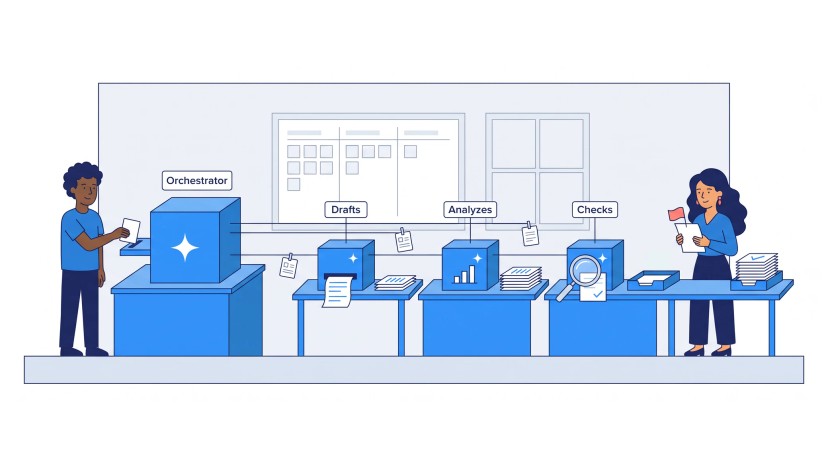
Several agents working on one process is a different subject. Our guides explain agentic AI as a way of working and multi-agent systems as their architecture. Agents that write, test and review code work inside an agentic SDLC.
Where an AI agent fits in a process
To find the place for an agent, look at a process as a chain of decisions rather than tasks. Matt Carlson's book *Agentic AI in Business* puts agents at decision points: places where several paths are valid and someone has to choose. A decision point is a good candidate when it recurs often, relies on patterns in data, takes more time than it should and costs money when people decide it inconsistently.
Two properties sort the rest: how often the decision repeats and how much its inputs vary.
- Repeats often, inputs vary: an agent. Sorting incoming requests, qualifying leads, matching invoices to orders and deliveries.
- Repeats often, inputs fixed: a workflow or plain code. The same rule on the same kind of input needs no judgment.
- Rare decisions whose effect cannot be undone: the agent prepares the case, and a person decides.
A quick test in interviews: when people explain how they decide and the answer starts with "it depends", there is judgment to capture, and possibly a place for an agent.
Types of AI agents
Textbooks classify agents by how they decide:
- Simple reflex agents react to what they see now with fixed rules.
- Model-based agents keep an internal picture of the situation and can act on what they cannot see at the moment.
- Goal-based agents choose actions that move them toward a goal.
- Utility-based agents weigh options by how good each outcome is.
- Learning agents improve their behavior from feedback.
Agents built on large language models usually work as goal-based agents: they plan toward a goal and adjust the plan as they go.
In business work a more useful split is by role. In our model of AI automation, agents play four roles:
- Production agents do the work: they draft, fill in, calculate, prepare.
- Verification agents check the work of production agents against written standards and send what fails back or to a person. They are only as good as the standards behind them.
- Coordinating agents distribute work between people and agents and track it to completion.
- Adapting agents, at the last stage, analyze how the system performs and propose improvements to its own way of working.
AI agent examples in business
| Function | What the agent owns | What stays with people |
|---|---|---|
| Customer intake | Every inbound request on any channel: collects the details, checks the service area and the rules, books the slot | Requests outside the rules and sensitive conversations |
| Finance | An incoming invoice: reads it, matches it to the order and the delivery, prepares it for payment | Approval of payments and of anything that does not match |
| Internal requests | A leave notice or an equipment request: checks the policy, updates the records, informs the people involved | Exceptions to the policy |
| Reporting | A weekly report: collects figures from each system, drafts the summary, flags what changed | Reading it and deciding what to act on |
| Compliance | A recurring check: collects the evidence, compares it with the requirement, files the result | Findings that need a decision |
| Risk monitoring | Reads project documents and meeting notes for risk signals and opens an issue | Whether the risk becomes a change request |
The details decide whether such an agent works. An intake agent has to treat a text message, an email and a booking platform message as the same kind of request. It also has to read back a phone number and check it, because one wrong digit loses the appointment. These rules come from the people who do the work today, and they go into the agent's instructions before it answers anyone. This is how our AI Agentic Execution service builds an AI receptionist: around your service rules and calendar, tested on real requests before it answers customers. Our reference solution for lead intake and dispatch works such an agent through for a service business.
How to build an AI agent
An agent needs three foundations before it owns any work: a defined process, structured and current knowledge, and systems it can reach. In many companies these were handled informally, through experience and conversations. People can work that way. An agent cannot, because it follows what it can read.
Setting up an agent has become easy: Claude, ChatGPT, Microsoft Copilot and Google Gemini all offer no-code or low-code ways to do it. Building one you can trust with a piece of business work takes six steps.
- Choose the work and the outcome. Pick one piece of work that repeats, has a clear result and costs real effort today. Name the outcome the agent will own, not a task it will help with.
- Write the description. Before any setup, write down the outcome, the inputs and outputs, the workflow with its completion conditions, the rules, the decisions the agent may take, the exceptions it must hand to a person and the criteria for an acceptable result. State the goal as a business outcome with its trade-off, for example more qualified leads within the approved segments, and say what the agent does not own. When the scope changes, the description changes first.
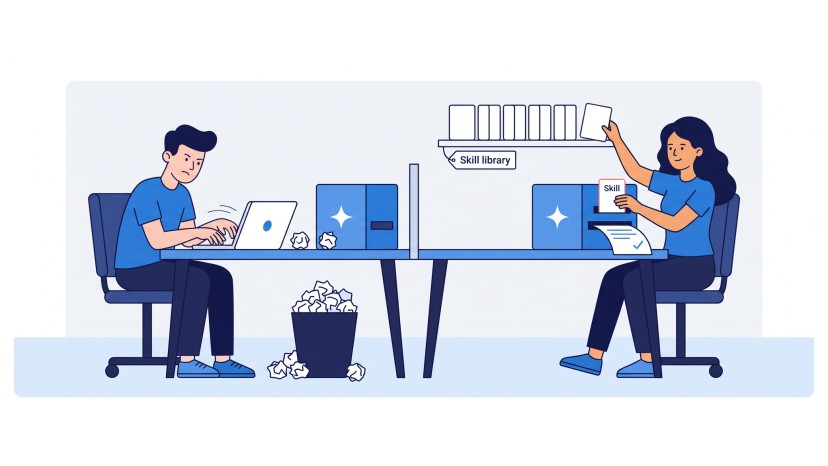
- Prepare the knowledge. Put the policies, product facts and examples the work depends on into a form the agent can read, and keep them current. Whatever was never written down becomes a failure in production.
- Connect the systems. Give the agent access to the systems it reads and writes, with permissions limited to what the work needs. Enforce the important rules in the tools as well as in the instructions: a tool that refuses an action outside the rules stops a mistake that an instruction alone would not.
- Test on real cases. Start on historical data: the agent proposes, sends nothing, and people grade its proposals. Run it on the main flow, the edge cases and the failures you collected, and score each result against the criteria. Put the fast checks first, such as format and completeness, and the expensive ones, such as review by a specialist, last.
- Run under supervision, then widen. Start with the lowest-risk cases, with limits on time and cost per task and a fallback for every failure: retry within limits, hand the case to a person or wait. A person reviews the results at first. Autonomy grows as the share of results that pass stays above the quality bar for the next stage.
Keep that description and the instructions in a document you own rather than only inside one platform. Then the agent can be rebuilt on another platform when a better or cheaper one appears, without rewriting what it does.
What stays with people
People keep the control points the organization defines. Actions with real consequences, such as moving money, changing a customer's terms or publishing something to the outside world, need a named person's permission before they run. Sensitive results are reviewed by a defined person before they move on.
Draw this line before the agent is built. Otherwise it either stops all the time or acts where it should not. Even when an agent runs a piece of work on its own, people read its logs, receive the cases it cannot finish and decide when its rules change.
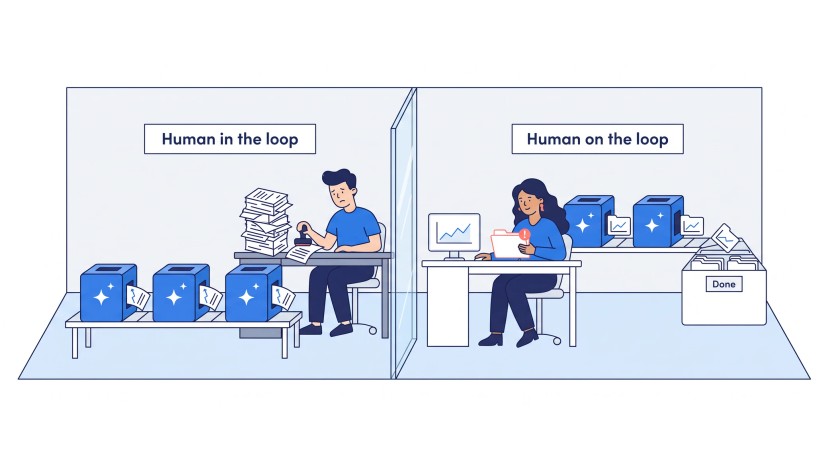
Oversight comes in two modes. For high-risk actions the agent waits for a person's approval before it acts. For the rest it acts, logs the action in a way that can be rolled back, and a person reviews afterwards. Each time a person steps in, record why. Those reasons are the best material for improving the agent.
How to measure an AI agent
Judge an agent by its results, not its activity: a lead qualification agent by how accurate its verdicts are, not by how many emails it sent. Three measures show whether an agent is healthy:
- Decision quality: the share of its decisions a person would confirm. For our own agents we track this together with the decisions a person reversed.
- Consistency: the same input gets the same verdict.
- Autonomy: the share of work done without correction and the rate of escalations. High autonomy with many errors is a risk. Low autonomy with few errors means the agent is held back more than it needs to be.
Watch for failure signals: escalations that keep rising, broken rules, answers that contradict each other, quality that drops as volume grows and complaints from the people the agent serves. Each one is a reason to return the agent to closer supervision until its tests pass again.
Best AI agents and platforms: how to choose
There is no best AI agent in general, because an agent is only as good as the work it was defined for. The platform question is simpler than it looks. Use the one your team already works in, provided it meets your data and security requirements: OpenAI's ChatGPT, Anthropic's Claude, Microsoft Copilot, Google Gemini or an open-source stack.
Two choices keep that decision open. Keep the agent's definition in a document of your own, and expose your business systems through standard connectors any agent can use. When a better or cheaper platform appears, the agent is moved to it rather than rebuilt.
What to expect from AI agent development
If you hire someone to build an agent, ask for two things: an agent that owns a defined piece of work, and the written description of that work. Before go-live the agent is tested on real cases. It then runs under supervision, gets refined and is handed over with guidance for the people who supervise it. Without the description you get an agent that performs a task while people still run the process around it.
Our AI agent development builds the workflow around each agent too, because the result depends on the whole chain. When the foundations are missing, AI Process Reengineering, AI Knowledge Base and AI Connectivity supply them. Common questions are answered in the FAQ on AI Agentic Execution.