I’m often asked, “Is Agile still relevant?” or “Will Software Factories replace traditional development models?” The short answer: Agile isn’t going anywhere — and Software Factories aren’t a replacement.
Agile is a well-established approach that has shaped the way teams build software for over two decades. The Software Factory model, on the other hand, is an emerging response to the demands of large-scale, industrialized software delivery. It’s not about which model is better — it’s about understanding where each one fits.
After years of consulting with a wide range of teams, I’ve seen how Agile continues to thrive and how Software Factories are starting to gain traction in organizations seeking scalability, consistency, and throughput.
The truth is, they serve different purposes. Some teams thrive in fast-moving, exploratory environments, while others need structured, repeatable processes to scale efficiently. Understanding when and how to apply each model is a strategic advantage, and technical leaders need to make this decision intentionally.
In today’s fast-paced digital world, choosing the right development model isn’t about picking a side. It’s about aligning your delivery approach with your team’s capabilities, your product’s maturity, and your organization’s long-term goals.
Agile Workshop: Built for Speed and Flexibility
The Agile Workshop is a de facto standard model rooted in adaptability and creativity. Picture a small, skilled team working like artisans in a studio — collaborating closely, adjusting continuously, and solving complex problems with minimal overhead.

This model emphasizes:
- Quick starts: Teams can launch without waiting for full architecture or specs.
- Flexible roles: Developers, designers, and product leads often share overlapping responsibilities.
- Progressive elaboration: Architecture and design emerge over time.
- High skill demand: Workshop models are most effective with experienced, autonomous professionals.
It’s ideal for early-stage products, unique client solutions, or any context where uncertainty is high and speed is most crucial. However, it may struggle with scale and consistency when the team size or project complexity grows.
Before we dive into the Factory model, see how traditional Agile starts to break down in the age of AI — read “Why AI Makes Agile Obsolete.”
Software Factory: Designed for Scale, Rooted in Lean
At first glance, the Software Factory model may appear to be a rebranded version of the traditional Waterfall approach, characterized by structured phases, specialized roles, and detailed plans. But that’s a misconception. While both models prioritize planning and standardization, Software Factories are not linear in the way Waterfall was. In fact, they align more closely with Lean principles than with traditional project management.
Think of Software Factories as a modern, industrialized implementation of Lean, optimized for execution at scale.
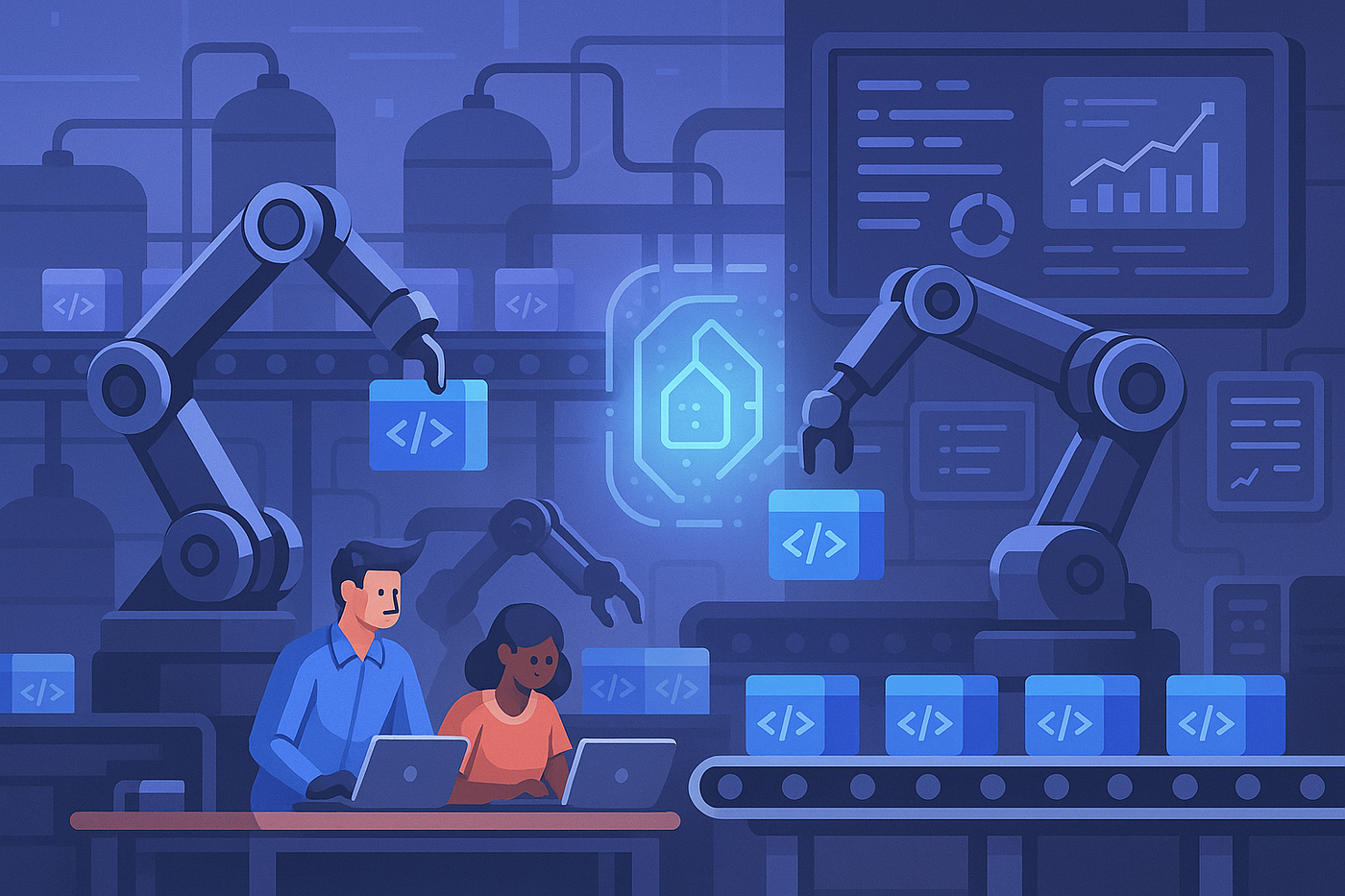
Unlike Agile teams that iterate end-to-end (from discovery to delivery), Software Factories separate business iteration from execution iteration. Here’s how it works:
- The business team defines a small, testable scope — often informed by customer feedback, metrics, or strategic hypotheses (à la Lean Startup).
- The Software Factory executes that scope with speed and precision — using automated pipelines, standardized components, and well-defined roles.
- Once delivered, learning happens at the business level, leading to the next scoped iteration.
This creates a tight feedback loop between business experimentation and technical delivery — an iterative cycle, just at a higher abstraction layer.
Key characteristics include:
- Standardized components: Uses reference architectures, proven patterns, and internal libraries to minimize redundancy.
- Specialized roles: Engineers focus deeply on their domains — architecture, development, testing, DevOps — enhancing throughput and reducing rework.
- Automation and CI/CD: Heavy investment in pipelines and tooling ensures fast, repeatable, high-quality delivery with minimal manual intervention.
- Execution agility: While not exploratory in the same way as Agile Workshops, Software Factories are highly responsive to new input — when that input is clearly defined.
Where Lean is a philosophy — emphasizing waste reduction, continuous improvement, and customer value — Software Factories are a tangible realization of those principles. They operationalize Lean by:
- Streamlining flow across the value chain
- Minimizing work-in-progress and handoff friction
- Reusing and automating wherever possible
- Enabling rapid, low-cost experimentation — when paired with business-level iteration
This model thrives in enterprise environments, platform teams, and product lines — especially where consistency, reliability, and scale matter more than raw exploration.
Workshop vs. Factory: Which Model Fits Your Mission?

These models differ not only in execution but in mindset. To help you assess fit, here’s a side-by-side comparison:

Use this table to evaluate which model best aligns with your team’s structure, delivery goals, and product complexity.
Outlook: From Agile Roots to an Industrial Future
Agile changed the game in the 2000s, giving teams autonomy and speed. But software has evolved. Modular software architectures, delivery automation, and AI-assisted development are pushing us toward more industrialized, factory-style approaches.
The future isn’t binary. Both Agile Workshops and Software Factories will coexist. Moreover, the gap between them will shrink. Some workshops will become more structured to improve scalability. Some factories will become more flexible to accommodate customization.
Each will serve different ends of the software delivery spectrum:
- Software Factories will dominate mass production — delivering repeatable, cost-effective, and high-volume solutions.
- Agile Workshops will focus on high-value niches — providing uniquely formulated, custom solutions where factories aren’t practical.
In that balance lies the future of modern development.
Pick the Right Model for Your Team
Are you building one-off solutions with a small, expert team? Then the Agile Workshop may be your best fit. Are you producing complex software systems or product lines with large, cross-functional teams and diverse skill levels? Then the Software Factory model may offer greater sustainability and cost-efficiency.
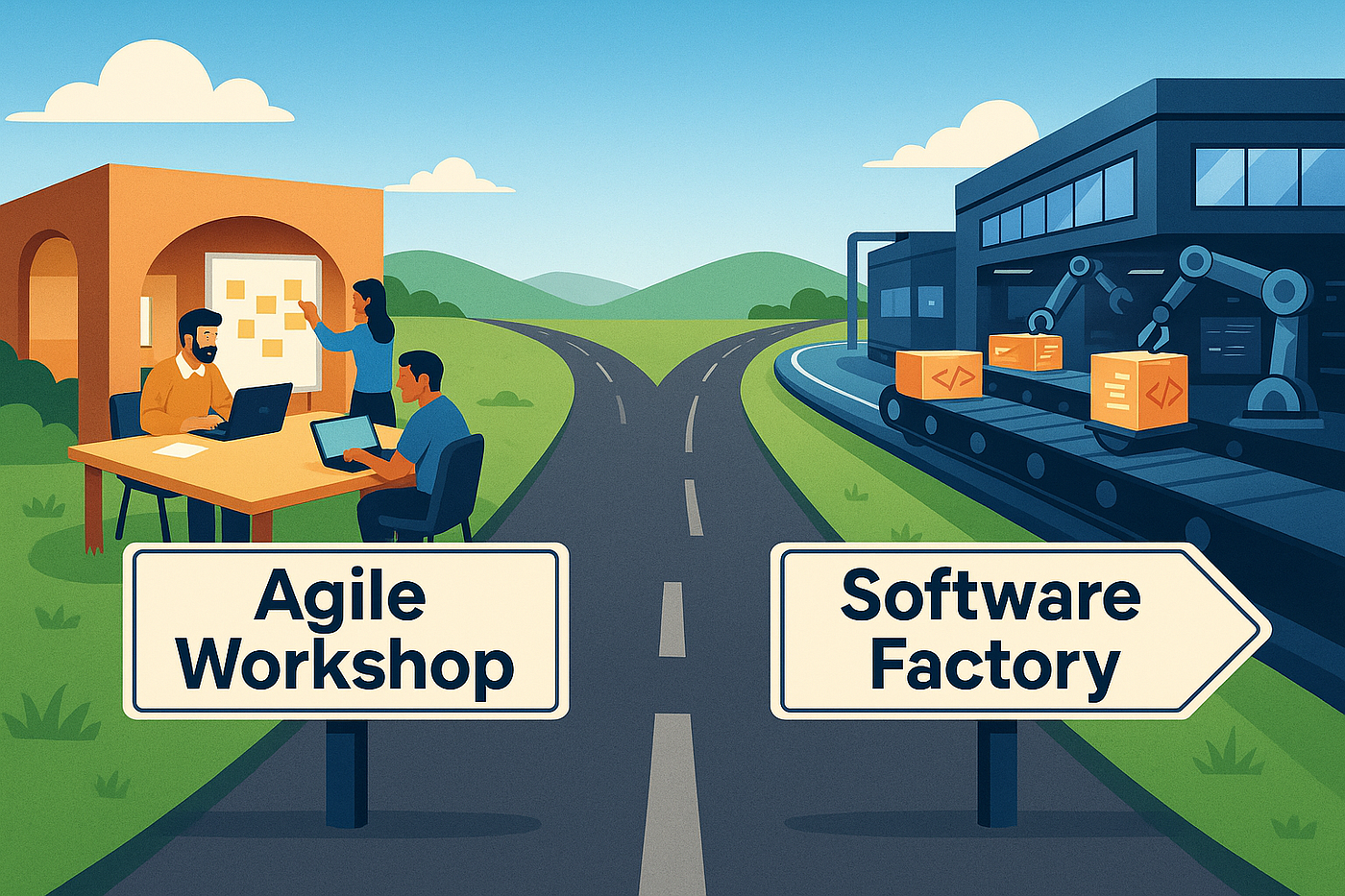
Technical leaders shall make smart, strategic decisions by selecting the development model that best matches their mission, product strategy, and delivery context.
Our Related Posts
🔹 Why AI Makes Agile Obsolete
Why post-Agile teams need structure, documentation, and repeatable processes to fully leverage AI — and how Software Factories help close that gap.
🔹 What Is a Software Factory, Really?
Explore the four principles that define a true Software Factory — and how they differ from traditional Agile or DevOps setups.
🔹 Software Factory and AI Agency: Two Sides of the Same Coin
Understand how Software Factories and AI-native teams complement each other as dual operating systems for scalable delivery.