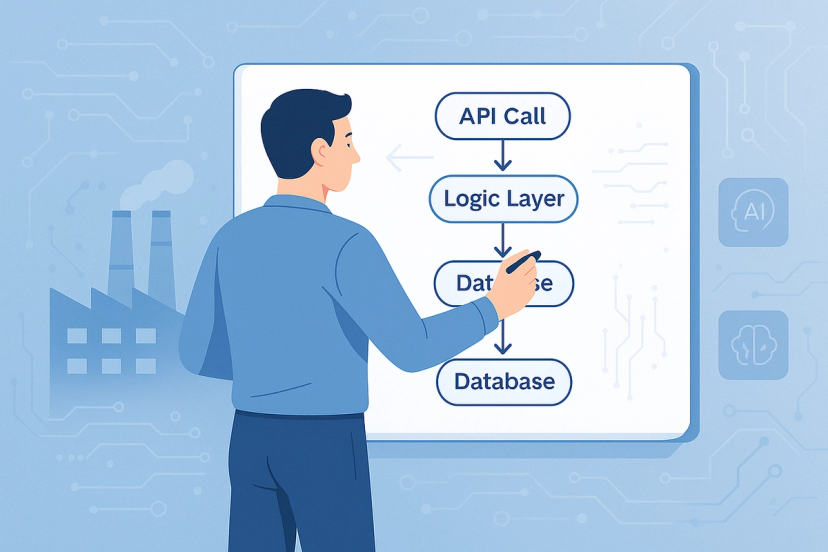
In my work, I often talk about Software Factories and AI Agencies. People tend to treat them like separate ideas — different tools for different goals. But over the years, I’ve come to see them as deeply interconnected. In fact, the more I work with them, the more I realize: they’re two sides of the same coin. And if you’re serious about scaling software delivery intelligently, you need both.
Let me explain.
The Software Factory: It’s Not Just About Tools
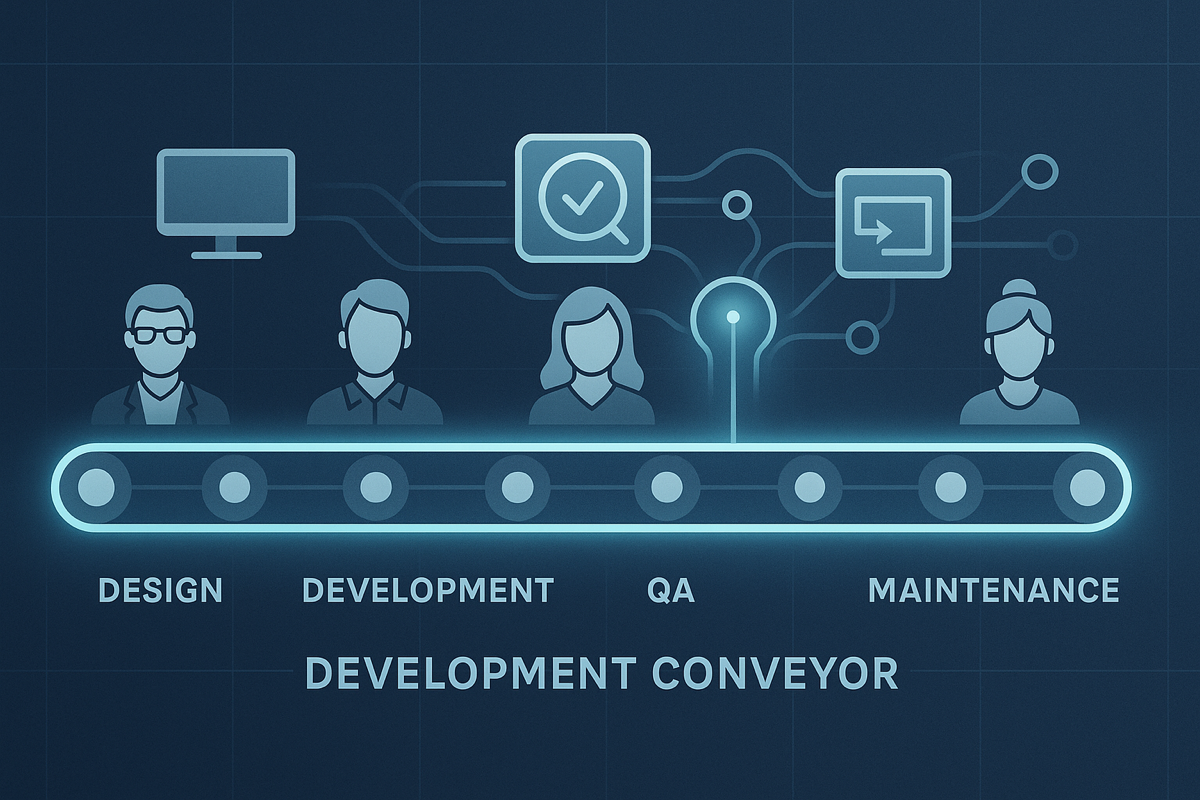
A Software Factory is a structured operational model built on three core principles: standardization of components, deep specialization of roles, and development conveyors that streamline handoffs. It’s designed to bring predictability, clarity, and control into how software is delivered.
Importantly, a Software Factory doesn’t require automation. It can be implemented entirely with manual processes, as long as those processes follow consistent patterns and interfaces. By modularizing the development process and defining interactions between people, tools, and workflows, the Software Factory turns delivery into an assembly line — one that can handle complexity while still producing consistent results. It’s a model that prioritizes repeatability, quality, and scalability through structure and specialization.
The AI Agency: Automating the Chaos

An AI Agency focuses on applying artificial intelligence to replace or augment manual work across business operations. These intelligent agents can perform a wide range of tasks — triaging inputs, writing code, testing software, managing documentation — all without direct human involvement.
What’s remarkable is that an AI Agency doesn’t require a well-organized environment to start. It can operate in ad hoc, messy settings — doing random tasks, generating drafts, answering queries — and people can fill in the gaps. But it follows a roadmap. From task-based automation, to cross-domain coordination, to eventually orchestrating full end-to-end operations — each phase builds on the last. With every step, organizations inject more intelligence into their workflows, reducing the human workload while increasing speed and scalability.
Where Structure Meets Intelligence
AI is pattern-based. It learns from patterns, follows instructions, and executes decisions based on precedent. To connect systems, generate quality output, or integrate multiple workflows, AI needs well-established patterns to train on and interpret from.
And defining patterns means putting some structure in place.
Without consistency and repeatability, AI agents have nothing to latch onto. If workflows are chaotic or undocumented, models will start producing inconsistent outputs, making integration harder and injecting more noise into the system. That’s the paradox: AI thrives on freedom but needs boundaries to be effective.
Structure gives AI the context it needs. Clear guidelines, consistent workflows, and standardized outputs are what turn automation into acceleration — not confusion.
And here’s where the two paths begin to converge. The more structured your operation becomes, the more opportunities you create for automation. And the more automation you implement, the more structure is needed to keep things coherent and efficient. As organizations mature, one increasingly demands the other.
The Light-Off Future: When the Factory Runs Itself
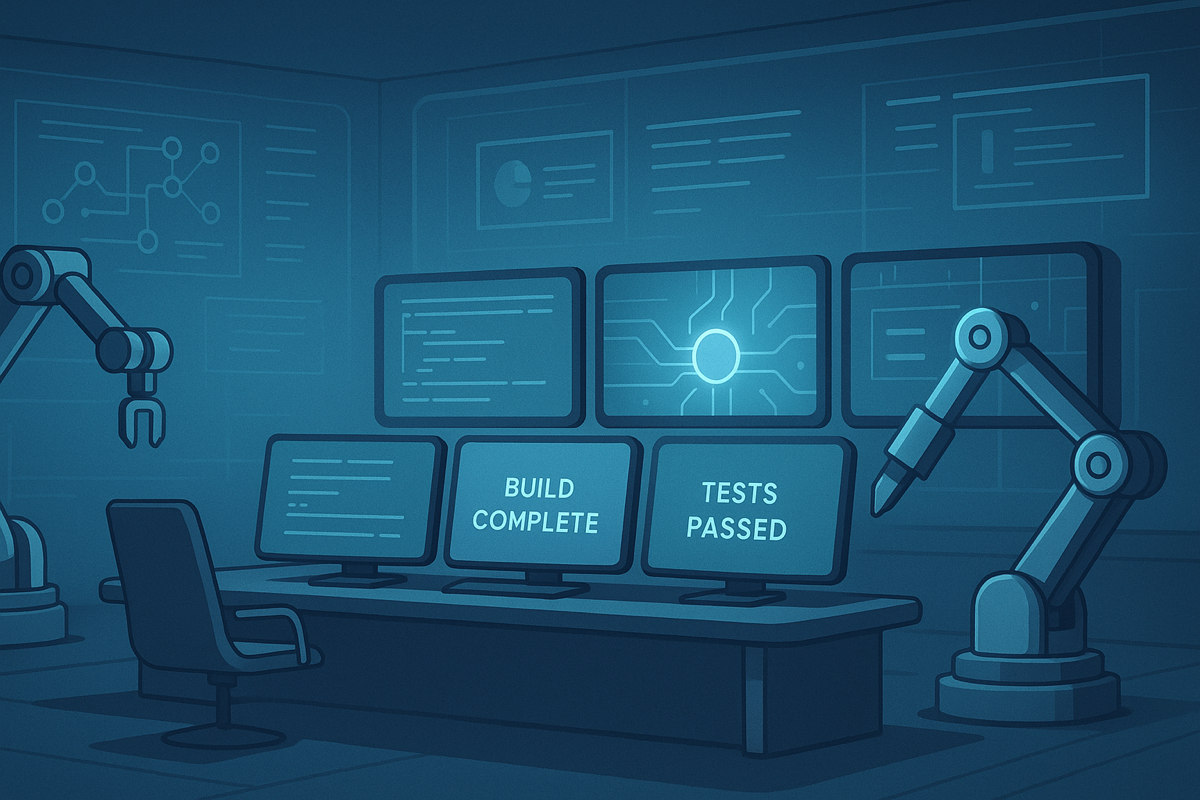
Eventually, the boundary between the Software Factory and the AI Agency disappears. What began as two separate ideas converge into something more powerful: the Light-Off Software Factory.
In this mature model, most of the routine work is handled by AI agents. Planning, estimation, testing, release — all coordinated with minimal human involvement. The environment is structured yet adaptive. Human oversight still matters, but it shifts from execution to guidance and optimization.
You’re not just scaling with people anymore. You’re scaling with intelligence — delivered through a factory-grade process. And this is where the magic happens: structure without intelligence is rigid. Intelligence without structure is chaotic. But together, they create a system that’s resilient, scalable, and far more powerful than the sum of its parts.
So the next time you hear “Software Factory” or “AI Agency,” don’t pick a side. Real progress begins when you stop seeing them as separate — and start building toward the moment they become one.
Subscribe to stay ahead on AI Augmentation and Software Factory trends.