The term Software Factory gets used often, but its meaning is still widely misunderstood. Some equate it with CI/CD pipelines or DevOps automation. Others imagine futuristic coding bots writing software with minimal human input. But these interpretations miss the real value of the concept.
In my previous post, we explored the most common misconceptions holding back the Software Factory model. Now it’s time to clarify what this model truly is — and why it matters more than ever.
Defining the Software Factory
A Software Factory is an organizational model for software development that applies manufacturing principles to maximize efficiency, consistency, and scalability. It is structured around four core principles: standardization of components, specialization of work, development conveyors, and industrial engineering. This model supports any level of tooling or automation, enabling the systematic production of high-quality software at speed and low cost.
What does this definition tell us?
First, it emphasizes that a Software Factory is not a toolset — it is a special organization of work. It borrows methods and disciplines from traditional factories and adapts them to the needs of software teams. Its foundation is built on four guiding principles that structure how software is designed, built, and delivered. Finally, the definition makes clear that the model is technology-agnostic: it works whether the process is entirely manual, fully AI-driven, or somewhere in between.
Let’s take a closer look at the principles that make this model work.

Principle 1: Standardization of Components
In industrial manufacturing, standardization refers to the practice of defining consistent, repeatable designs or procedures to simplify production, ensure compatibility, and improve quality. Standardized components reduce waste, accelerate assembly, and make scaling possible.
In a Software Factory, standardization is achieved through reference designs and architectures. These are not literal copies, but shared templates that address recurring challenges. For example, a persistent storage module may use a well-understood data access pattern. A workflow engine might implement a reusable orchestration structure. Even highly custom components often follow predictable shapes. By identifying these patterns and formalizing them into reference designs, teams can build unique systems faster, with fewer mistakes and more architectural integrity.
Principle 2: Specialization of Work
In traditional factories, specialization means dividing labor into well-defined roles, where each worker focuses on a narrow, repeatable task. This allows for higher proficiency, less context switching, and tighter quality control.
The same logic applies to software. The Software Factory moves away from generalist roles like “full-stack developer” and instead defines narrow, focused responsibilities. A backend engineer may specialize solely in persistent logic, another in domain-specific business rules, and another in API contracts. On the frontend, distinct roles might include interface integration, UI state management, or styling. This focused distribution of labor enables deeper expertise, repeatability, and a cleaner production process that reduces overlap and ambiguity.
Principle 3: Development Conveyors
A conveyor in manufacturing is a structured, sequential process that moves workpieces through defined stations, where each stage contributes specific value toward the final product. Conveyors enforce order, prevent backtracking, and create measurable flow.
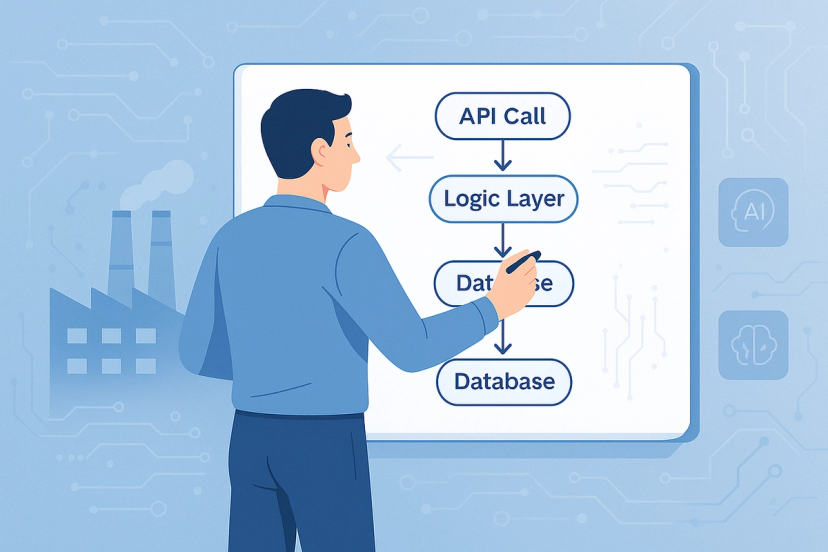
In software development, the conveyor principle structures how features or components move from conception to completion. Rather than developers pulling arbitrary tasks from a backlog, work is broken down into logical stages — design, development, integration, testing, deployment — and handed off between specialists. For example, a design artifact becomes the input for a logic developer, whose output feeds into API integration, and so on. Each step is predictable, scoped, and supported by clear handoffs. This eliminates chaos and fosters a cadence that’s easier to measure, optimize, and scale.
Principle 4: Industrial Engineering
Industrial engineering is the discipline of optimizing complex processes by applying systems thinking, quantitative analysis, and feedback loops. It focuses on improving throughput, minimizing waste, and maximizing the efficiency of operations.
In the Software Factory, industrial engineering ensures the development process is not managed by intuition, but by transparent metrics and continuous improvement. Teams track performance indicators such as lead time, defect rates, and team throughput. They identify bottlenecks and inefficiencies — not to assign blame, but to improve the flow of work. Over time, this data-driven approach turns the development organization into a responsive, adaptive system — much like a factory that continuously refines its operations.
Moving Toward the Next Era of Software Development
The industrial revolution didn’t just invent new machines — it invented a new way of organizing work. That shift, from artisanal chaos to structured production, created a step-change in productivity and cost efficiency. It allowed businesses to scale, to adopt new technologies, and to grow entire industries on the back of predictable, repeatable systems.

The Software Factory offers the same opportunity for software development. By shifting our focus from tools to structure, we can unlock new levels of scale, consistency, and adaptability. This model also lays the foundation for efficient AI integration, because AI systems thrive not in chaos, but in clear patterns and predictable workflows. As we explore more AI-enhanced production in future posts, the Software Factory will be the framework that makes it practical, sustainable, and scalable.
And this is just the beginning. In future articles, we’ll dive deeper into each principle — and explore how to apply them in real development environments.