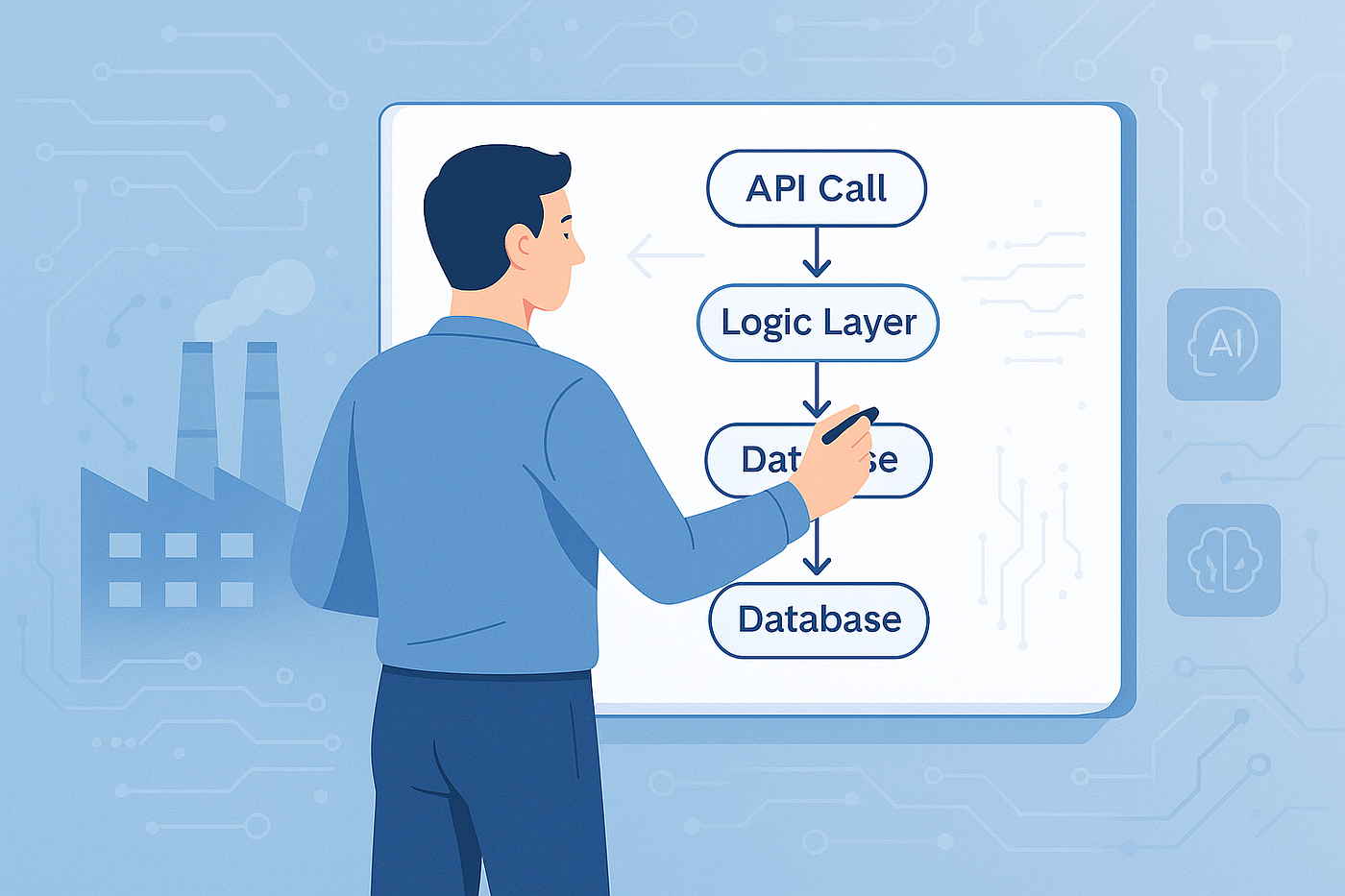
AI is supposed to accelerate software development. So why are we still stuck managing it line by line?
When my team began integrating AI-assisted coding into our internal workflows and client solutions, we defaulted to what we knew best: the traditional bottom-up approach. We started with data models, then business logic, then gradually built up to APIs and user interfaces.
It worked — sort of.
But with AI in the loop, each layer demanded fresh context. Each new snippet required another round of prompting. We found ourselves writing and rewriting, not because the code was bad, but because the flow was wrong. AI didn’t need more instructions. It needed direction.
So, we flipped the flow. We started coding backward, from the end result we wanted to see. API response? UI behavior? Test output? That’s where we began.
And suddenly, everything clicked.
What’s Wrong with Forward Coding?
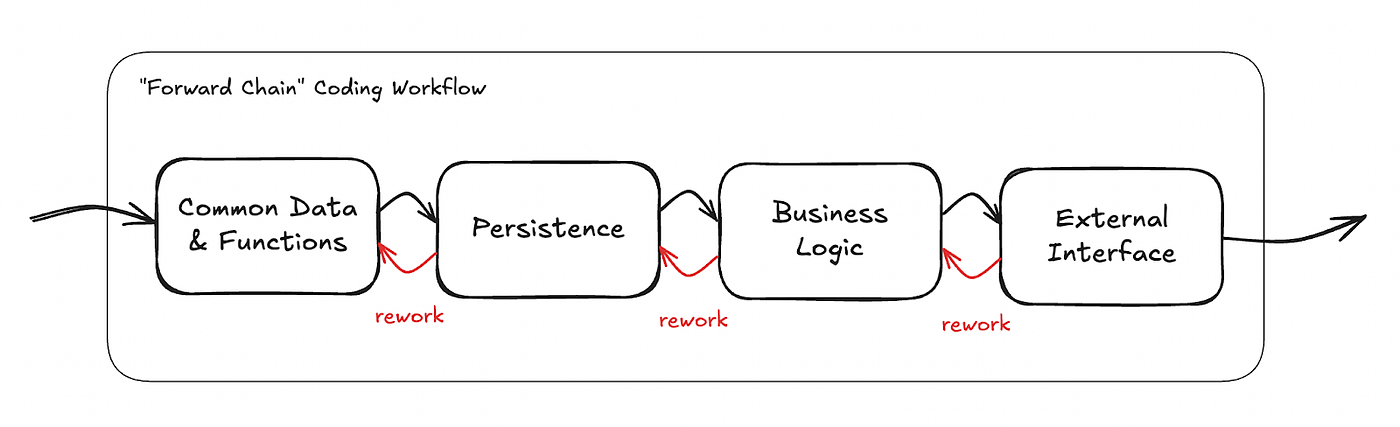
Forward Chain development has long been the standard, starting from the internals like data models and logic. It works well when humans drive the process. Developers have a mental map of the whole system. They build only what’s needed and nothing more.
But AI doesn’t work that way.
It doesn’t know what you know. If you start from the backend, the AI has no idea what the user sees, what the endpoint needs, or how the system should behave. So you explain. And re-explain at every step. That’s not productivity. That’s micromanagement.
In traditional coding, minimizing code is the goal. In AI-assisted coding, minimizing iterations is the win. And Forward Chain workflows create more of them.
Coding from the End: A Smarter AI Workflow
Backward Chain Coding starts with the output: a user interface, an API call, or a test result. From that goal, AI works backward to generate what’s needed underneath. The result is faster delivery, clearer code alignment, and fewer development cycles.
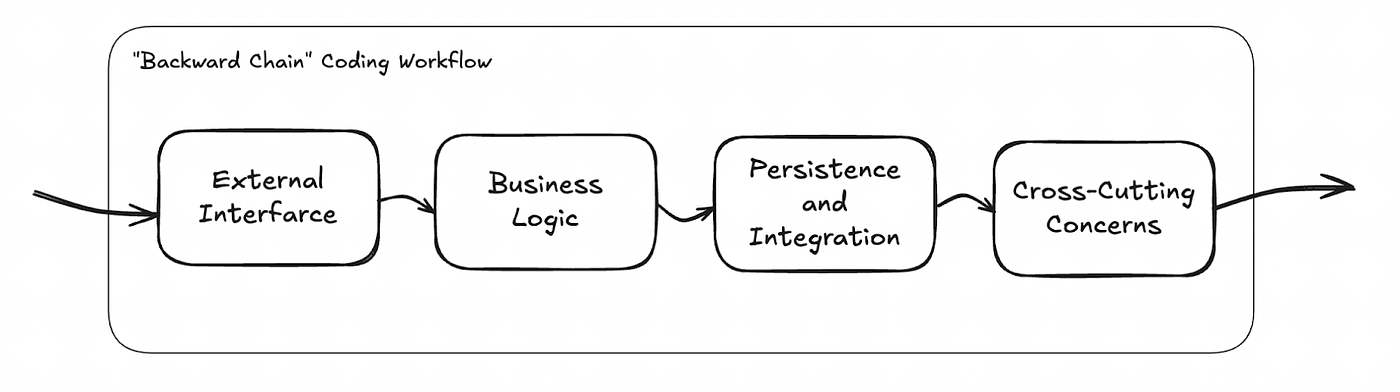
In the past, this approach wasn’t common. It required creating mocks, stubs, and scaffolding that would later be replaced. Too much overhead.
But now, AI can generate all of that in seconds.
Define the outcome. Feed it to the AI. Let the system backfill the logic, data, and dependencies. It’s goal-first development, and it works.
How to Apply It Across the Stack

Backend Development
- Start with the API specification: define endpoints, request/response structures, and behavior.
- Next, generate the external API implementation.
- Then, build the business logic to support that behavior.
- Finally, implement the presentation layer (if needed) and connectors to dependent services like databases, queues, or third-party APIs.
This ensures that all layers serve the contract, not the other way around.
Presentation Development
- Start with UI mockups and defined user interaction flows.
- Then, generate the visual components and layout with styling.
- Next, implement the presentation logic — event handlers, state management, and control flow.
- Finally, connect the interface to backend services to make the experience interactive and real.
This mirrors how users perceive software, from screen to behavior, not from schema to screen.
Testing Development
- Start with a defined test case or desired outcome.
- Next, generate the test structure — test classes, methods, and fixtures.
- Then, code the test flow: input variations, condition paths, and expected assertions.
- Finally, connect the tests to the actual components under test.
This keeps tests purpose-driven and grounded in behavior, not internal code layout.
Embedded & Other Systems
- Combine and adapt workflows based on the domain.
- For embedded systems, start from a device interaction, then generate the logic, control loops, and hardware connections.
- For automation scripts, define the final system output, then backfill logic and environment bindings.
- For CLI tools, start from the command response, then generate the internal processing steps.
No matter the domain, the principle holds: define the outcome first, let AI build toward it.
Backward Thinking, Forward Momentum

Backward Chain Coding is no longer inefficient — it’s AI-optimized.
Where throwaway code once meant wasted effort, AI now generates scaffolding instantly. Starting from the outcome — an API response, UI behavior, or test result — lets teams align faster, cut rework, and reduce iterations.
AI doesn’t replace developers — it removes friction. By focusing on goals first, you streamline development and let the AI handle the heavy lifting underneath.
Backward is now the fastest way forward.