

What you pay for when you run Hermes Agent
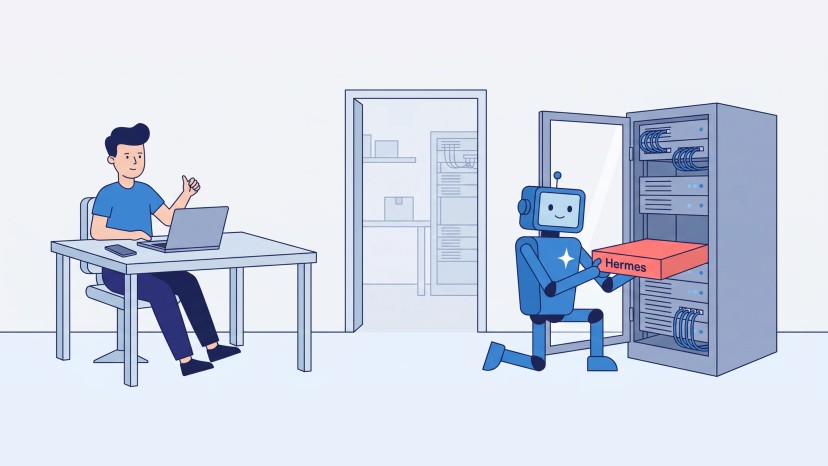
Hermes Agent itself costs nothing: it is open source under the MIT license. The bill has three parts.
- The server. Ours is a small cloud server at $8.89 a month (how we set it up is in Hermes Agent Setup).
- The model. Every message, every tool step and every scheduled job is paid for in tokens at the provider's price. This is the part that grows with use.
- Optional services such as speech-to-text, paid web search or image generation, billed by their own providers if you add them.
We run Hermes on DeepSeek. These are its list prices per million tokens on 27 November 2026, off-peak and peak:
| Price per 1M tokens | deepseek-flash | deepseek-v4-pro |
|---|---|---|
| Input, cache hit | $0.003 / $0.006 | $0.022 / $0.044 |
| Input, cache miss | $0.15 / $0.30 | $0.66 / $1.32 |
| Output | $0.60 / $1.20 | $1.98 / $3.96 |
What simple tasks cost: our measured numbers
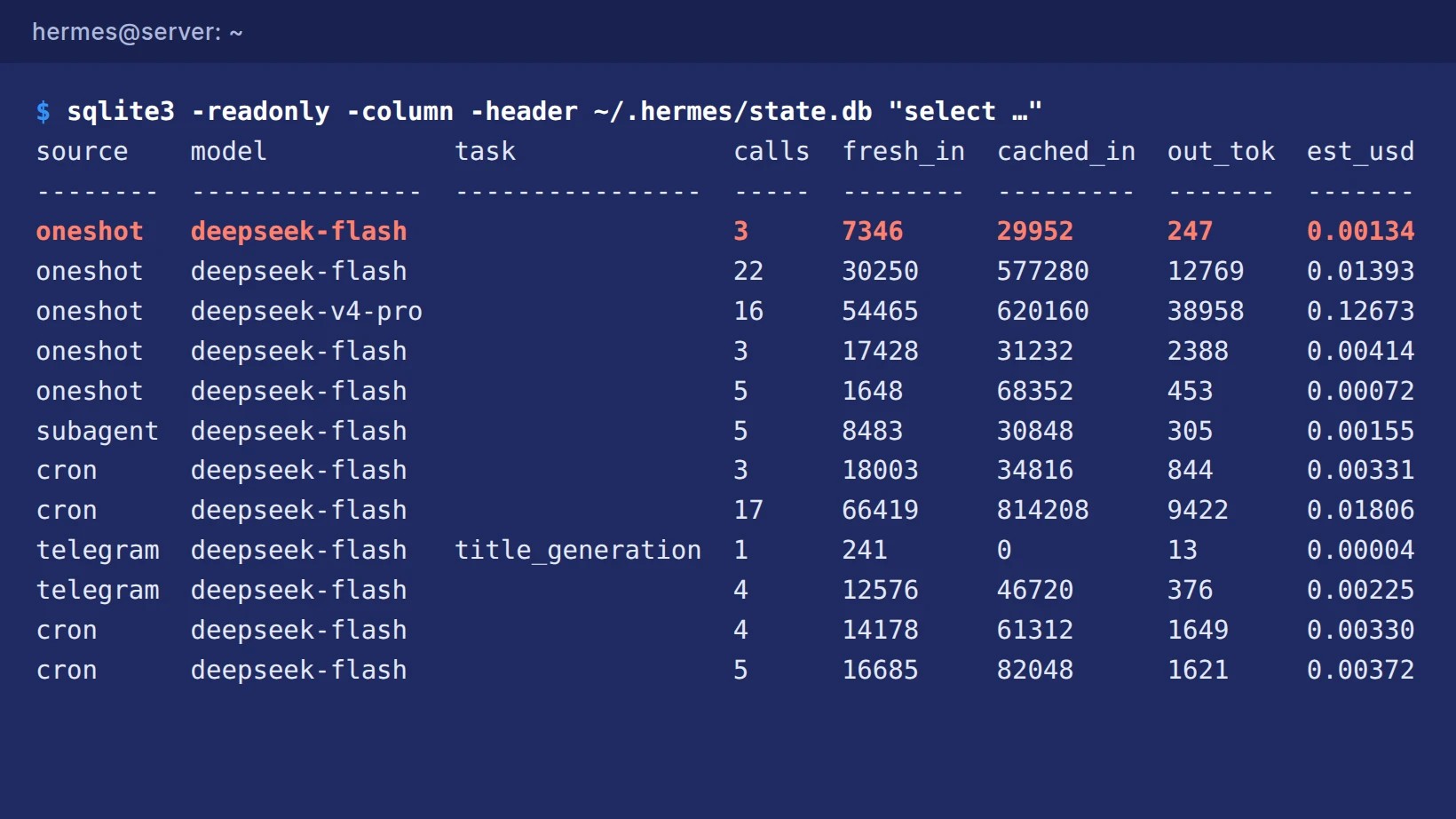
Hermes records every model call in its session database: the calls, the fresh and cached input tokens, the output tokens and an estimated cost. These are the DeepSeek sessions of our first days on that provider.
| Task | Model calls | Input, fresh / cached | Output | Cost |
|---|---|---|---|---|
| A one-line test question, two tool steps | 3 | 7,346 / 29,952 | 247 | $0.0013 |
| A short request in Telegram, three tool steps | 4 | 12,576 / 46,720 | 376 | $0.0023 |
| A lookup handed to a helper agent | 5 | 8,483 / 30,848 | 305 | $0.0015 |
| A daily check that found new items | 3 to 5 | 14,178 to 18,003 / 34,816 to 82,048 | 844 to 1,649 | $0.0033 to $0.0037 |
| A weekly job that searches several sites and writes a digest | 17 | 66,419 / 814,208 | 9,422 | $0.018 |
| An audit of a job's logs and output against its rules | 22 | 30,250 / 577,280 | 12,769 | $0.014 |
| The same audit on deepseek-v4-pro | 16 | 54,465 / 620,160 | 38,958 | $0.127 |
| Naming a new chat | 1 | 241 / 0 | 13 | $0.00004 |
Where the tokens go
Our one-line test question took 37,298 input tokens to produce 247 tokens of output. The reason is how an agent works. Each step is a separate model call, and each call carries the whole setup again:
- the persona, the rules and the memory (up to 12,000 characters of memory on our server);
- the list of skills the agent can load;
- the definitions of every tool it may use, which are the largest part: when we measured it, the system prompt was 12 KB of text and the tool definitions 28 KB;
- the conversation so far, including every tool result.
A question that needs two tool steps is three calls, and each tool result makes the next call longer. Output stays small. In our sessions the model's thinking was counted inside the output figures, and output was still a few percent of the tokens.
Why the cache decides the bill
Because each call starts with the same long prefix, the provider can serve most of it from its cache. On DeepSeek a cache hit costs $0.003 per million tokens against $0.15 for fresh input, a fiftieth of the price.
In the 22-call audit, 577,280 of the 607,530 input tokens were cache hits, 95 %. The run cost $0.014. Billed as fresh input, the same tokens would have cost $0.099, seven times more.
The practical rule: keep the start of the prompt stable. An edit to the persona, memory or skills changes that start, and the next calls pay full price until the cache fills again. Change those files in batches, not a line at a time in the middle of a busy day.
Flash or Pro: is the bigger model worth it?
We gave both DeepSeek models the same task: audit a scheduled job against its rules, using its logs and its output.
| deepseek-flash | deepseek-v4-pro | |
|---|---|---|
| Model calls | 22 | 16 |
| Time | 1.4 minutes | 5.9 minutes |
| Output tokens | 12,769 | 38,958 |
| Cost | $0.014 | $0.127 |
| Result | Found the trap and the duplicates, made one wrong claim | Every number right, no wrong claims |
Pro cost nine times more and took four times longer. Its list price is four times higher for fresh input and three times higher for output, and it wrote three times more output, most of it thinking. We kept Flash as the default. Pro is the better choice for work that nobody checks before it is used.
Peak hours double the bill
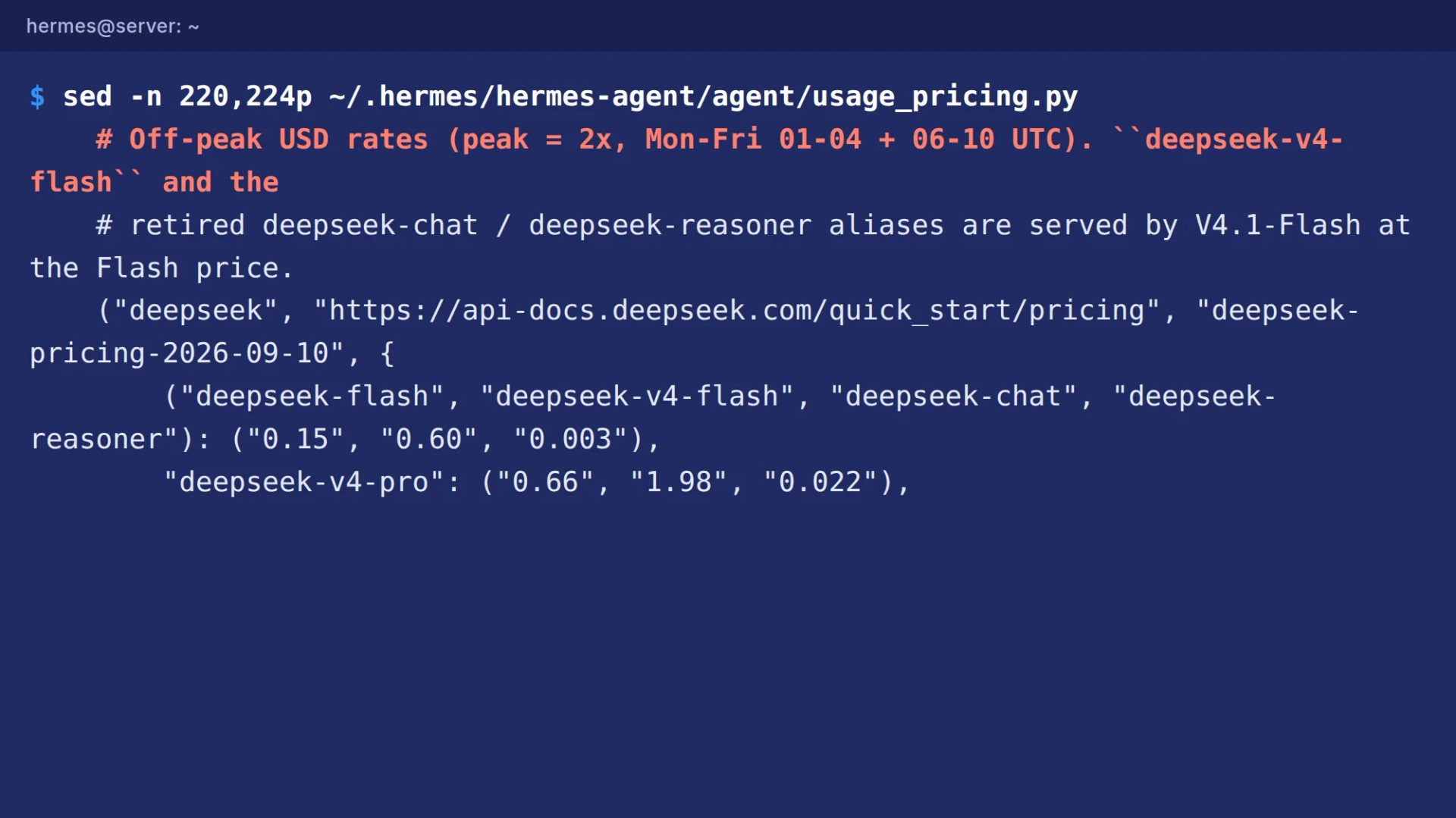
DeepSeek charges twice the list price from 01:00 to 04:00 and from 06:00 to 10:00 UTC on weekdays. Hermes estimates every session at the off-peak price; its own pricing code says so.
Every weekday session on our server fell inside the peak window. The daily job is scheduled for 02:00 UTC, the weekly job ran at 03:00 and the Telegram request at 07:48. The estimates of all our sessions add up to $0.18; with the peak surcharge on the weekday ones the real figure is $0.21. The DeepSeek balance shows $0.24 spent in six days, and the remainder is test calls we made to the API outside Hermes.
The fix costs nothing: schedule recurring jobs between 04:00 and 06:00 or between 10:00 and 01:00 UTC, or at weekends.
How to cut the cost of a scheduled task
Scheduled jobs are where an agent's cost quietly repeats. Five habits keep them cheap.
- Let a script do the mechanical part. Our daily job starts with a script that fetches the source, drops duplicates and items outside the rules, and wakes the agent only when something new is left. In the last six days it woke the agent three times. The other three runs cost nothing.
- Give the model the judgment and leave the plumbing to code. Fixed steps run better as plain code or a workflow. An agent is worth its tokens where a decision varies, which is also where we place production agents in a business process.
- Hand bulk reading to a helper. A helper agent on the low-cost model reads the pages and returns a short result, and the main conversation stays short.
- Cap the run. Our limit is 90 model turns per task. A job that loops stops there instead of spending.
- Run it off-peak. A daily job at the wrong hour pays double on every weekday.
Settings that change the bill
| Setting | Effect on cost |
|---|---|
| The model | The largest lever: Pro's fresh input costs 4.4 times Flash's |
| A gateway between you and the provider | A reseller we tried first added close to 1,000 hidden prompt tokens to every call; going direct removed them |
| Memory size | Up to 12,000 characters of memory ride along with every call |
| The skill list | Unused bundled skills still appear in the list each call carries; we parked the ones we never use |
| Context length | A longer context keeps long tasks coherent but resends more per call; compression itself is a model call |
| Unused toolsets | Small: switching off four saved 74 tokens per call |
The reseller lesson goes beyond money. Its hidden instructions overrode our own persona, and we could not verify which model answered. Use the provider's own API.
What a month of Hermes Agent costs
An example month for one person, built from the unit costs above at off-peak prices:
| Work in the month | Runs | Per run | Month |
|---|---|---|---|
| Short requests in Telegram, 10 a day | 300 | $0.0023 | $0.69 |
| Longer tasks like the audit, 4 a week | 17 | $0.014 | $0.24 |
| A daily check that finds something every other day | 15 | $0.0035 | $0.05 |
| A weekly research job | 4 | $0.018 | $0.07 |
| Model tokens in total | $1.05 | ||
| The server | $8.89 |
Even if every call landed in peak hours, the tokens would come to $2.10. At this level of use the server, not the model, is the main cost. The picture changes with a premium model or with heavy use: the same month on deepseek-v4-pro would cost several times more in tokens, and the longer tasks drive that growth.
How to track what Hermes Agent spends
- Hermes insights.
hermes insights --days 30prints sessions, input and output tokens, the estimated cost, models, platforms and the most used tools. - The session database holds the same numbers per session and per model; a read-only query, like the one in the screenshot above, answers "what did this job cost".
- The provider's balance is the real figure. DeepSeek returns it through its API, and it includes the peak surcharge that estimates leave out.
- A weekly report that puts tokens and estimated cost next to errors and changed instructions makes a jump in spending visible within a week.
How EIC plans the running cost of agents
The numbers here come from one person's agent, but the method carries to any agent. Measure cost the way you measure quality: on real cases, before the agent runs on its own, with the model, the schedule and the cache in the calculation.
We build AI agents on the platforms our clients already use, open-source agents included, and test each one on real work before it goes live. How we set up and secured the agent behind these numbers is in Hermes Agent Setup. For how we define, test and supervise an agent, read the AI Agentic Execution FAQ.