
A $34M omnichannel retailer had its AI strategy, processes, knowledge and connectivity in place but no production AI. EIC built the execution layer that put 4 operating areas into production on existing systems, with people keeping consequential decisions.
Privately held U.S. specialty retailer selling branded footwear, casual apparel, accessories, care products, and seasonal merchandise through 6 stores, one owned eCommerce storefront and one external marketplace: $34.0M annual net sales and 126 regular employees. The remaining step was to turn the foundations already built into production AI execution.
Part 5 of 5 at the same retailer, built on the strategy, processes, knowledge and connectivity of the first four parts. Read part 1: the AI investment strategy →
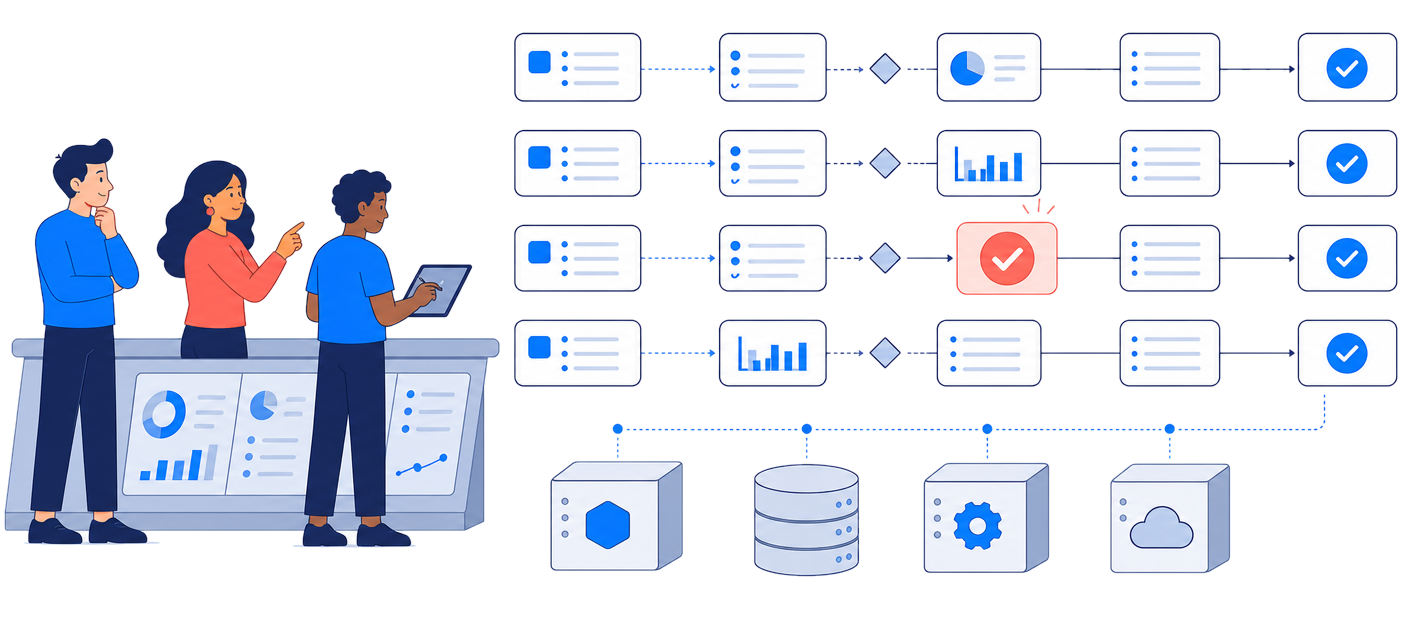
The retailer had moved beyond isolated AI experimentation. What remained was the difficult step between design and operation: production work still required orchestration, workflow state, deterministic controls, approvals, exception handling, and reliable execution across multiple systems.
Employees initiated steps, assembled context, interpreted outputs, decided what happened next, and moved work between applications
Some work needed assistants, some deterministic automation, some supervised agentic execution, and some explicit human decisions
A two-person IT & Business Systems team needed reusable architecture rather than a different technology stack for every use case
An API or MCP write capability could not automatically give AI permission to make consequential commercial or operational decisions.
Production systems needed to know what had completed, what was pending, what had failed, and when a person had to intervene.
AI could support warehouse business decisions but could not control robot movement, routing, traffic logic, or safety functions.
Each process step used the execution mechanism appropriate to the work. Deterministic logic handled what had to be exact. AI handled what required interpretation.

EIC implemented a common execution architecture so each use case did not require a separate AI stack.
Python served as the principal custom-development language, Microsoft Agent Framework managed orchestration and stateful execution, and OpenAI models provided language reasoning and interpretation.

The production applications consumed the same 11 governed knowledge collections and the same source-authority and access model, and production workflows used the AI Connectivity layer instead of integrating independently with every application.

Production readiness was evaluated as end-to-end process behavior, not simply model-response quality: source selection, retrieval relevance, tool choice, unauthorized-action prevention, workflow completion, escalation, latency, and operational cost.
Only after approval could governed tools update permitted purchasing or replenishment records and submit approved WMS actions.
A supervised agent assembles demand, inventory, inbound supply, purchasing, supplier, seasonal, promotion and planning context before planner review.
A supervised agent turns order, fulfillment, shipment, return, customer-history and approved-policy context into a prepared service package.
An automated workflow combines return state, order context, inventory demand, approved policy and recovery criteria before disposition or escalation.
An AI assistant with voice and text interfaces prepares exception context, while the WMS and HaiQ remain the execution authorities.
| Work area | Execution method | Why |
|---|---|---|
| Identifiers, calculations, thresholds, exact matching, policy tests, validations, permissions, state transitions, and write gating | Deterministic automation | Deterministic logic handled what had to be exact. |
| Semantic retrieval, synthesis, exception interpretation, contextual explanation, drafting, and bounded recommendations | AI execution | AI handled what required interpretation. |
| Inventory commitments and overrides, exceptional customer compensation, material write-offs, significant warehouse exceptions, financial judgment, and policy exceptions | Human authority | Human checkpoints retained accountable authority for consequential decisions. |

Exception-context assembly decreased from 18 minutes across four to five application views to 6 minutes in one AI-assisted review workflow, while inventory commitment remained a human decision.
Order, fulfillment, return, interaction, and approved-policy context was assembled before specialist action.
Operational context and recovery information were prepared before employee intervention.
72% of the interactions required by the next two automation initiatives reused an existing connector, authorization pattern, or business-level interaction.
No core ERP, commerce, WMS, returns, service, or robotics platform was replaced solely to implement production AI.
The retailer now had a reusable development and operating pattern for turning its prioritized AI roadmap into additional production capabilities without restarting architecture, knowledge preparation, connectivity, and governance from zero for every initiative.
The service behind this storyAI Process Automation →
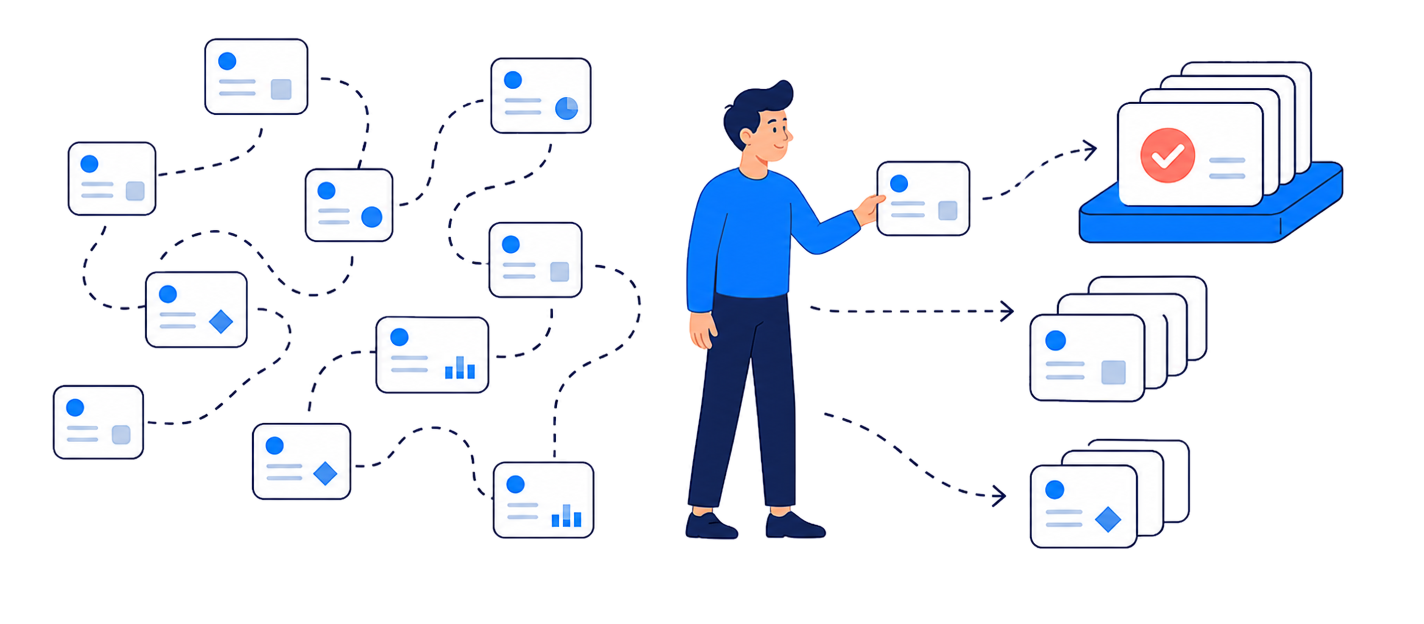
12 competing AI opportunities became one governed portfolio: 5 funded first, 4 deferred, 3 parked, and foundations built once for every later initiative.

Know-how that lived with experienced employees became explicit, validated target processes, so automation teams received approved process logic before design began.
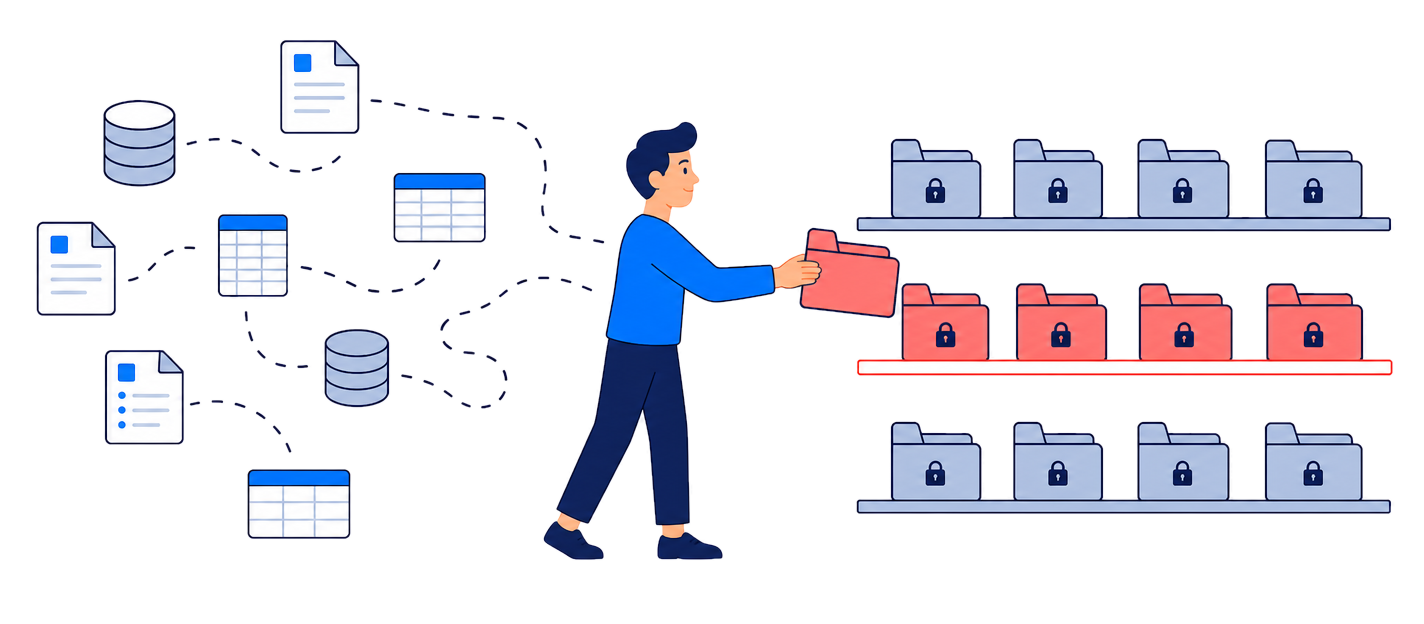
27 sources classified by authority, owner and retrieval method, and 11 governed collections instead of one corpus, before committing to a large retrieval platform.
EIC can help identify the first production workflows, reuse the process, knowledge, and integration foundations you already have, and build the AI execution layer required to put them into operation.