When I first started researching industrial software development methods in 2016, I was drawn to the term “Software Factory.” It sounded bold, efficient, and promising — like a model that could bring structure to the chaos of digital product creation. But the more I looked into it, the more I realized the term was deeply misunderstood. Definitions varied wildly, and none of them connected back to the powerful principles that gave factories their transformational edge during the Industrial Revolution.
This post is about correcting that misunderstanding — and in doing so, unlocking a clearer path toward scalable, intelligent, and efficient software delivery.
What We Learned from Real Factories — and Forgot
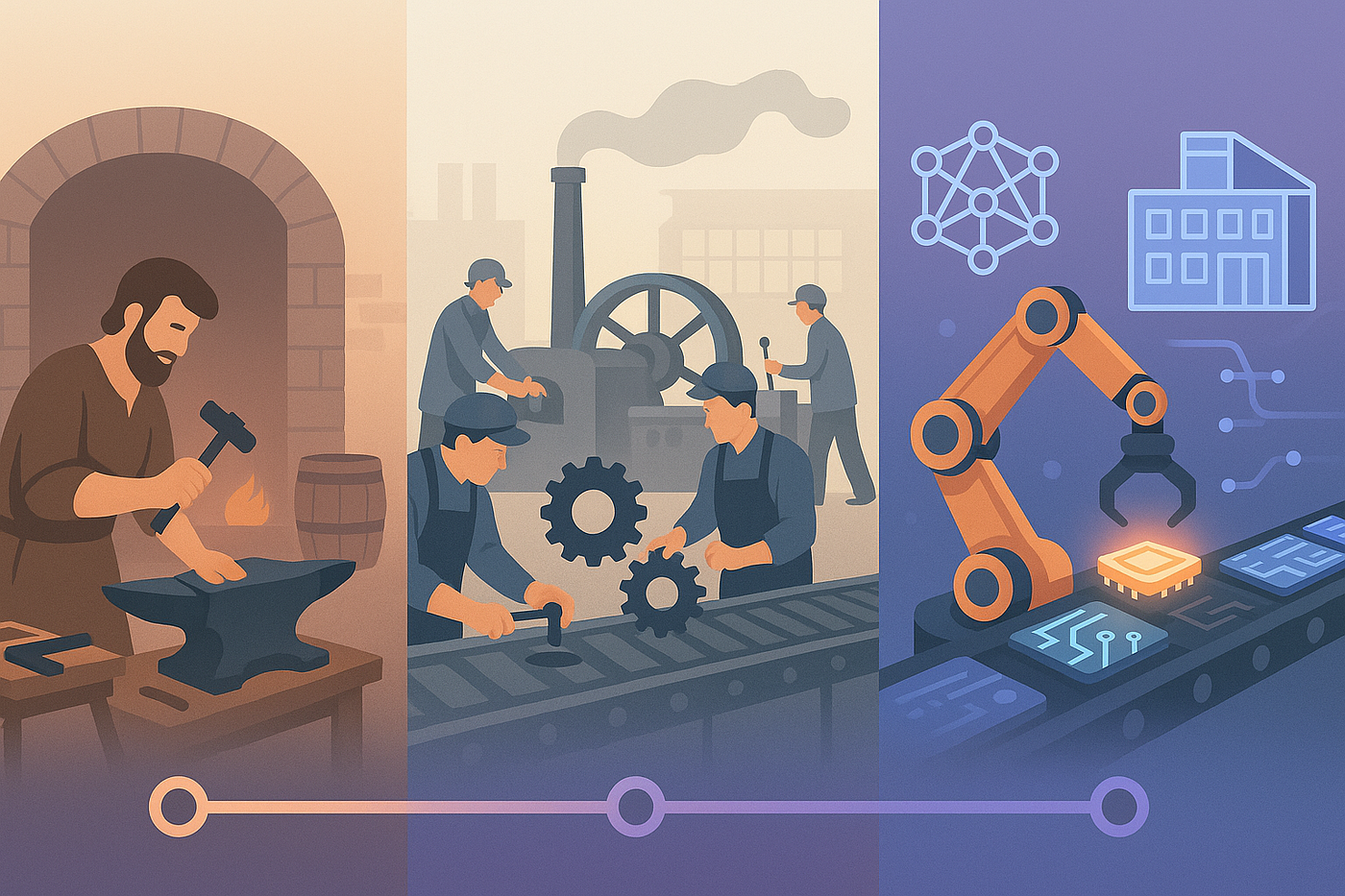
Let’s step back and remember what made factories revolutionary in the first place. The move from medieval workshops to industrial factories wasn’t just about putting things under one roof. It was about standardization. About the labor division. About creating products on assembly lines and introducing machines that enabled consistency at scale.
This evolution powered entire industries — from textiles to automobiles — and dramatically reduced the cost of production while increasing quality and volume. It wasn’t just technological; it was organizational.
Now, look at modern software development. Despite Agile and DevOps, many teams still operate like digital blacksmiths: broadly specialized, loosely coordinated, and constantly reinventing the wheel. And while we fantasize about fully autonomous, AI-driven software agents, we’ve skipped over the intermediate evolution step — the actual “factory” model that enabled industrial scale in the first place.
The Myth of the Modern Software Factory
The core problem is that the term “Software Factory” has been hijacked by the tools-first mindset. Many definitions focus on automation pipelines, DevSecOps workflows, or pre-built components, but rarely touch on the deeper organizational model.
In a real factory, tools are enablers — not the core. What matters is how labor is structured, how flow is governed, and how variation is managed without chaos. If we want to build scalable and intelligent software systems, we need to stop equating factories with CI/CD scripts and dashboards. We need to revisit the model’s original meaning.
Wikipedia Got It Wrong
Here’s how Wikipedia defines a Software Factory:
“A software factory is a structured collection of interrelated software assets that aids in the rapid development of applications. It applies manufacturing principles to software development, aiming to replicate the efficiencies found in traditional manufacturing processes. This approach often involves assembling predefined components to meet specific, externally defined end-user requirements, rather than building software from scratch.”
The emphasis here is on predefined components and automation — on tooling. It echoes the mistaken belief that if we just automate enough, we’ll be operating like a factory. But again, the real power of factories wasn’t in the tools — it was in the organization of work.

The DoD Missed the Mark Too
The U.S. Department of Defense offers a different definition:
“A Software Factory is a structured environment that integrates people, processes, and tools to facilitate the rapid and secure development, deployment, and maintenance of software applications. Embracing DevSecOps principles, these factories aim to deliver resilient software capabilities swiftly to meet mission-critical needs.”
At first glance, this definition is broader — it mentions people and processes along with tools. But it still lacks the critical foundation: a model of how work is divided, coordinated, and sustained. And by the end of the definition, it starts focusing on DevSecOps, shifting the conversation from underlying production principles to tooling and automation — once again, missing the core.
Rethink the Factory — Before We Build AI Ones
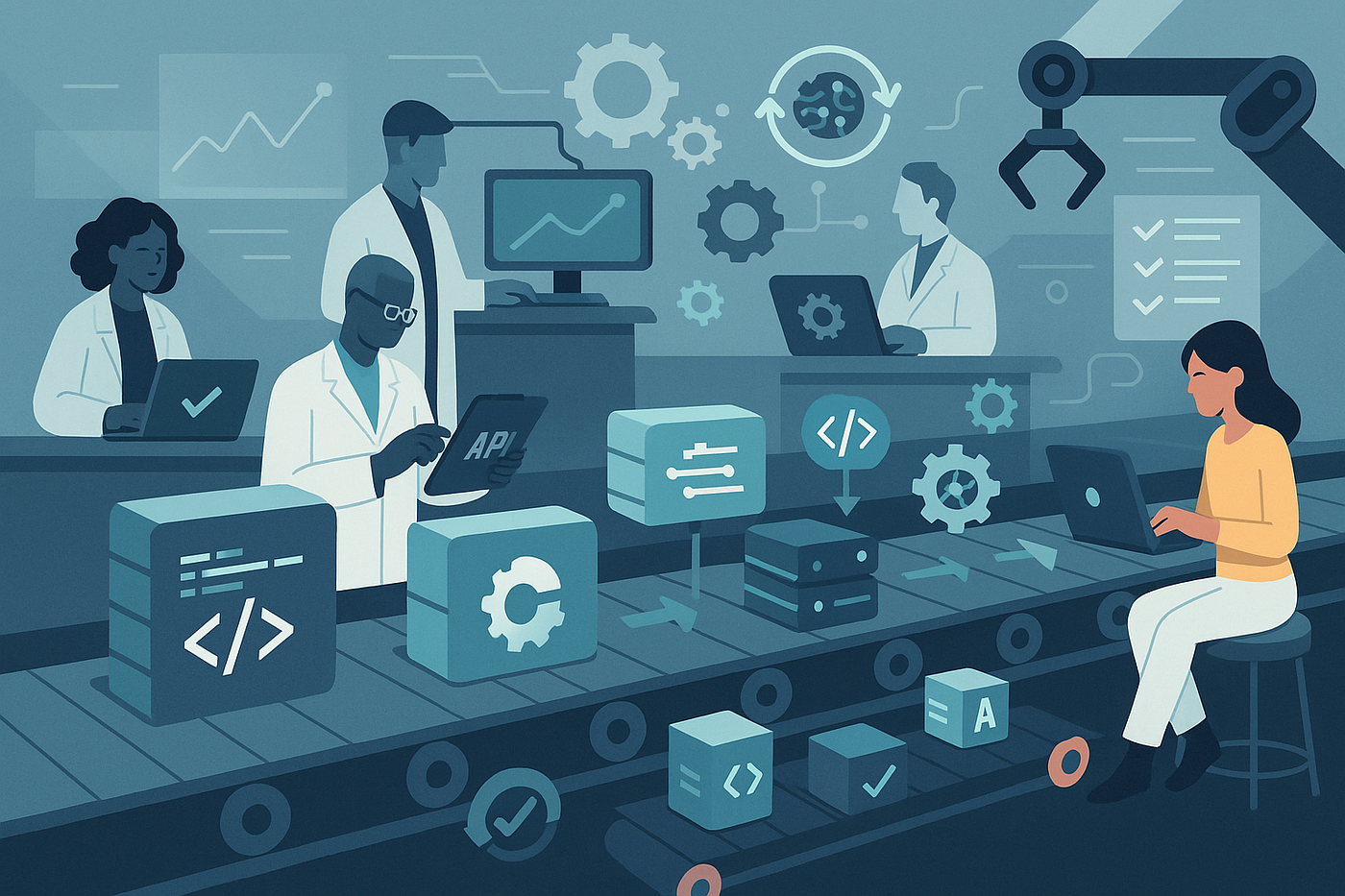
Here’s the truth: a factory is not a toolchain. It’s a way of organizing work. It’s about predictable flow, clear handoffs, feedback loops, and structured variation. If we reframe the Software Factory as a system of labor — not a stack of tools — we begin to see the opportunity ahead.
This matters now more than ever. As we dream of AI agencies and automated software creation, the real bottleneck isn’t tooling — it’s structure. We need to build environments where both humans and machines can contribute meaningfully, efficiently, and at scale.
The industrial revolution didn’t just happen because someone built a better loom. It happened because someone redesigned the whole system around that loom.
Let’s do the same for software. In my next post, I’ll share a more precise and practical definition of a Software Factory — one that reconnects it to the principles that made factories powerful in the first place.