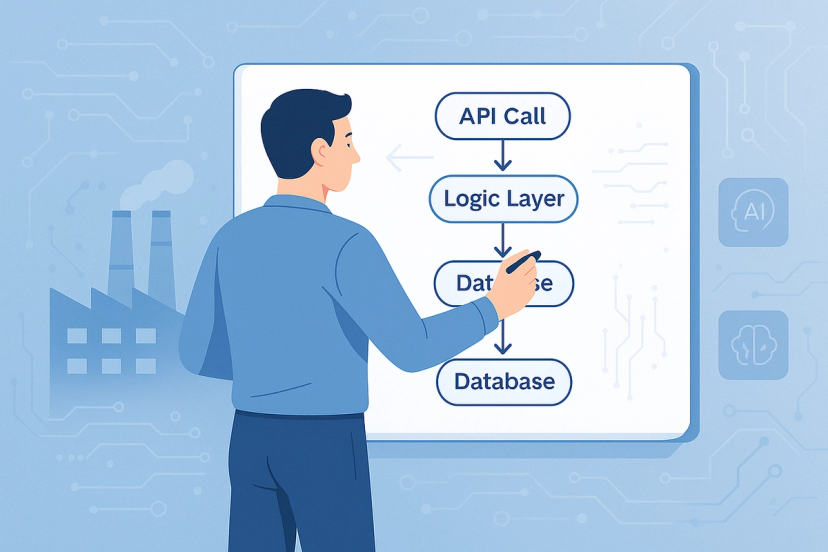
When I started exploring the concept of Software Factories, I wasn’t looking for a revolution. I was just trying to make sense of the chaos in modern software development — vague roles, overlapping responsibilities, inconsistent delivery. Everyone talks about the future where AI builds software autonomously, but most teams today struggle to keep their sprint boards clean.
That contrast made me curious. So I looked for parallels in traditional industries — and found them in manufacturing. Agile teams looked a lot like historical workshops. Software Factories reminded me of industrial-scale production. Then I looked deeper and found two more eras, one before and one after, that marked distinct leaps in productivity and cost-efficiency.
That made me think… maybe we’re skipping a step that we can’t afford to miss.
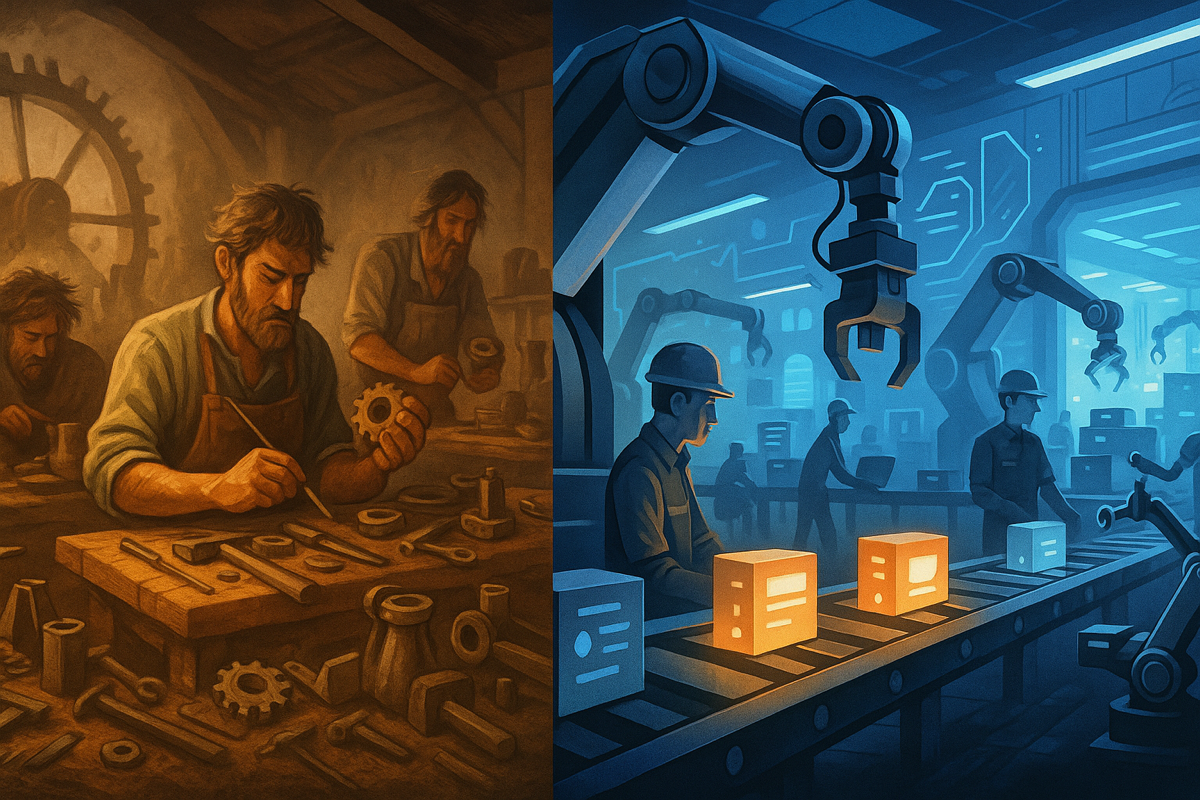
How Manufacturing Scaled: The Four Eras
Manufacturing didn’t leap from craftsmanship to automation. It evolved through four eras, each introducing new responsibilities, tools, and disciplines that increased productivity by orders of magnitude.

1. Self-Service Era (Pre-Craft)
In early societies, people made everything for themselves — tools, clothing, shelter — using primitive materials and methods. There were no specialists. Each person was responsible for their own survival. Productivity was minimal, and tools were little more than shaped stone or wood.
2. Workshop Era
Over time, dedicated craftsmen emerged. Masters taught apprentices in small workshops, producing goods collaboratively. Tools became more refined, and roles started to take shape — though still broad and loosely defined. Output improved, but production was still inconsistent and deeply tied to individual skill.
3. Factory Era
This was the first true step change. Industrial engineering introduced a disciplined approach to factory design and operations. Roles became narrow and specialized — operators, inspectors, assemblers. Standardized parts replaced one-offs. Conveyor systems moved products through repeatable stages. With this structure, productivity soared and costs dropped dramatically.
4. Lights-Off Factory Era
Modern factories run with almost no human intervention. Robotics, automation, and AI perform tasks around the clock. But this level of automation is only possible because the underlying processes are so well-defined. Structure came first — then automation.
Software’s Parallel Journey
Software has followed a similar path, though unevenly — and we’ve skipped over the most powerful era so far.
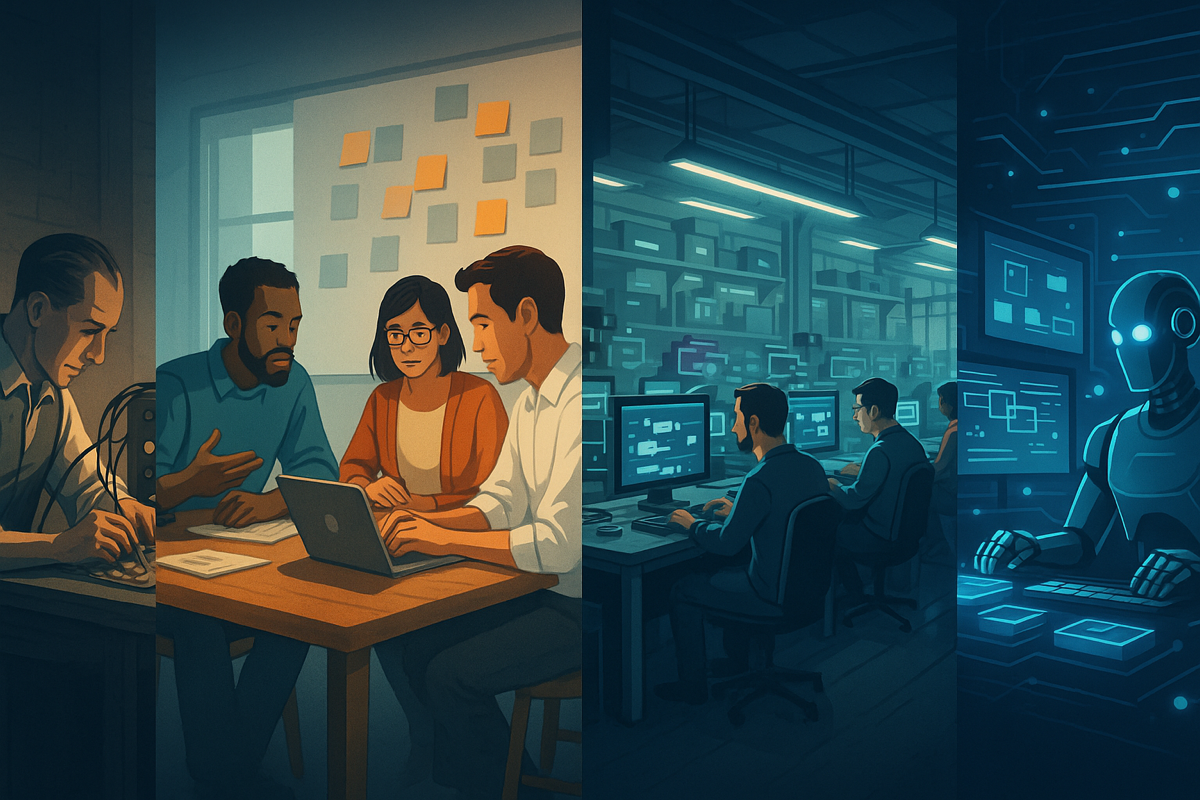
1. Self-Service Era
In the earliest days of computing, the people building hardware also wrote the software. Tools were crude: binary code, punch cards, assembly language. There were no “developers,” just engineers solving their own problems with whatever they had.
2. Workshop Era
As computing spread, software development became a profession. Teams formed. Agile methods encouraged collaboration, flexibility, and continuous delivery. Developers wore many hats. Tools like version control, IDEs, and CI/CD pipelines emerged. But structure remained loose, and success depended heavily on individual expertise.
3. Software Factory Era (The Missing Link)
Here’s the leap we’ve yet to fully make. A true Software Factory is designed for scale and consistency. It includes:
● Standardized components, created using reference designs, so teams don’t reinvent the wheel
● Narrow roles, each performing well-defined operations over known component types
● Development conveyors, where individual workstations are connected into pipelines that follow well-established processes
● Process engineering as a discipline, responsible for designing, optimizing, and running the software production system as a whole
This model reduces chaos, builds in repeatability, and — most critically — establishes the clear patterns that AI systems need to operate effectively.
4. Lights-Off AI Factory Era
This is the dream: a fully autonomous system that takes software from concept to production with minimal human input. It creates, tests, and deploys entire systems on its own. But we’re not there yet. Not even close.
Machines Didn’t Start the Industrial Revolution — Factories Did
It’s a common misconception that machines sparked the Industrial Revolution. In reality, machine power — like windmills and water wheels — had been around since Roman times. What changed everything wasn’t the technology itself, but the structure into which it was introduced.
Factories brought order. They standardized components, specialized labor, and implemented repeatable workflows. Only then could steam engines and automation deliver exponential productivity gains.
AI is our generation’s machine power. It’s capable, flexible, and evolving fast. But just like the steam engine, it needs a structured environment to thrive. Without clear inputs, defined roles, and predictable processes, AI can’t scale value. The Software Factory provides that structure.
Unlocking Today’s Advantage with Software Factories
Here’s the part most teams miss: automated software development by AI is still 10 or 20 years away. It’s exciting — but it’s still mostly a dream.
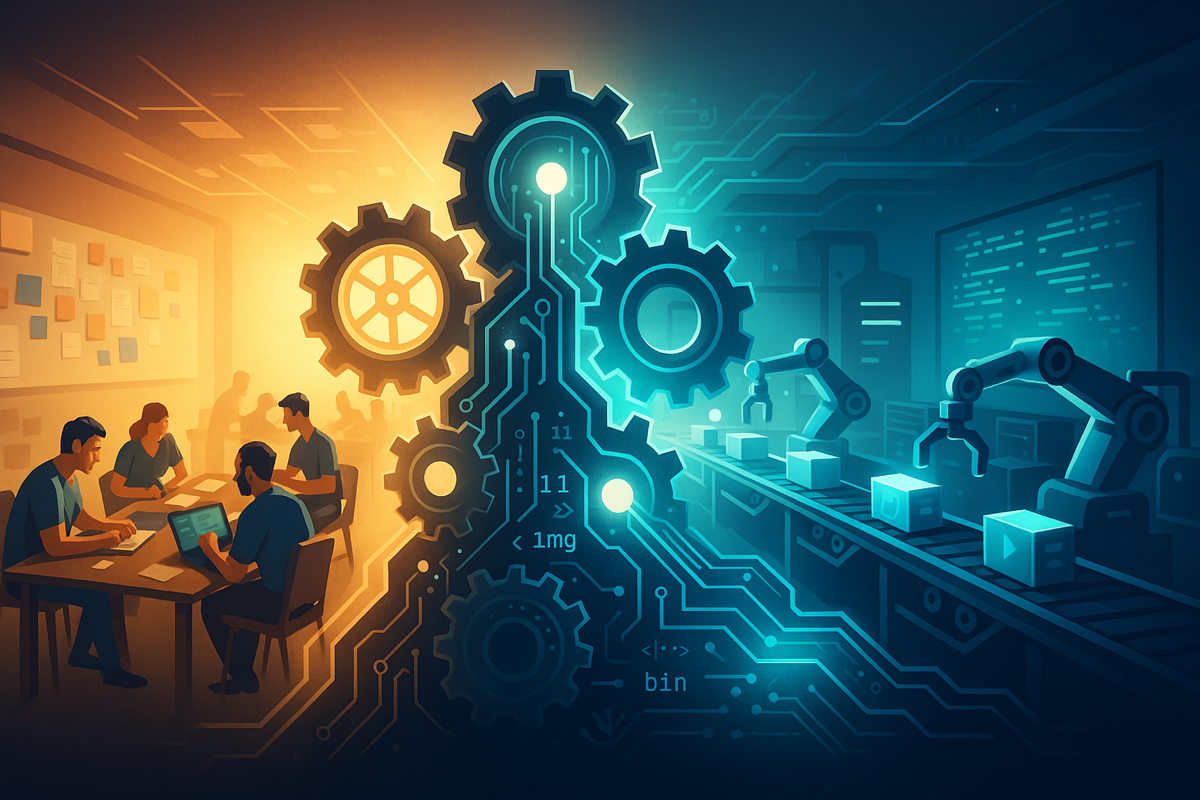
The Software Factory, on the other hand, is already within reach. By adopting it today, you can achieve 10x gains in productivity, cost efficiency, and delivery consistency — even with minimal AI involvement.
And when AI is ready to take a bigger role? Your organization will be ready too. With patterns, pipelines, and processes already in place, integrating AI will be smooth, not disruptive.
So the choice is simple: do you want to get there the easy way — or the hard way?
Want to learn more about AI augmentation and Software Factories?
Subscribe to our blog for insights that help you build smarter, faster, and more scalable software systems.