If you’ve ever wondered how some teams can deliver production-ready microservices in a single day, you’re not alone. A client once told us, “I can’t believe you built and shipped that new service already.” Their surprise is common — and it’s not because we have a secret army of superstar developers. The real secret? We’ve built a system that makes one-day delivery not just possible, but repeatable for any capable engineering team.
But why aim for one microservice per day in the first place at all?
Why do One-Day Microservices matter?
Delivering a microservice in a single day isn’t just about productivity — it’s how you maximize value for both developers and the business. Small, focused services mean less overhead and more time spent shipping features. Developers can start new tasks each day and finish them by day’s end, avoiding the drag of long, drawn-out projects.
For teams, this daily pace keeps momentum high. Each finished microservice is quickly integrated, tested, and released, so there’s no waiting around. Work is easier to split and parallelize, letting the whole team deliver faster. In contrast, building bigger services over several days slows releases and delays value.
Secret #1. Right Granularity
A microservice should always map to a single business function-nothing more, nothing less. Keeping each service this focused makes it small, clear, and fast to deliver. If you try to pack too much into one service, it becomes a macro-service: complexity grows exponentially with every new feature, making changes slow and risky. On the flip side, splitting things too finely leads to nanoservices, where each tiny service creates overhead in building, packaging, and infrastructure resources management.
Staying in the “micro” sweet spot means your team moves fast, your codebase stays clean, and your delivery cycles remain short and predictable. This balance is essential for scaling both speed and quality as your system grows.

Let’s zoom out and talk about the next breaking thing.
Secret #2. Well Defined Context
Even with perfectly focused microservices, teams can get stuck by missing the bigger picture. You might be building a new service but aren’t sure how it connects to the rest of the system or what happens if something fails upstream. This uncertainty slows everything down.
A bottom-up approach-starting with small pieces-only works if you map out how those pieces fit together from the start. Otherwise, you risk building disconnected parts that need costly rework.
The solution is simple: before coding, sketch a quick architecture diagram showing dependencies and data flows. This shared view helps everyone see where their work fits, so the whole system comes together faster and with fewer mistakes.

Secret #3. Templated Implementation
The third key to one-day microservices is having standardized templates ready to go. When you skip templates and start from scratch each time, even with experience, you end up reinventing solutions, writing code a bit differently every time, and facing new problems in unexpected places. This leads to wasted hours fixing bugs, researching approaches, and “inventing the wheel” for things that should be routine.
With proven, production-ready templates for common service types, you get more than just speed. Templates bake in best practices, security, and compliance checks, so you’re not creating problems out of thin air. You focus your energy on the unique parts of your service, while the routine, well-tested pieces just work. This means less boilerplate, fewer errors, and a much faster, more reliable path from idea to production.

Step-by-Step: Building a Microservice in One Day
Here’s how a typical one-day data microservice build breaks down, including how much time each step usually takes. These times are based on real-world team benchmarks and reflect a well-prepared setup with templates and architectural clarity.
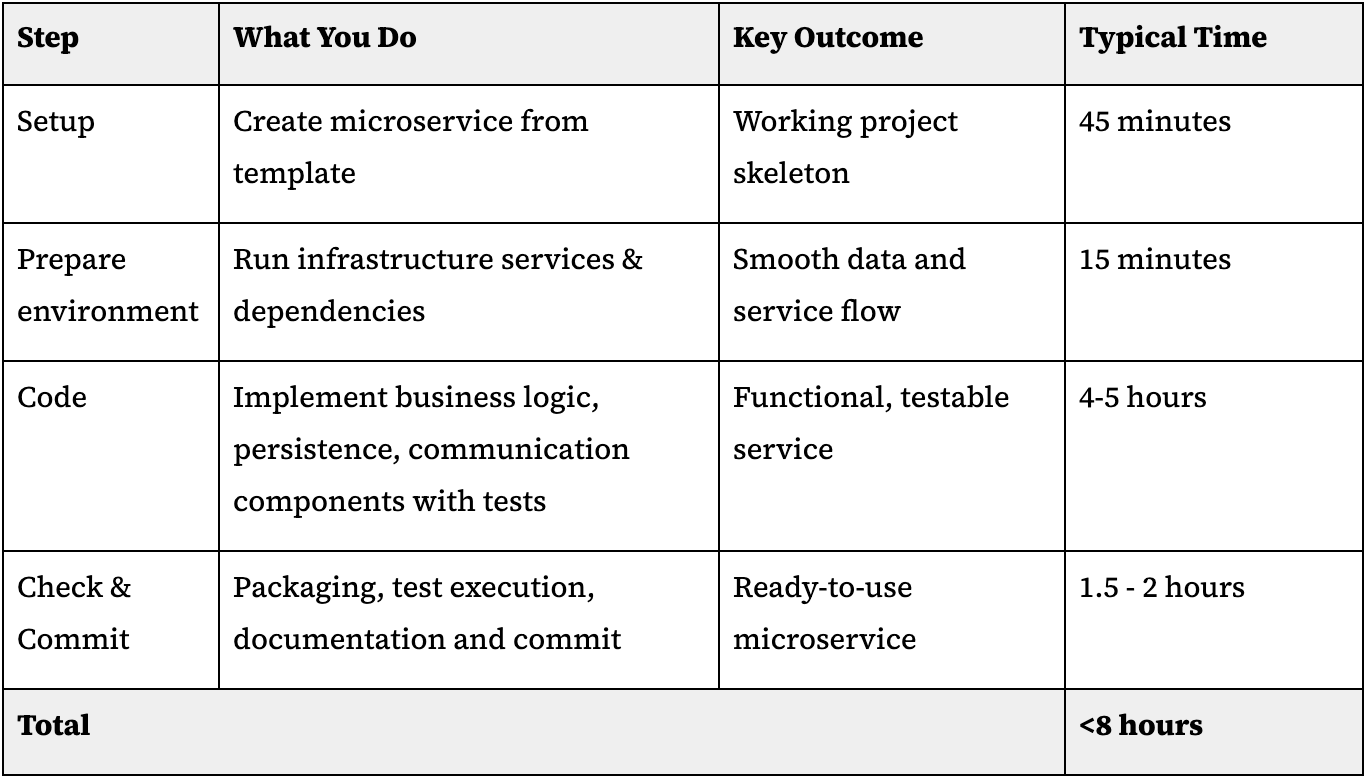
With this structure, each phase stays focused and efficient. The result: a real, production-grade microservice delivered in a single day-without cutting corners or sacrificing quality.
How fast does microservice delivery happen in your team these days?
Feel free to drop a comment — I’d love to hear how others approach it.